
AI optimisation is one of those phrases that means different things depending on who is selling it. Search for it with Cardiff on the end and the results mix AI developers, training courses and search agencies, which tells you the term is still settling. For most business owners the question underneath is simpler: when someone asks ChatGPT or Google for a recommendation, will my business be in the answer?
That is the meaning this article uses. Below is a plain-English breakdown of what AI optimisation covers, how much AI search already shapes local searches, and the order I would fix things in if I ran a Cardiff business today. If you want a baseline before you change anything, our free AI visibility check scores your business against 15 signals.
What does AI optimisation actually mean?
AI optimisation is the work of making your business easy for AI assistants and AI search features to find, understand and recommend. In practice it breaks into three jobs, and each one has its own name in the industry.
- Generative engine optimisation (GEO): making sure tools such as ChatGPT, Gemini, Copilot and Google's AI Overviews can read your site and treat it as a trustworthy source when they write an answer. Our plain-English guide to GEO goes deeper.
- Answer engine optimisation (AEO): writing pages so a direct question gets a direct answer near the top, which makes them easy to quote. See what AEO is and how it differs from SEO.
- Listings and reputation: keeping your name, address, phone number, services and reviews consistent across Google, Bing, directories and review sites, because AI tools cross-check these before they name a business.
The phrase is also used for something else entirely: using AI inside a business to speed up quoting, admin or follow-up. That is a separate job, and we cover it in AI automation in Cardiff.
Worth knowing: most of this sits on top of ordinary good SEO. Google's own guide to optimising for its generative AI features says optimising for AI search is still SEO, and that there is no special schema markup to add. If your SEO is sound, you are already part of the way there.
Is AI search already affecting local businesses in Cardiff?
Yes, for most service businesses, though not evenly. Google launched AI Mode in the UK in July 2025, and AI Overviews now sit above the normal results on a large share of local service searches.
The most useful recent numbers come from a study of 400 live US and UK Google searches across 20 local service industries, collected in October 2026. It found that:
- 177 of the 200 UK searches (88.5%) showed an AI Overview.
- Local businesses' own websites earned an estimated 35% of the citations in those answers.
- 70% of the sources cited did not rank in the top ten for the same search.
- "Near me" searches behaved differently: only 5 of 40 showed an AI Overview, while 39 of 40 showed the map pack.
Two things follow for a Cardiff business. Cost and how-to questions, such as "how much does a boiler service cost?", are where AI answers are most likely to appear (the study found one on every cost search it checked), and your site can be quoted in that answer even if it is not on page one. Searches such as "electrician near me" are still won in the map pack, so your Google Business Profile matters as much as ever. Our guide to winning the map pack in Cardiff covers that side.
What should a Cardiff business fix first?
Start with the facts AI tools check about you, then the pages they quote, then the signals that make them confident. This is the order I would work in, and most of it can be done in-house.
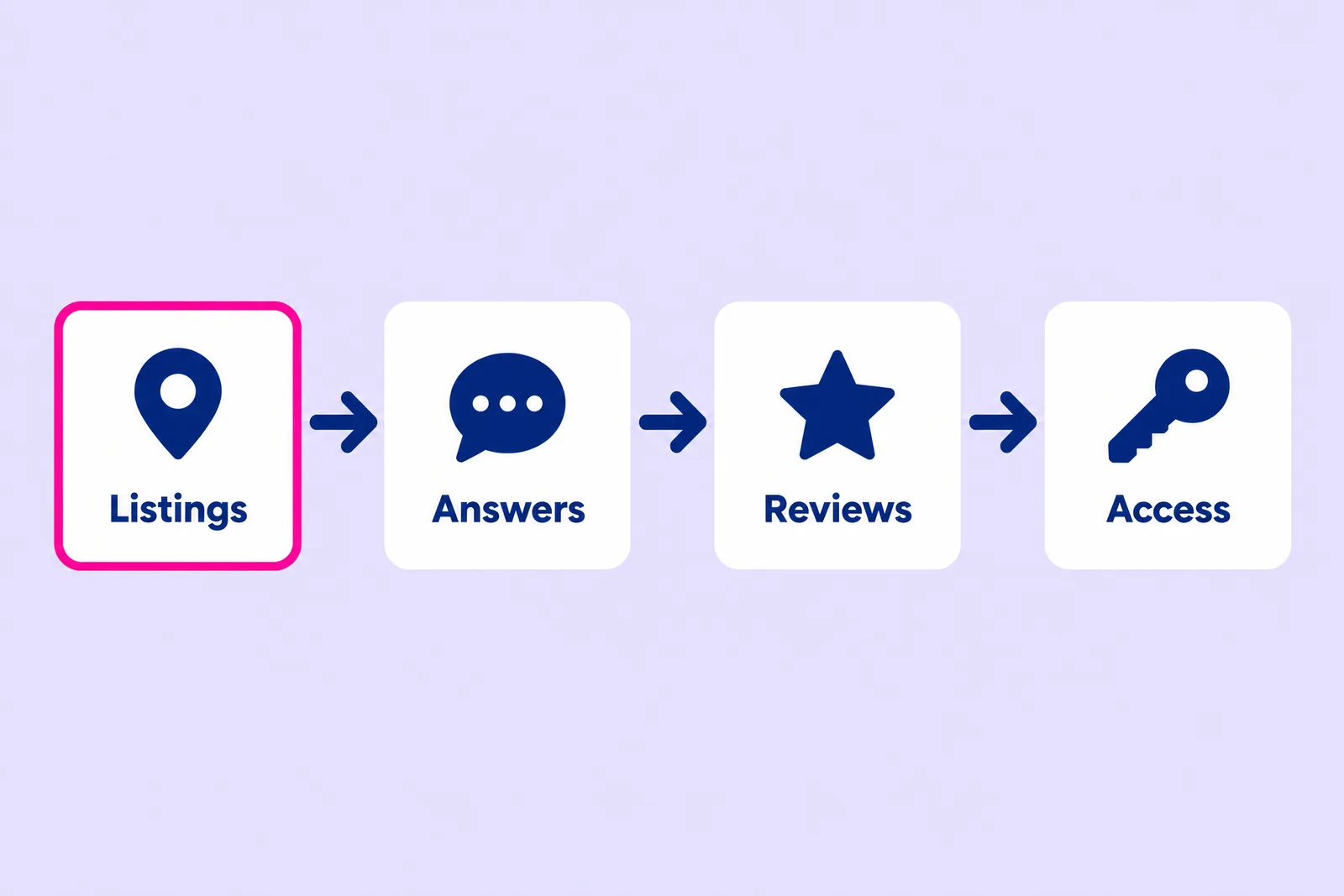
- Get your listings straight. Your Google Business Profile comes first: correct categories, services, opening hours, service areas and photos. Then claim Bing Places for Business, which is easy to forget. Research from Whitespark suggests ChatGPT leans on Bing's local data for local results, and Copilot draws on Bing too. Make sure your name, address and phone number match exactly wherever they appear.
- Rewrite your main service pages to answer questions. Each core service needs its own page that says, near the top, what you do, who it is for, which areas you cover and roughly what it costs. Phrase subheadings as the questions customers ask, and answer each one in the first sentence or two. This is the part AI tools quote.
- Build reviews and mentions steadily. Ask every happy customer for a Google review, and reply to the ones you get. Mentions on local directories, trade bodies and Cardiff community or news sites all help AI tools confirm you are real and active.
- Check AI crawlers can read your site. Ask whoever manages your website to confirm that robots.txt and any firewall settings let search crawlers in. OpenAI says sites that block its OAI-SearchBot crawler will not be shown in ChatGPT search answers. Keep the key facts in page text a crawler can read, since images and PDFs often hide them.
Where this goes wrong: it is tempting to start with the technical step, or to buy AI-written content in bulk, while your Google profile still shows last year's opening hours. AI answers are only as good as the facts they find, so fix the facts first.
How do you know if AI optimisation is working?
Check by hand once a month and track where enquiries come from. There is no fixed AI ranking to report on, because AI answers change from one run to the next, so you are measuring a pattern over time.
- Ask the tools directly. Write down five to ten questions your customers actually ask, such as "who is a good accountant for a small business in Cardiff?", and put them to ChatGPT, Gemini, Copilot and Google each month. Note whether you appear, what is said about you and which sources are cited.
- Ask new customers how they found you. Add "an AI assistant such as ChatGPT" as an option on your enquiry form and ask the question on your first call.
- Watch Search Console. Google includes traffic from AI Overviews and AI Mode in the normal Search Console performance report, so rising impressions on question-style searches are a useful sign.
Should you do it yourself or get help?
Most small businesses can handle the first two steps themselves over a few afternoons. Help is worth paying for when you have several services or locations, when your website makes page changes slow, or when you want someone to run the monthly checks and fix what they find.
If you do bring someone in, ask what they will change in the first month, how they will report on AI answers, and which tasks overlap with any SEO you already pay for. Our AI search service covers the full set, from listings and answer-first pages to monthly reporting, and calls run on Zoom, so you can start without anyone needing to visit.