

More of your customers now ask an AI assistant before they ask Google. OpenAI said in August 2026 that ChatGPT had passed one billion weekly users, and Ofcom's April 2026 research found that 54% of UK adults use AI tools such as ChatGPT, Copilot or Gemini. When someone types "who's a good accountant near me?" into ChatGPT, it replies with a short list, and the businesses on that list get the call.
There is no form to fill in and no fee that buys a place in the answer. ChatGPT builds each recommendation on the spot from what it can find and cross-check about you. This guide explains where it looks, why consistent facts carry so much weight, and the audit and testing routine I would run for any business that wants to show up. If you want a quick read of where you stand before you start, our free AI visibility check scores your business against 15 signals.
How does ChatGPT decide which businesses to recommend?
ChatGPT decides by searching the web in the moment, gathering what several sources say about businesses that match the question, and summarising the ones it can describe with confidence. For local and buying questions, that live search matters far more than anything the model picked up in training.
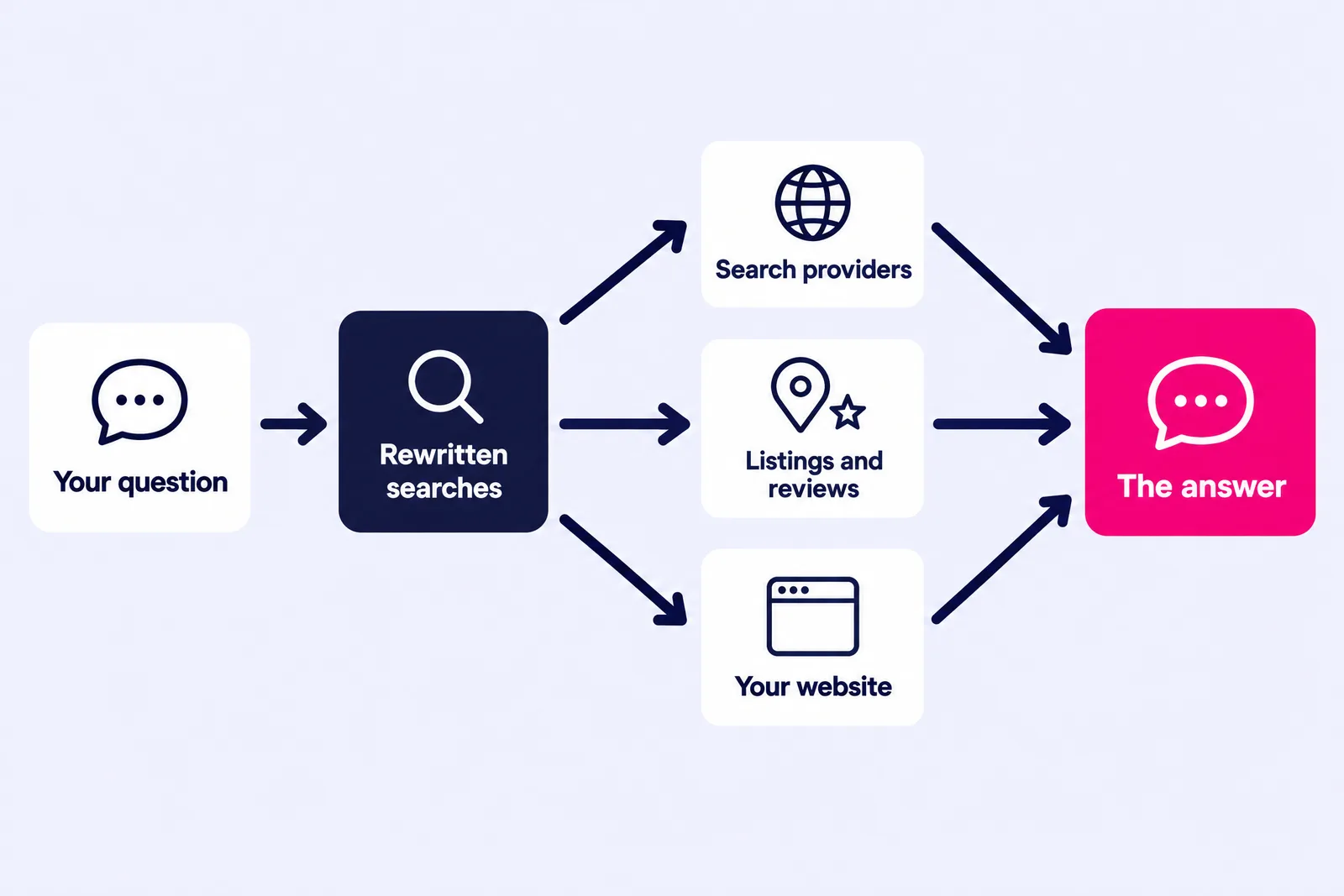
OpenAI's own help page on ChatGPT search describes the process. ChatGPT rewrites your question into one or more targeted searches, sends them to its search providers, and may run follow-up searches after reading the first results. It can add your general location to improve local results, and on the iPhone and Android apps it may show a map alongside the answer.
Who those providers are has been pieced together by researchers. A September 2026 study by Peec AI concluded that ChatGPT's results come from OpenAI's own index plus at least eight external providers, including licensed local data from Yelp and Tripadvisor and scraped Google results. In July 2026, Axios reported that Yelp is licensing its reviews and listings to OpenAI for local answers. The Yelp deal, and most of the published local research, are American. For a UK business the practical point is simpler: ChatGPT pulls from many places at once, so no single listing guarantees anything.
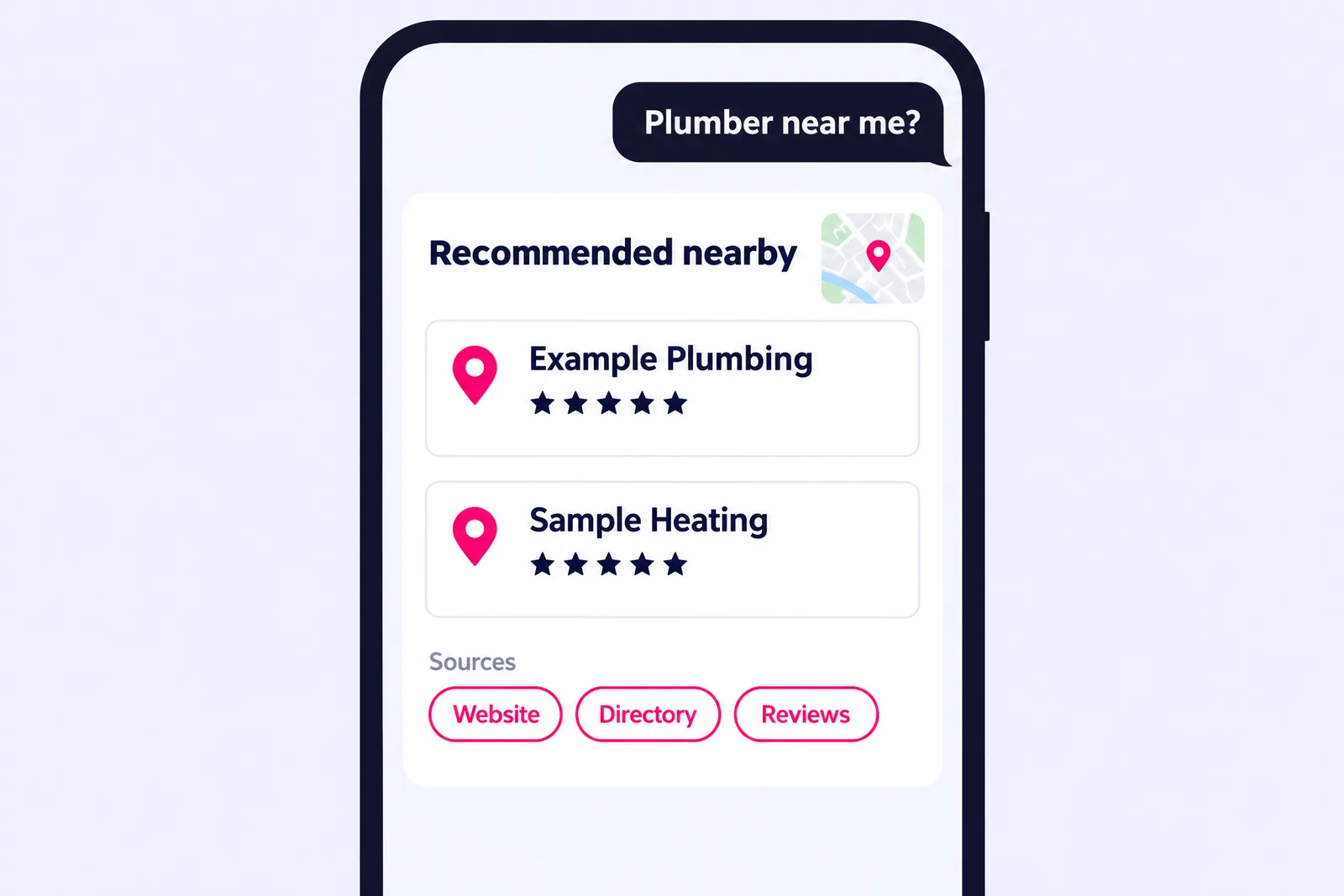
Local answers can also carry a business panel with opening hours, address, phone number, photos and star ratings. Near Media's analysis found those panels appear to be assembled on the fly from several providers, with photos drawn from the business's own website and from third-party directories. Put plainly, ChatGPT stitches your profile together from whatever it finds. If the pieces disagree, the stitching shows.
Where does ChatGPT get its information about local businesses?
ChatGPT draws on a mix of business websites, directories, review platforms and mentions on other sites, and the mix shifts by question and over time. The two local studies with published methods point in different directions, which is itself the useful lesson.
| Study | When | What was tested | What ChatGPT cited |
|---|---|---|---|
| BrightLocal | November 2024 | 800 local searches across 20 US cities | 58% business websites, 27% mentions on other sites, 15% directories |
| LinkTech Solutions | September 2026 | 20 local questions in Southern California | 45 of 53 citations were directories or review lists; 2 were business websites |
BrightLocal's study of 800 local searches found business websites were the most cited source, especially for searches with buying intent. Nearly two years later, a smaller test of 20 local questions found directories and "best of" review lists made up 45 of 53 citations, with only two business websites cited directly. The methods differ, so neither is the final word. What both show is that ChatGPT rarely relies on your website alone. It looks for other places that describe you, then decides whether the story holds together.
Worth knowing: in the 2026 test, 80.7% of the businesses listed were in the town or city the question named. Location is a basic filter, so state yours clearly everywhere you appear.
Why does consistency across your listings matter so much?
Consistency matters because an assistant building an answer from several sources needs those sources to agree before it can describe you with confidence. When your website says one thing and your listings say another, you hand it a reason to choose a competitor whose details line up.
This is my reading of the evidence rather than a rule OpenAI publishes, so treat it as a working principle. The business panels Near Media examined were reconciled from several providers. The answers in the 2026 test leaned mostly on directories. An assistant that summarises across sources will favour businesses where those sources tell the same story: the same name, address, phone number, services and area covered.
Inconsistency builds up quietly over years. A move to new premises, a change of mobile number, a rebrand, a service you stopped offering, a directory listing set up by someone who has since left. None of it looks serious on its own. Together, it gives an assistant conflicting answers to simple questions about who you are and what you do.
Where this goes wrong: businesses that have traded under two names, or that list a personal mobile on some sites and an office landline on others, are the usual culprits.
What should a consistency audit check?
A consistency audit should check the five places that describe your business: your website, your map listings, directories, review sites and social profiles. In each one, compare the same five facts (name, address, phone, opening hours and services) and fix every mismatch at the source.
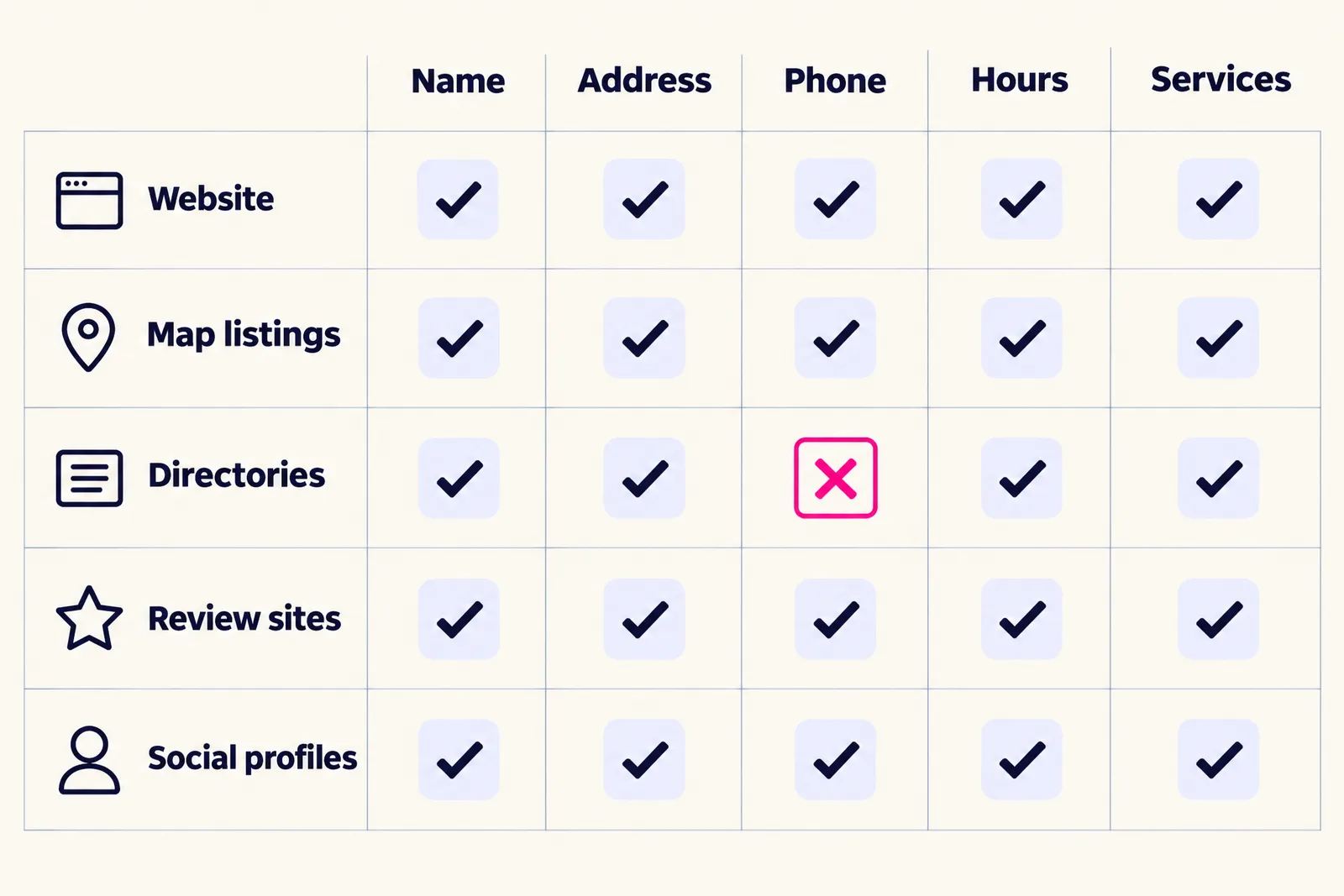
1. Your website
- What it is: the one source you fully control, and the one every other listing should match.
- What to check: your trading name, full address with postcode, one main phone number, opening hours, a clear list of services and the areas you cover, all in plain text.
- Watch out for: old addresses in the footer, and old landing pages or PDFs that still show former details.
2. Map listings
- What it is: Google Business Profile, Bing Places for Business and Apple Business Connect, which feeds Apple Maps.
- What to check: name, category, address, phone, hours, website link and services all match your website exactly.
- Watch out for: duplicate listings, and edits suggested by the public that changed your details without you noticing. Peec's study found Microsoft's search technology among ChatGPT's providers, so Bing Places is worth claiming even if you rarely think about Bing.
3. Directories
- What it is: general and trade directories such as Yell, Thomson Local, Checkatrade and TrustATrader, plus professional body registers and local business group listings.
- What to check: search for your business name, your old phone numbers and any former addresses to find listings you had forgotten about.
- Watch out for: listings you can no longer log in to. Most directories have a claim or correction process, and it is worth the time.
4. Review sites
- What it is: Google reviews plus whichever platforms matter in your sector, such as Trustpilot, Checkatrade or Tripadvisor.
- What to check: the business details on each platform, how recent your latest reviews are, and whether you reply to them.
- Watch out for: a strong profile on one platform and an abandoned one elsewhere that still carries old details.
5. Social profiles and mentions
- What it is: your LinkedIn, Facebook and Instagram pages, plus supplier pages, association listings and articles that mention you.
- What to check: contact details match, and your description of what you do uses the same words as your website.
- Watch out for: descriptions that have drifted. If your website says you specialise in commercial fit-outs and your LinkedIn page says residential refurbishments, an assistant has to guess which is true.
When the audit turns up more than a handful of problems, fix them in this order.
| What you find | Why it comes first |
|---|---|
| Wrong phone number or address on a map listing | Customers act on these details directly, and local answers show them in business panels |
| Duplicate listings for the same business | Two versions of you split the evidence and contradict each other |
| An old trading name still live | An assistant may treat you as two separate businesses |
| Services described differently from site to site | An assistant cannot match you to a specific question with confidence |
| Stale opening hours | Easy to fix, and wrong hours put customers off quickly |
How do you make your website easy for ChatGPT to read and quote?
Let OpenAI's search crawler in, put your key facts in plain text on obvious pages, and answer the questions customers actually ask on your service pages. An assistant can only quote what it can reach and understand.
Check your robots.txt
OpenAI's crawler documentation says sites that block OAI-SearchBot will not be shown in ChatGPT search answers, and that changes to robots.txt take around 24 hours to filter through for search. GPTBot is a separate setting that governs model training, so you can allow search while blocking training if you prefer. Ask whoever manages your website to check both, because firewall and security settings can block crawlers without anyone deciding to.
Put the facts where a machine can find them
Your name, address, phone number, hours and service area belong in plain text on your contact page and in your footer, as well as in any image or map embed. LocalBusiness structured data (schema markup) states the same facts in a format machines read directly. It will not win you recommendations by itself; it removes doubt about who you are and where you work.
Write service pages that answer real questions
People ask assistants full questions: "who can rewire a Victorian terrace?" or "which accountant handles R&D tax claims for small companies?". Pages that answer questions like these near the top, in plain language, give ChatGPT something specific to quote. This is the heart of answer engine optimisation, and our guide to generative engine optimisation explains how AI tools choose which pages to cite. Both sit within the wider work of AI search optimisation.
Best for: businesses with several services. Give each service its own page that answers its own questions, so an assistant can match the right page to the right request.
How much do reviews and mentions matter?
Reviews matter, though more reviews alone will not put you at the top. Steady, recent reviews on the platforms your sector uses, plus genuine mentions on other credible sites, give ChatGPT independent evidence that you are who you say you are.
The September 2026 test is a useful check on "just get more reviews". The business with the most reviews was listed first in only 2 of 19 answers, although the top three businesses had a median of 112 reviews against 72 for the rest. Volume helps you into the list. It does not decide the order.
Mentions matter because they are evidence you did not write yourself. In BrightLocal's study, mentions on other sites made up 27% of the sources ChatGPT cited. Useful mentions for a local business include supplier and partner pages, trade association member listings, local news coverage, sponsorship pages and "best of" roundups written by real publishers.
Skip the shortcuts. Bought reviews and paid link schemes break the rules of the platforms these assistants draw on, and a profile that gets flagged or cleaned up loses the very evidence you were trying to build.
Where should a city-based business start with AI recommendations?
Start with the places that describe you locally: your map listings, the two or three directories that matter most in your trade in your area, and your website's contact and service pages. Local answers lean heavily on location, so being clearly and consistently placed in your town or city is the first job.
For example, for most companies in Cardiff and South Wales, that means an accurate Google Business Profile and Bing Places listing, the trade or professional directories customers here actually use, and a website that names the areas you genuinely serve, whether that is Pontcanna and Canton or Penarth and the Vale of Glamorgan. Bilingual businesses should keep their name and description consistent in both Welsh and English. Our guide to SEO in Cardiff covers the map listing side in more depth, and the same groundwork serves AI assistants.
The same approach works in any city. A Manchester accountant or a Bristol electrician faces the same test: do the places that describe you agree, and do they place you where your customers are?
How do you check whether ChatGPT recommends you?
Ask the questions your customers would ask, in several different wordings, repeat them over several weeks, and log how often you appear. A single screenshot tells you very little, because AI answers change from one run to the next.
SparkToro's January 2026 research, based on 2,961 responses, found less than a 1 in 100 chance that ChatGPT would give the same list of brands in any two runs, and less than 1 in 1,000 that it would give the same list in the same order. Its advice was to measure how often a brand appears across many prompts and repeated runs, and to stop treating AI "rankings" as fixed positions. The same research found that people word similar requests very differently, so testing one phrasing misses most of what customers type.
- Write ten questions a customer might ask, from the short ("plumber near me") to the specific ("who can fit a heat pump in an older house?"). Include your town in some and leave it out of others.
- Ask each one in ChatGPT with search on, in a temporary chat so your own history does not colour the answer.
- Record whether you appear, who else appears and which sources are cited.
- Repeat the set every two weeks and judge the trend across the whole set, never a single answer.
- Add "How did you hear about us?" to your enquiry form, with AI assistants as an option, so you can see whether visibility turns into enquiries.
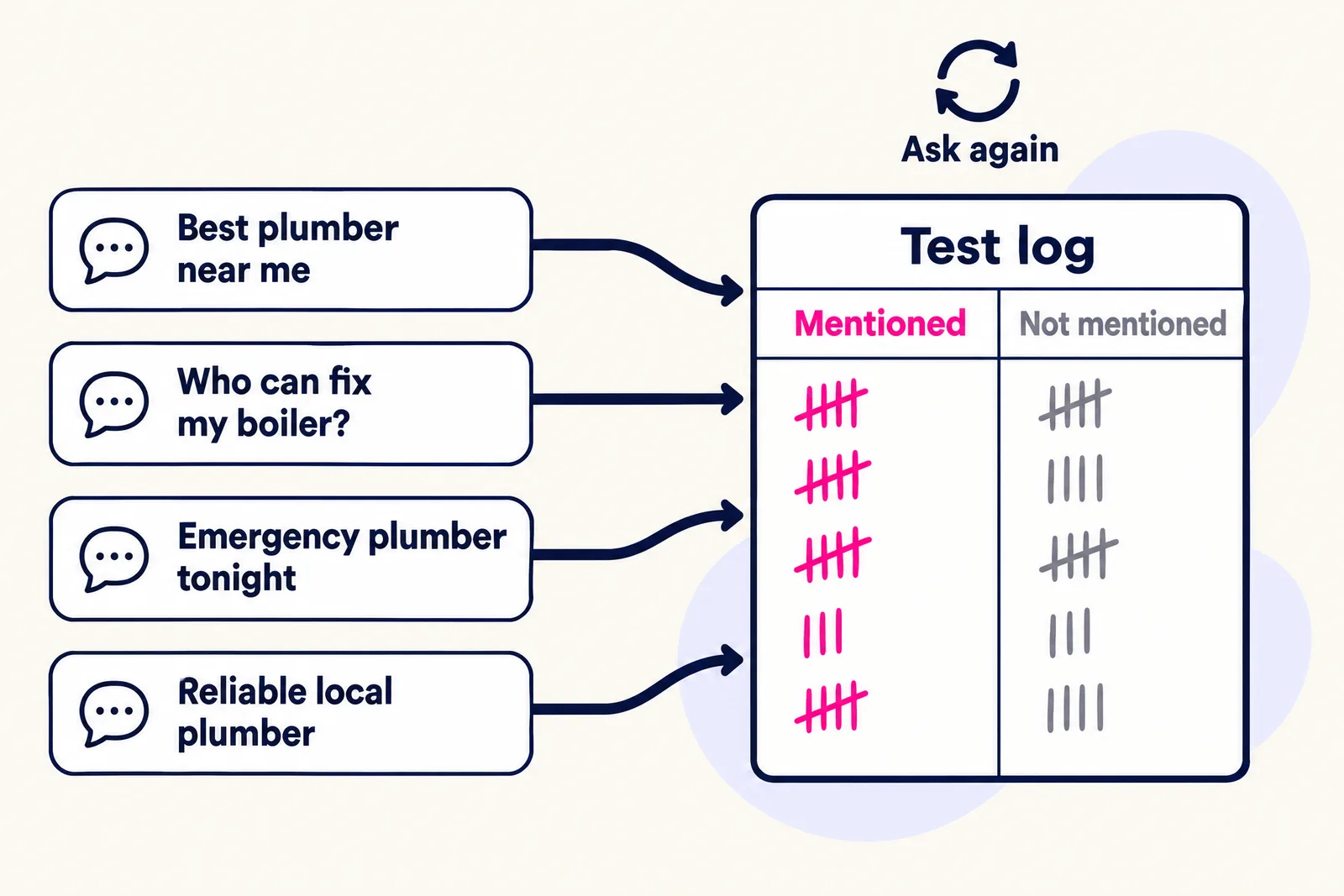
The cited sources are the most valuable part of the log. If the same directory or review list keeps appearing in answers for your service, that is where you need an accurate, active listing, and it tells you more about your own market than any general advice can.
Can you pay to be recommended by ChatGPT?
You cannot pay for a place in the answer itself. ChatGPT now carries ads in the UK, but OpenAI says ads do not influence the answers it gives. Ads went live for UK users on the free and Go plans in June 2026, according to PPC Land, and OpenAI's own announcement says ads are always labelled as sponsored and kept visually separate from the answer.
That makes ChatGPT ads a separate channel to test, much like paid search. The recommendation still has to be earned through the work in this guide. Be wary of anyone selling guaranteed placement in AI answers: given how much answers vary between runs, nobody can promise a position.
What does a 30-day plan look like?
Spend the first fortnight fixing facts and the second strengthening your website and evidence, then start testing. Most of it can be done in-house by an owner or office manager.
- Week one, audit. List every place your business appears, compare the five facts and note every mismatch. Check that your robots.txt allows OAI-SearchBot.
- Week two, fix the sources. Update map listings first, then directories, review profiles and social pages. Merge or remove duplicates.
- Week three, strengthen your website. Add a clear contact and service area section, LocalBusiness schema and answer-led copy on your three most important service pages.
- Week four, build evidence and start testing. Ask recent customers for reviews on the platform that matters most in your sector, pursue one or two genuine mentions, and run your first test log.
After that, repeat the test log every fortnight and re-check your listings every quarter. Anything that changes in the business, from a new phone number to a new service, should go out to every listing on the same day it goes on your website.