
Search for AI automation in Cardiff and you will find plenty of agencies promising to transform your business. What most owners actually need is smaller and more useful: a clear answer on which job to hand over first, what it will cost and how to stop it turning into a sprawling project.
The timing is right to ask. The UK government's AI Adoption Survey 2026, published on 29 October 2026, found that 32% of UK businesses used at least one AI technology in 2026, up from 16% in 2025, and administration was the most common use among those using or planning to use it (81%). Closer to home, Novuna Business Finance research reported by Business News Wales found that three in ten Welsh small business owners already use AI, while 29% are unsure how it could be used in their business.
This guide is for that second group, and for anyone who has tried a chatbot and wondered what comes next. It covers the workflows worth automating first, a simple way to choose between them, how to scope a first project on one page, what it costs and where to get support in Cardiff and South Wales. If you would rather work through it with someone, our AI and automation service is where we map, scope and build that work for local businesses.
What does AI automation actually mean for a Cardiff business?
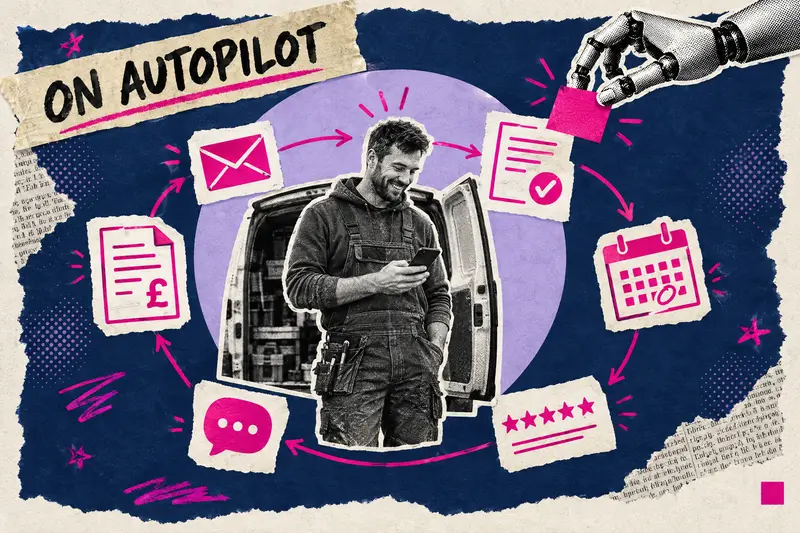
AI automation means software doing the repeatable steps of a job between the tools you already use, with AI handling the steps that need reading or writing, such as sorting an enquiry, drafting a reply or pulling details out of a PDF. A person stays in charge of anything a customer sees.
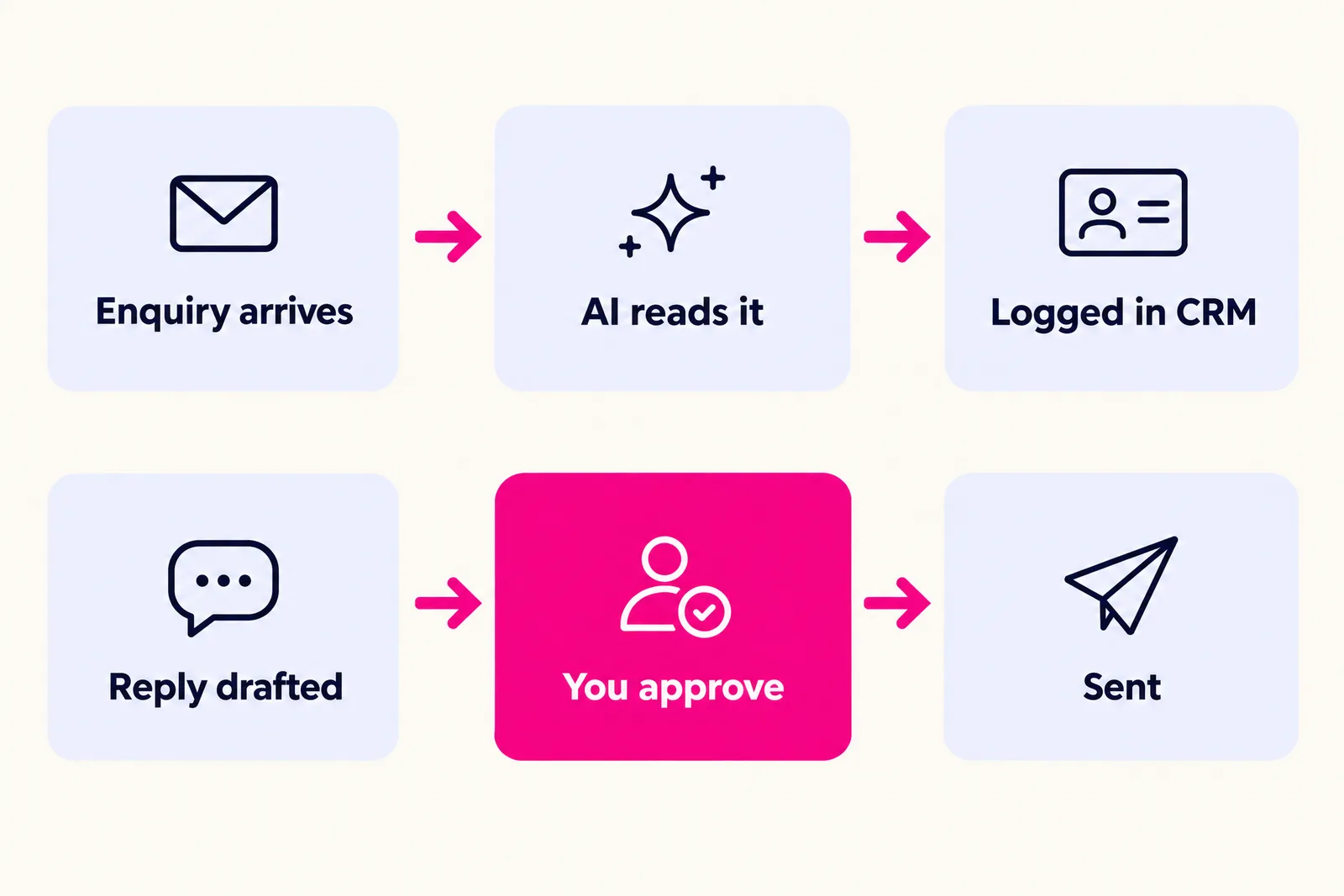
It helps to think of it in two layers. The first is plain automation: when a form is submitted, create a contact, send an acknowledgement and add a task. That has been possible for years. The second layer is what changed recently. AI can now read a messy enquiry and work out what the customer wants, where they are and how urgent it is, then draft a sensible reply in your tone for you to approve.
Most of what a small business needs can be built on software it already pays for: Microsoft 365 or Google Workspace, an accounting package, a CRM or job management system, and your website forms. The government survey makes a useful point here. Businesses said cost mattered, but mainly the time, effort and resources needed to put AI in place, rather than the price of the tools. That matches what I see. The hard part is deciding what to automate and defining it properly. The software is rarely the bottleneck.
The results can be worth the effort. In NatWest Cymru research reported by Nation.Cymru in September 2026, 80% of Welsh businesses using AI reported efficiency gains.
Which workflows should a local business automate first?
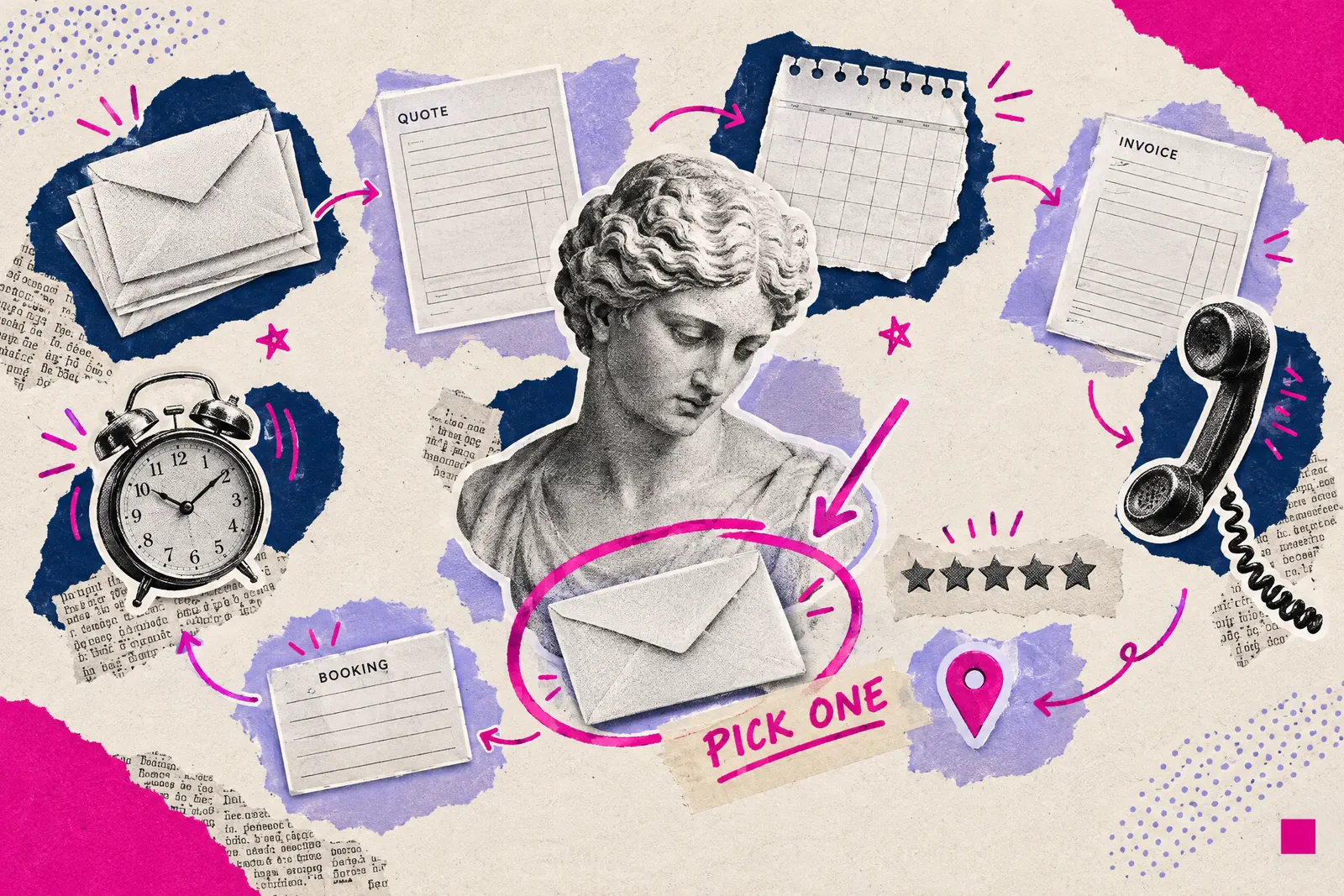
Start with work that happens every day, follows the same steps each time and sits close to revenue. For most local businesses that means one of five workflows: enquiry handling, quote follow-up, bookings and reminders, invoices and payment chasing, or review requests.
- Enquiry reply and triage. What it is: every enquiry gets an instant, useful acknowledgement, AI picks out the job type, location and urgency, and the details land in your CRM with a task. Best for: trades, clinics, professional services and anyone whose enquiries arrive through several channels. Watch out for: replies that promise things you cannot deliver; keep the first reply factual and let a person send anything that commits you.
- Quote follow-up. What it is: a short, polite sequence of follow-ups after a quote goes out, which stops the moment the customer replies or books. Best for: businesses that send quotes and then lose track of them. Watch out for: chasing people who have already said yes by phone; the sequence must check the CRM status before each message.
- Bookings and reminders. What it is: confirmations, reminders and rescheduling links sent automatically from your calendar or booking system. Best for: appointment-based businesses where no-shows cost real money. Watch out for: double bookings when two calendars are involved; pick one source of truth first.
- Invoices and payment chasing. What it is: invoices raised when a job is marked complete, with reminders sent on a schedule until payment arrives. Best for: any business doing its own credit control. Watch out for: chasing a customer you are already in a dispute with; give someone an easy way to pause reminders.
- Review requests. What it is: a request for a review sent after each completed job, with AI drafting replies to new reviews for you to check. Best for: local businesses competing in Google's map results. Watch out for: offering incentives or only asking happy customers, which breaks review platform rules.
If none of these fits, our list of 12 AI automation examples for small businesses gives a longer menu, grouped by where the time goes.
How do you choose the right first workflow?
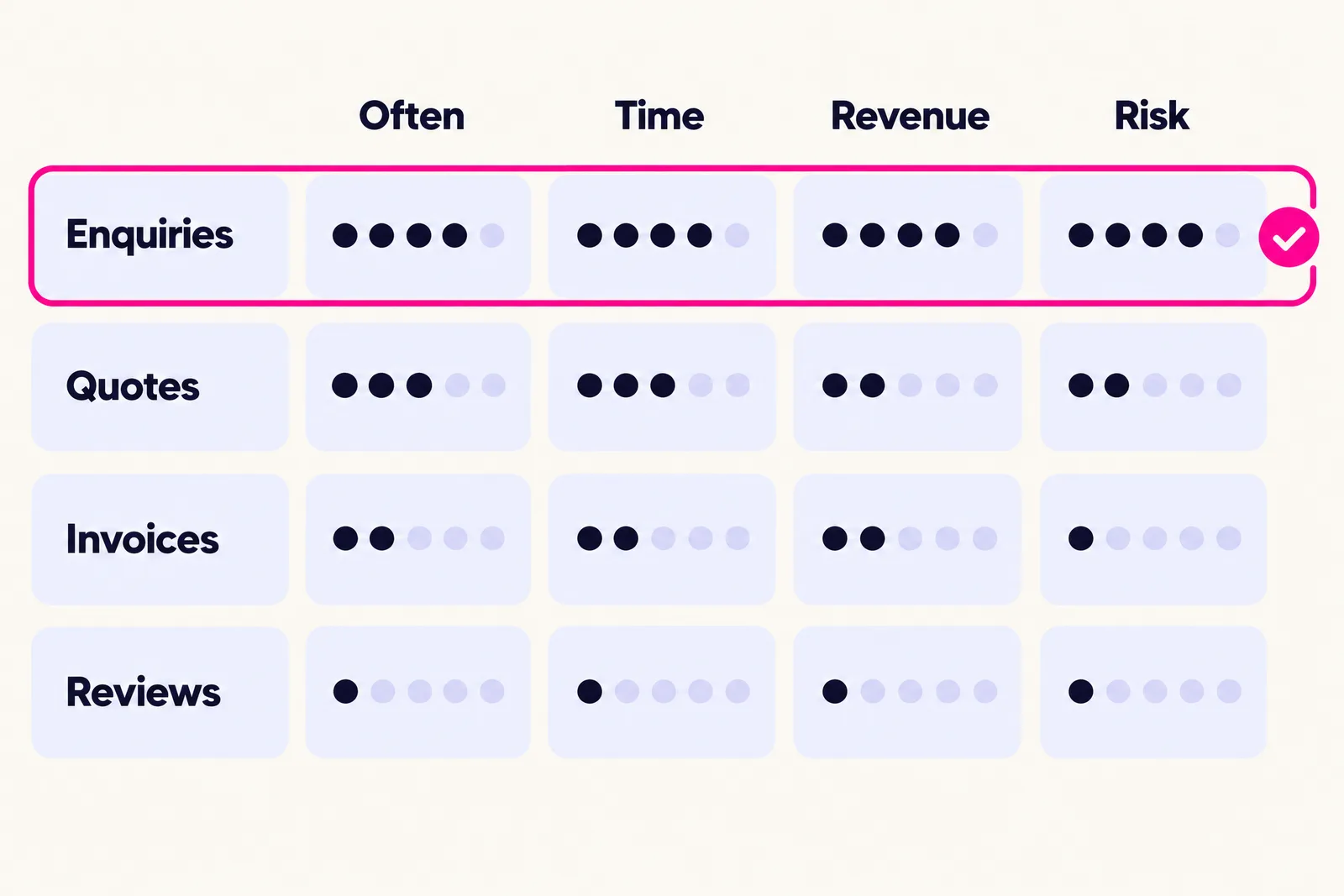
Score each candidate workflow against the same five questions, then start with the one that scores highest without carrying much risk. Ten minutes with a pen will usually make the answer obvious.
- How often does it happen? Daily beats weekly, and weekly beats monthly. Automation pays back through repetition.
- How long does it take each time? Include the switching cost: finding the email, opening the spreadsheet, remembering where you left it.
- How close is it to revenue? Slow enquiry replies and forgotten quotes cost you jobs. A tidier filing system rarely does.
- What does a mistake cost? For a first project, pick something where an error is easy to spot and cheap to fix. Leave payroll and anything legal for later.
- Is the information already in one place? If the data lives in three spreadsheets and someone's head, sorting that out is the first project.
Take a typical trades business in Cardiff or the Vale of Glamorgan. Enquiries arrive every day through the website form, Google Business Profile messages and missed calls. Each one needs the same few details before anyone can quote, and every slow reply risks the job going to whoever answered first. That scores high on frequency, time and revenue, and a slip in an acknowledgement is easy to spot and cheap to fix, which is why enquiry handling is so often the right place to start.
Worth knowing: the job you dislike most may not be the best first pick. A monthly task that takes three painful hours scores lower than a ten-minute task you do six times a day.
How do you scope a first automation project?
Write the whole workflow on one page before anyone builds anything. If it does not fit on a page, it is two projects, and you should pick one of them.
A good one-page scope answers eight questions:
- Trigger: what starts the workflow? A form submission, an email to a particular inbox, a job marked complete.
- Steps: what happens, in order, written as plain sentences anyone in the team would recognise.
- Systems: which tools are involved, and who holds the logins and admin rights.
- AI steps: exactly where AI reads, sorts or drafts, and what it is allowed to decide on its own.
- Human check: the point where a person approves before anything reaches a customer.
- Success measure: one number you will compare before and after, such as time to first reply or quotes chased per week.
- Owner: the named person who looks at it each week and spots when something looks wrong.
- Out of scope: what this project will not do. This line saves more money than any other.
Before the build starts, spend two weeks counting. Log how many times the task happens and roughly how long each one takes. Without a baseline, you will never know whether the automation earned its keep, and the next decision becomes guesswork.
Where this goes wrong: trying to connect everything at once. A first project that touches the website, the CRM, the accounts package and the calendar has four times the places to break. Prove one workflow, then extend it.
What does AI automation cost in Cardiff?
On our pricing, AI and automation work starts at £500 + VAT for a single automation build, and runs up to £2,500 set-up plus £450 a month for a connected system we manage for you. Anything outside those shapes is scoped at our hourly rate, with the scope and hour budget agreed before work starts.
| Size of project | What it suits | Price (+ VAT) |
|---|---|---|
| Single automation | One well-scoped workflow, such as enquiry reply and triage, built and handed over | £500 one-off |
| Connected core | A small set of linked automations across enquiries, your CRM and follow-up, with ongoing support | £1,200 set-up, then £250 a month |
| Managed AI operations | Follow-up, admin and reporting running on one connected system that we look after | £2,500 set-up, then £450 a month |
| Scoped build | Anything that does not fit the shapes above | £95 an hour, budget agreed first |
Two other costs belong in your budget. The first is any software subscription the workflow relies on, which you pay to the provider and keep in your own name. The second is your own team's time to define the process and check the early output. That second cost is the one people forget, and it is the one the government survey flagged.
Best for: most businesses we speak to, a single automation is the right first step. It is the cheapest way to find out what automation is worth to you before committing to anything bigger. If the workflow you have in mind involves moving work between several systems, our workflow automation service explains how we approach those builds.
Where can Cardiff and South Wales businesses get help with AI automation?
There are three routes, and they work well together: free public support through Business Wales, training so your team can use AI confidently day to day, and a build partner for the workflows that need connecting properly.
Business Wales. In January 2026 the Welsh Government announced £2.1 million of AI support for Welsh businesses, including £600,000 for a Business Wales AI awareness and adoption programme and £1 million through the Flexible Skills Programme, where employers pay 25% of the cost of eligible AI training. Business Wales also lists AI webinars, workshops and an e-learning module on its artificial intelligence page. It is a sensible, free first stop for awareness and skills, so check what currently applies to your business.
Training. Automation works better when the people around it understand what AI is good and bad at. For founders, our one-to-one AI training runs on Zoom, at your office or at ours in Pontcanna, and covers how to use AI in your own working day. For teams, our AI workshops in Cardiff run as open half-day sessions or private company sessions.
A build partner. When you talk to anyone about building automations, Cardiff-based or otherwise, look for five things. They ask how your business works before they talk about tools. They suggest starting with one workflow. Every account is set up in your name so you own it. The scope is written down with a human check built in. And they tell you plainly what support looks like after launch, because automations need a named owner and the occasional repair when a connected app changes.
My own view, after more than twenty years in sales and marketing and a lot of time inside other people's processes: the businesses that get the most from automation share one habit. They pick one workflow, define it properly and measure it before moving on to the next.