

Type a question into Google and an AI Overview often answers it before you see a single blue link. Ask ChatGPT or Copilot the same thing and you get a paragraph with two or three sources underneath. The businesses whose pages supplied that paragraph got the attention. Everyone else got scrolled past.
Answer engine optimisation, or AEO, is the practice of being the page that supplies the answer. There is a lot of noise about it this year. Some of it is useful, and some of it sells shortcuts that Google has now said in writing do not help. This guide covers what AEO is, how it differs from SEO and GEO, what changed in 2026, and a checklist you can apply to one service page this week.
What is answer engine optimisation?
An answer engine is any tool that replies to a question with a written answer, usually with a few source links underneath. Today that means Google's AI Overviews and AI Mode, ChatGPT with search, Microsoft Copilot, Perplexity and the voice assistants on phones and smart speakers. Google's featured snippets, the boxed answer above the results, were the first mainstream version.
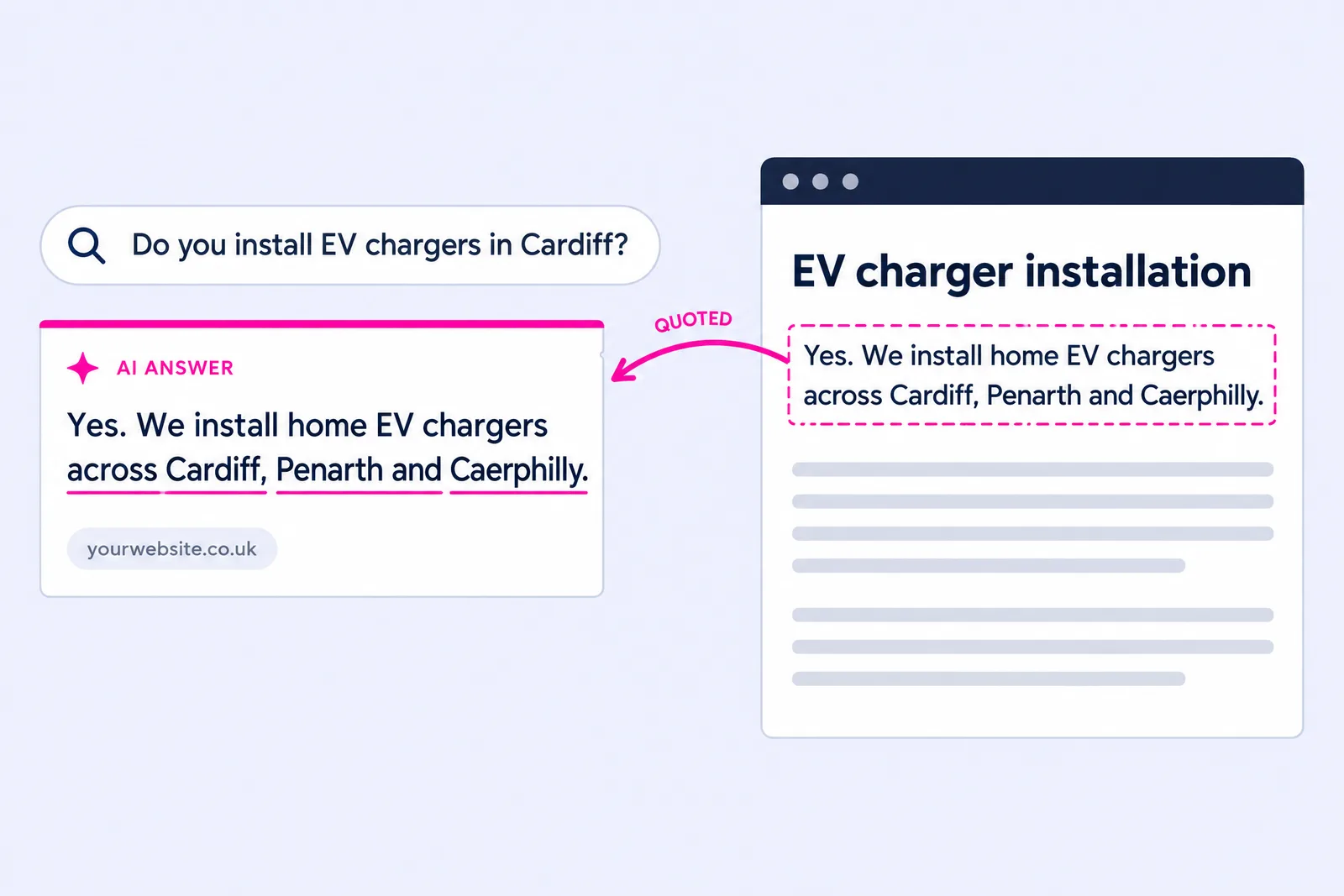
Answer engine optimisation is the work of making your pages the obvious source for those answers. In practice it comes down to one discipline: for each question a customer asks, your site holds one clear, accurate, self-contained answer that a machine can lift and a person can trust.
I started my career in sales, and the habit that served me best there applies here. Answer the question the customer asked, first and plainly, then give the detail. Answer engines reward the same habit.
How is AEO different from SEO and GEO?
SEO is the broad work of getting your pages crawled, indexed and ranked for the searches that matter to you. AEO narrows the focus to the passage: one question, one quotable answer. Generative engine optimisation (GEO) widens it again, to how AI tools summarise, compare and recommend businesses using many sources. We cover that in our guide to what generative engine optimisation is.
| Aspect | SEO | AEO | GEO |
|---|---|---|---|
| Unit of competition | The whole page | One passage that answers one question | Your business as described across the web |
| Goal | A high position in the results list | Being quoted or linked as the answer | Being cited or recommended in AI answers |
| Where it shows | Classic Google and Bing results | AI Overviews, AI Mode, ChatGPT search, Copilot, voice assistants | ChatGPT, Gemini, Perplexity, Copilot and Google's AI features |
| Main levers | Crawlability, relevance, links, page experience | Question headings, short direct answers, facts in text | Consistent details, reviews, mentions and evidence beyond your site |
The three overlap far more than the acronyms suggest, and Google has now said so. Its guide to optimising for generative AI features, first published in May 2026, tells site owners to "prioritize effective SEO strategies over 'AEO/GEO hacks'".
So a fair working definition is this: AEO is SEO done with care at the level of the individual answer. A page can rank on page one and still never be quoted, because the answer sits in the fourth paragraph, hides in an image or is wrapped in sales language. AEO fixes that.
How do answer engines decide which page to quote?
None of the companies publishes its full method, so treat anyone claiming the exact formula with caution.
Google AI Overviews and AI Mode
Google's page on AI features and your website says a page needs to be indexed and eligible to show in Search with a snippet to appear as a supporting link, with no additional requirements. It also describes query fan-out: the system may run multiple related searches across subtopics to build one response. That favours a site where each common question has its own clear answer.
Snippet controls matter too. Google says nosnippet, data-nosnippet, max-snippet and noindex limit what is shown from your pages in Search, and that includes AI features. If a developer once added a nosnippet tag to a page template, your best answers may be ineligible without anyone noticing.
ChatGPT search
OpenAI's crawler documentation states that sites which block OAI-SearchBot will not be shown in ChatGPT search answers. GPTBot is a separate crawler used for model training, and you can block one while allowing the other.
Microsoft Copilot and Bing
Microsoft now reports how often Copilot and Bing's AI-generated summaries cite your pages, along with the grounding queries used to retrieve them. Those queries show the exact questions your content is being matched to.
What changed for AEO in 2026?
Much AEO advice online predates these four changes.
- FAQ rich results have gone. Google's Search Central update log records that the FAQ rich result stopped appearing in Google Search from 7 May 2026, and its documentation was removed in June. FAQ markup will no longer win the expandable questions under your listing. On-page FAQs still help readers and give answer engines clean questions and answers to work with.
- Google published its own AI optimisation guide. Since May 2026, Google has stated that creating llms.txt files, AI text files or Markdown versions of pages "will neither harm nor help" visibility in Google Search, and that seeking inauthentic mentions across the web "isn't as helpful as it might seem". It asks instead for unique, expert-led content that provides value beyond common knowledge.
- Bing started reporting AI citations. On 10 February 2026 Microsoft introduced an AI Performance report in Bing Webmaster Tools, in public preview. It shows total citations in Copilot and Bing's AI summaries, which pages were cited and a sample of the grounding queries.
- Google added AI reporting to Search Console. Google introduced generative AI performance reports in June 2026 and completed the worldwide rollout on 31 August 2026. They show impressions in AI Overviews and AI Mode by page, though not clicks.
The audience is already there. Ofcom's Online Nation 2025 report found that about 30% of UK searches now show an AI Overview, and 53% of UK adults say they see these summaries often.
Does structured data still matter for AEO?
Less than many agencies claim. Google's AI guide says structured data is not required for generative AI search and there is no special schema.org markup to add. Its AI features page asks that any structured data you do use matches the visible text on the page.
Our view is to treat markup as housekeeping. Accurate Organization or LocalBusiness markup that repeats your real name, address and opening hours does no harm. What earns the quote is the visible text: a clear question, a direct answer and facts a reader can check.
How do you make one service page answer-ready?
Start with the page for the service that brings in your most valuable work, and work through this list.
- Collect the real questions. Go through the last month of emails, calls and enquiry forms and write down the questions customers asked about this service, in their words. Aim for six to ten.
- Answer the main question at the top. Open the page with 40 to 60 words that answer the most common question directly: what you do, for whom, where, and how it works or roughly what it costs.
- Turn the other questions into headings. Use one heading per question, phrased the way a customer would ask it. Put the answer in the first one or two sentences beneath it, then add the detail.
- Make each answer stand alone. A quoted passage loses the paragraphs around it. Name the service and the location inside the answer, and avoid phrases such as "as mentioned above".
- Put the facts in text. Prices or price ranges, areas covered, lead times, guarantees and accreditations you actually hold. Facts locked in images, PDFs or sliders are easy for answer engines to miss.
- Show who is answering. Name the person behind the advice, link to the regulation or standard you follow, and use figures you can stand behind. Google's guide asks for expert, experienced takes that go beyond common knowledge.
- Check the doors are open. Confirm robots.txt allows Googlebot, Bingbot and OAI-SearchBot, that no nosnippet tag sits on the page, and that your hosting or CDN is not blocking crawlers. Then use the URL Inspection tool in Search Console to see the page as Google does.
- Match the rest of the web. Your Google Business Profile, directory listings and the page itself should give the same name, services, areas and contact details.
Here is the difference for a hypothetical Cardiff electrician answering one common question.
| Question | Hard to quote | Answer-ready |
|---|---|---|
| Do you install home EV chargers? | We offer a comprehensive range of electrical services to the highest standards. | Yes. We supply and install home EV chargers across Cardiff, Penarth and Caerphilly, starting with a free survey and a fixed written quote. |
How do you measure AEO?
- Google Search Console. Appearances in AI Overviews and AI Mode count towards the Performance report under the Web search type, and the generative AI reports show AI impressions by page.
- Bing Webmaster Tools. The AI Performance report shows citations and a sample of the grounding queries behind them. If those queries differ from the questions on your page, add the missing questions.
- Analytics. In GA4, look at referrals from chatgpt.com, perplexity.ai, gemini.google.com and copilot.microsoft.com, and track enquiry form completions from those visits.
- A monthly question test. Run the same ten customer questions in Google AI Mode, ChatGPT and Copilot on the first working day of each month, and record whether your page is quoted or linked. Answers vary between runs, so judge the trend over three months.
Then tie it back to enquiries. Our work for Pest & Property Solutions is a reminder of where most leads still start: 82.7% of the enquiries from its new site came from Google organic search. Answer-ready pages serve that search traffic and the AI tools at the same time.
Where should a city-based business targeting local areas start with AEO?
Start with the local questions your customers already ask, wherever you trade. A plumbing company in Manchester, a dental practice in London and an electrician in Cardiff all get questions about which areas they cover, how soon they can start and what a job usually involves.
For example, for most companies in Cardiff and South Wales, the questions are specific and local: whether you cover Llandaff or Barry, how soon you can start, whether you work on older terraces in Canton and Pontcanna. Those are exactly the questions answer engines field, and small business websites rarely answer them clearly. A business that answers them plainly on its own pages gives every answer engine something solid to quote. Swap in your own city and neighbourhoods and the method is the same.
At Roddy Digital, an AI-first agency in Cardiff, we run AEO as part of one programme with SEO and GEO: access first, then answer-ready pages, consistent business details and monthly measurement against enquiries. Our answer engine optimisation service explains how that works, and our SEO, AEO and GEO service covers the wider programme.
If you want a quick read on where you stand first, the free Cited AI visibility check scores 15 signals that affect whether AI tools can find and quote your business.