


Search for GEO services in Cardiff and you will find as many geology and land survey companies as marketing ones. That tells you where the market is. Generative engine optimisation is new enough that most business owners are still working out what it means, and new enough that anyone can add it to a services page.
Customers have moved faster than the market. Ofcom research published in April 2026 found that 54% of UK adults use AI tools such as ChatGPT, Copilot or Gemini, and Google now shows AI Overviews and AI Mode to searchers here. When one of those tools answers "who should I use for this in Cardiff?", it names a few businesses and leaves everyone else out.
This guide sets out what a GEO service should include, how it overlaps with the SEO you may already pay for, the questions to ask before you hire anyone, and how to judge progress when there is no fixed AI ranking to point at. If you want to see where you stand first, our free AI visibility check scores your business against 15 signals.
What does a GEO service actually do?
A GEO service makes your business easier for AI tools to find, trust and quote when they answer a customer's question. In practice that means checking AI tools can read your website, making sure the facts about you match everywhere they look, rewriting key pages so they answer real questions plainly, and tracking how often you appear in AI answers over time.
The tools in scope are usually ChatGPT, Google's AI Overviews and AI Mode, Gemini, Microsoft Copilot and Perplexity. Each builds its answers in its own way, but they share a habit: they look things up on the open web, then summarise what they find. If the term is new to you, our explainer on what generative engine optimisation is covers the basics.
A good GEO service produces things you can see and check: an audit, a prioritised list of fixes, rewritten pages, corrected listings and a monthly record of how AI answers describe you. If a provider cannot show you those, you are paying for a label.
How is GEO different from the SEO you already have?
Most of it is the same work. Google's guide to optimising for its generative AI features, last updated in July 2026, says plainly that optimising for AI search is still SEO. It also says there is no special schema markup to add, that Google Search does not use llms.txt files, and that there is no need to break content into tiny pieces for AI to understand it.
So if your SEO is in good shape, a large part of GEO is already done. What a GEO service adds sits around the edges of a normal SEO retainer:
- More than one search engine. ChatGPT search relies on OpenAI's own crawler, OAI-SearchBot, and OpenAI says sites that block it will not be shown in ChatGPT search answers. Copilot draws on Bing. Plenty of SEO work only ever looks at Google.
- Answers as well as rankings. Pages need to state plainly what you do, who for, where and roughly what it costs, near the top, so a summary can lift those facts accurately.
- Your reputation away from your own site. AI tools cross-check listings, directories, reviews and mentions. Mismatched details make you harder to recommend with confidence.
- A different way of measuring. AI answers change from one run to the next, so a ranking report does not translate. More on that below.
Worth knowing: if a provider quotes for GEO as a separate project on top of SEO you already pay for, ask which tasks overlap. Paying twice for the same technical audit is easy to do and hard to spot on an invoice.
What should a GEO service include?
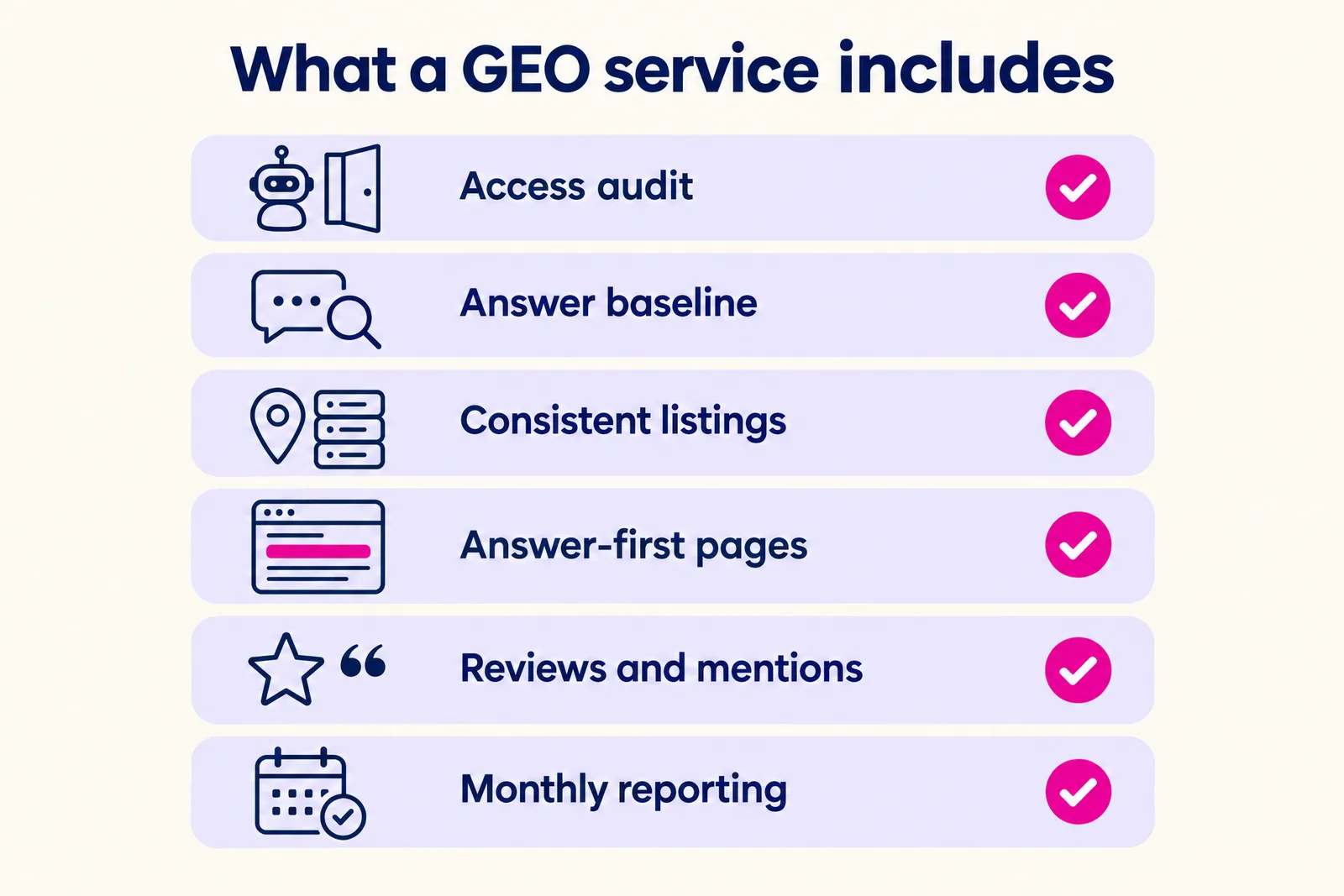
A complete GEO service covers six pieces of work: an access audit, a baseline of current AI answers, consistent listings, answer-first pages, reviews and mentions, and monthly reporting. Some businesses only need part of it, but you should know exactly which parts you are buying.
- Access audit. What it is: a check that Googlebot, Bingbot and OAI-SearchBot can reach your important pages, that nothing in robots.txt or your security settings blocks them, and that key content sits in the page text rather than inside images or scripts. Watch out for: blanket blocking of AI crawlers added by a developer or a plugin without anyone deciding it.
- Answer baseline. What it is: a fixed set of questions your customers actually ask, run across the assistants they use, with every answer logged before any work starts. Watch out for: a handful of questions run once. That tells you almost nothing.
- Consistent listings. What it is: your name, address, phone number, opening hours, services and areas checked and matched across your website, Google Business Profile, Bing Places, Apple Business Connect and the directories in your sector. Watch out for: old addresses and numbers left on directories years ago.
- Answer-first pages. What it is: service and location pages rewritten so the opening lines answer the question a customer would ask, followed by the detail, prices or price ranges where you can share them, and FAQs that deal with real objections. Watch out for: dozens of thin pages written for every possible question, which read badly and add little.
- Reviews and mentions. What it is: a steady routine for asking happy customers to review you, replying to every review, and earning genuine mentions from local press, trade bodies and partner sites. Watch out for: anyone selling bulk mentions or placements. Google's guide says seeking inauthentic mentions is not as helpful as it might seem.
- Monthly reporting. What it is: the same question set rerun, AI impressions and citations from Google and Bing, the work completed and the enquiries that came in. Watch out for: a report built around one screenshot of ChatGPT naming you.
Ask any provider, including us through Roddy Digital's GEO service, to show you where each of these sits in their proposal. For a closer look at the listings and consistency work, see our guide on how to get recommended by ChatGPT.
Which questions should you ask before hiring a GEO provider?
Ask what they will deliver in the first month, how they will measure progress and who owns the work if you stop. The answers separate providers doing real work from those reselling a dashboard.
| Question to ask | A good answer sounds like | A red flag |
|---|---|---|
| What exactly will you do in the first month? | An access audit, a logged baseline of AI answers and a prioritised list of fixes with owners | "We will optimise your brand for AI" with no named deliverables |
| Which AI tools will you test, and how often? | The assistants your customers use, each question run several times every month | One screenshot per tool |
| How will you measure progress? | Share of answers across a fixed question set, AI impressions and citations, and enquiries | A guaranteed position, or a promise to make you "number one in ChatGPT" |
| How does this fit with our current SEO? | A clear list of which tasks overlap and which are new | A separate audit and retainer that repeats existing work |
| Can I see the questions and the raw answers? | Yes, every month, in a shared file you keep | Only a summary score from a tool you cannot inspect |
| Who owns the listings and content you create? | You do, with every login held in your business's name | Listings set up under the provider's own accounts |
| What happens if we stop? | Pages and listings stay yours and keep working | Visibility depends on a software licence you lose |
Where this goes wrong: guarantees. Google states that no third-party tool has access to its internal ranking or AI systems, and no outside agency controls what ChatGPT says. Anyone guaranteeing you a place in AI answers is guessing.
How do you judge GEO progress without fixed AI rankings?
Track how often you appear across many questions over time, alongside the AI reporting Google and Microsoft now provide and the enquiries you receive. A single answer proves very little, because AI tools rarely give the same answer twice.
A study by SparkToro and Gumshoe, reported by Search Engine Land, had around 600 volunteers run 12 identical prompts nearly 3,000 times across ChatGPT, Claude and Google's AI. The chance of getting the same list of brands twice was under 1 in 100. The more useful finding was that some brands still appeared in 60% to 90% of answers for a given need, and that smaller regional markets gave steadier answers than big national categories. For a local business that is encouraging: your share of answers can be measured, even if your position cannot.
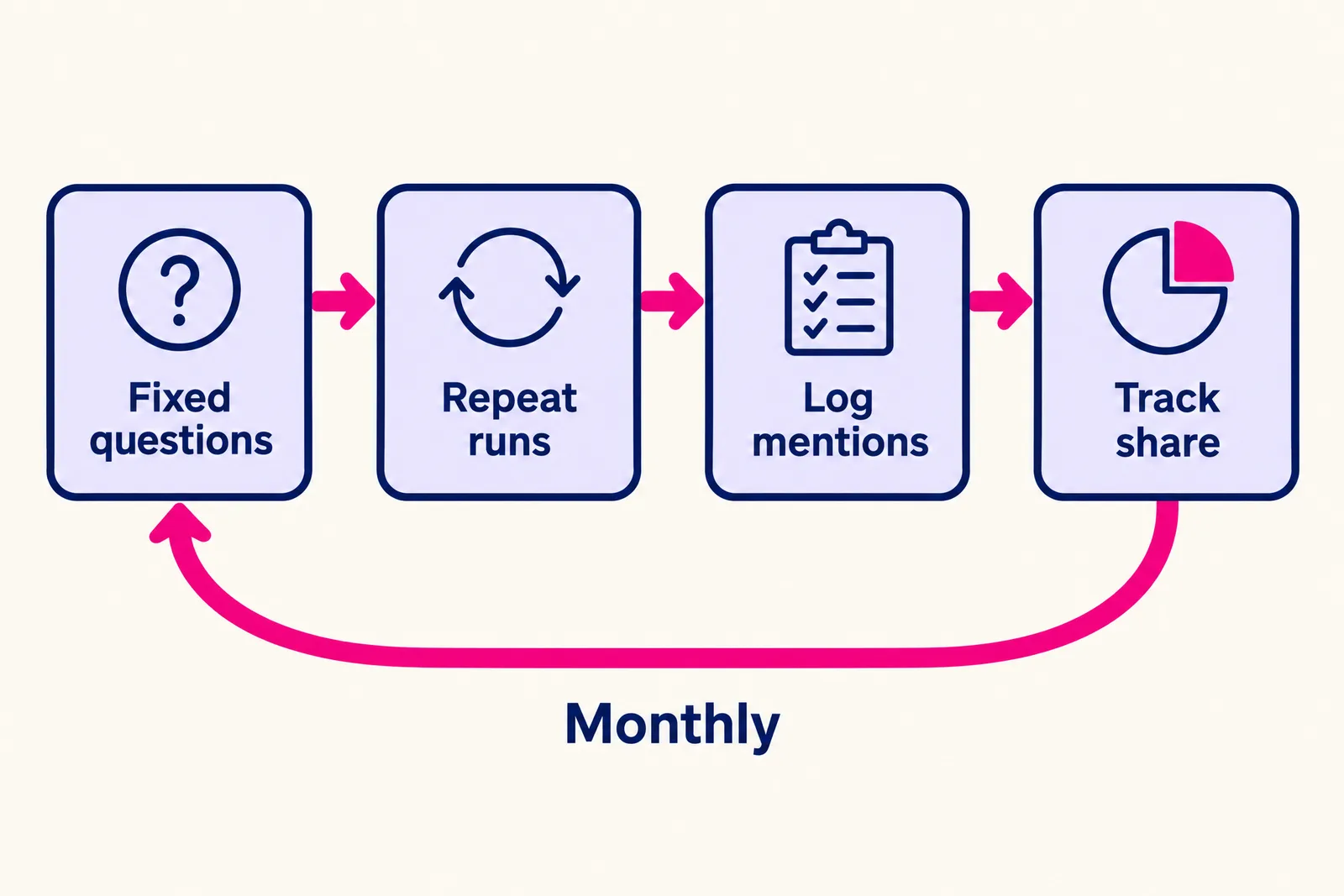
A sensible monthly routine has four steps:
- Fixed questions: a few dozen questions in your customers' own words, covering your main services, areas and buying moments.
- Repeat runs: each question run several times in each assistant, in a fresh session, at the same point each month.
- Log mentions: whether you were named, how you were described, which sources were linked and which competitors appeared.
- Track share: the percentage of answers that name you, by service and by assistant, month on month.
Then add the platform data. Google's generative AI performance report in Search Console has been available to all websites since 31 August 2026 and shows impressions in AI Overviews and AI Mode by page, country, device and date. It shows no clicks and no queries, so treat it as a visibility signal. Microsoft's AI Performance report in Bing Webmaster Tools, in public preview since February 2026, shows how often your pages are cited in Copilot and other AI answers, and the grounding queries behind those citations.
Finally, ask every new enquiry how they found you, and add an AI assistant as an option on your enquiry form. It is the closest thing you will get to a direct measure.
What should GEO look like for a Cardiff business?
For a Cardiff business, GEO starts with the questions local customers type or say, such as "best family solicitor in Cardiff", "emergency boiler repair in Canton" or "accountant in Cardiff for contractors". Those are the questions to baseline, because they are the ones that turn into enquiries.
Three things carry extra weight locally. First, your Google Business Profile and Bing Places listing need to match your website exactly, because they are among the most visible records of your business that AI tools can find. Second, areas: if you serve Penarth, Barry, Newport or the Vale of Glamorgan, say so on your site in plain sentences, and only create a page for an area where you have something real to say about working there. Third, local proof: reviews that mention the service and the area, and genuine mentions from Cardiff and Welsh sources such as local press, trade bodies, business networks and the suppliers you work with.
Our guide to SEO in Cardiff covers the map pack side in detail. The overlap is deliberate. In my view, the local basics carry most of the weight in AI answers too, and a GEO service that skips them is building on sand.
How long should a GEO service take, and how should it be priced?
Give it at least three months before you judge it, and expect the price to reflect the scope of work rather than a promise of results. Some fixes land quickly: OpenAI says robots.txt changes take around 24 hours to reach its search systems. Content, listings and reputation take longer to be picked up and to change what the assistants say about you.
When you compare quotes, ask each provider to split the price into four parts: audit and baseline, one-off fixes, ongoing content and listings work, and monitoring and reporting. That makes quotes comparable and shows whether you are paying for work or for software. If you already have an SEO provider, ask them for the same split and see what is missing.
Best for: a monthly GEO service suits businesses whose customers ask for recommendations before they buy, such as professional services, trades, clinics and hospitality. If most of your work comes from repeat customers or tenders, a one-off audit and a round of fixes may be all you need.