
A quote that gets no reply is rarely a final answer. More often the buyer is busy, comparing prices, waiting on a partner or unsure what happens next. Following up is where a lot of work is won or lost, and it is the part most owners find awkward because nobody wants to sound pushy.
I started my career in sales, including as a sales coach at the AA from 2005, and the principle I still use is simple: a follow-up feels pushy when it asks for something and gives nothing back. This guide covers what to set up before the quote goes out, when to follow up, which channel to use and the wording for each message, including the one that politely closes the loop. If you would rather have the timing and reminders handled for you, our workflow automation service builds quote follow-up into the way your enquiries are already managed.
What should you do before the quote goes out?
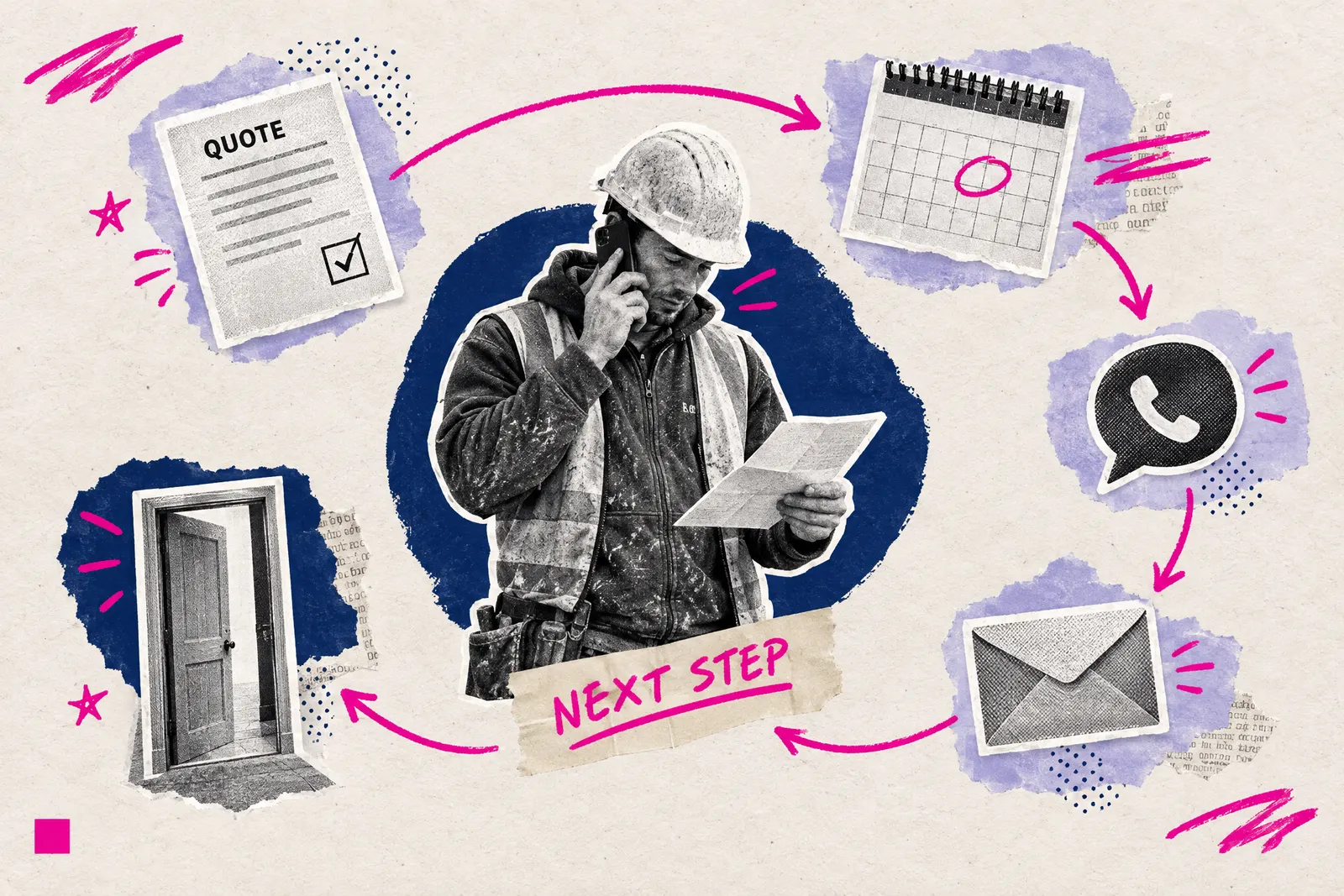
Agree the next step while you are still talking to the buyer, before the quote is sent. The easiest follow-up is one the buyer is already expecting, so ask three questions at the visit or on the call and note the answers against the job.
- When are you hoping to decide? This sets the timing for every follow-up, and it comes from them rather than from your diary.
- Is anyone else involved in the decision? A partner, a finance director or a landlord who has not seen the quote is one of the most common reasons a quote goes quiet.
- What else are you weighing this up against? Another quote, doing nothing, or doing it next year. You cannot answer an objection you do not know about.
Then build the quote so it invites a conversation. Include a short summary of what is covered, the two or three things that drive the price, a date the price is valid until and, where it makes sense, a good, better and best option so the buyer is choosing between versions rather than simply accepting or rejecting one. Close the covering email with a time already offered: "I've pencilled in ten minutes on Thursday afternoon to go through it with you. If that doesn't suit, just reply with a better time."
Worth knowing: a validity date protects your price and gives you an honest reason to get in touch before it runs out, which is far easier to write than "just checking in".
When should you follow up on a quote?
Make the first follow-up two or three days after the quote lands, then time every later touch around the date the buyer gave you for their decision. That way each message arrives when the buyer is actually thinking about the decision.
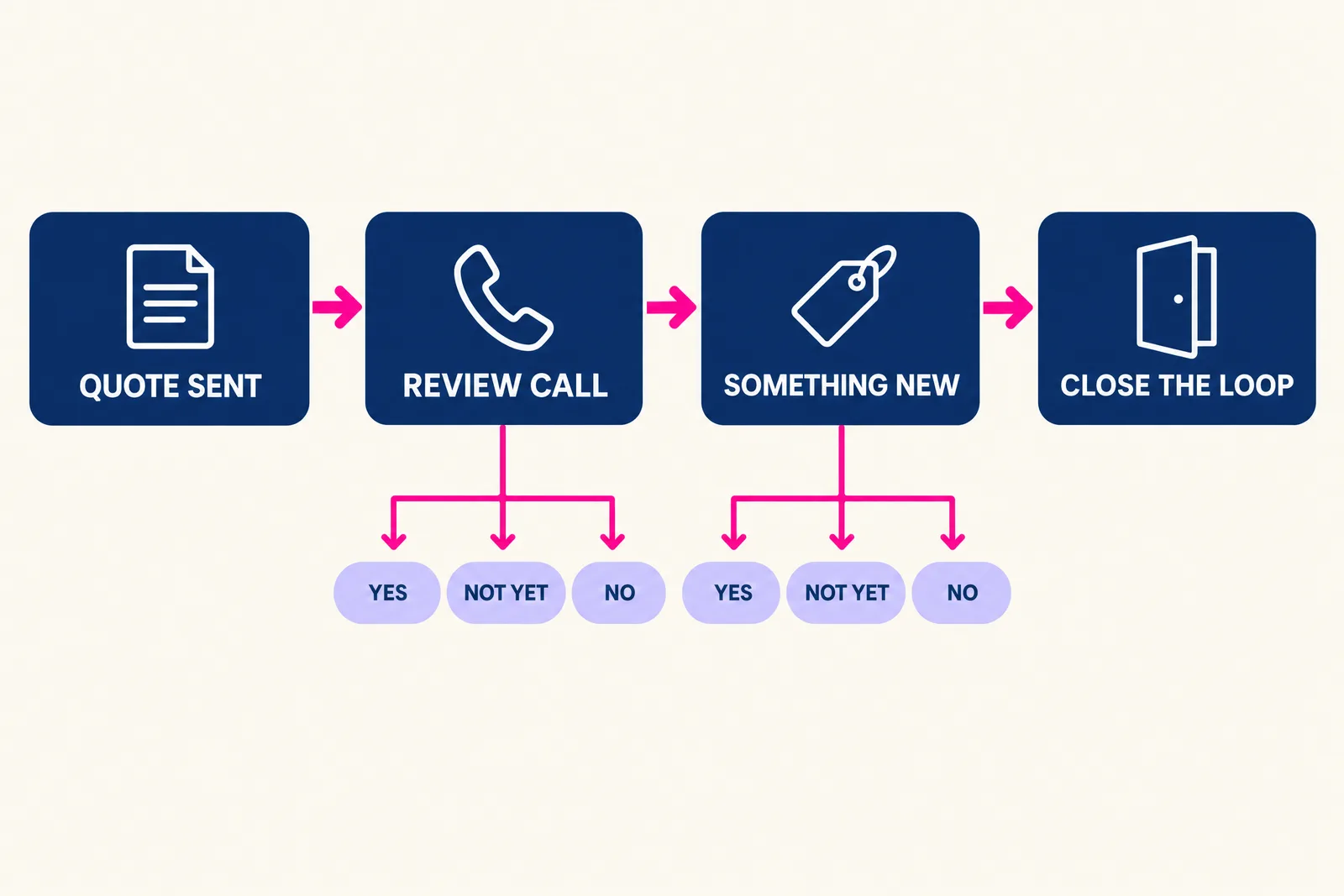
For most service businesses the pattern is a review call, a second message about a week later that adds something new, and a close-the-loop note around two weeks after the quote. We set out that full schedule, with every touch and channel, in our guide to why leads go cold, so here is how to adjust it to what the buyer told you.
| If the buyer said | First follow-up | After that |
|---|---|---|
| "We're deciding this week" | The next working day, by phone | One more call before their decision day, then close the loop a few days after it |
| "Sometime this month" | Two or three days after the quote | Something new about a week later, then close the loop around two weeks after the quote |
| "We're waiting on someone else" | Offer a short call with both of them | Check in on the day they expected an answer, then close the loop |
| "No rush, maybe next year" | A short email confirming you have noted their timing | A reminder a few weeks before that timeframe, with an updated price if costs have moved |
| No date given | Two or three days after the quote | The standard schedule, asking for a decision date on the first call |
On the first call, also ask when is easiest to reach them and note it against the job. A call at a time the buyer chose is much more likely to be answered than one at a time you guessed.
Which channel should you use to follow up on a quote?
Use the phone for the first follow-up, then mix email and text or WhatsApp depending on what the buyer prefers. A call lets you hear the hesitation behind "we're still thinking", which a written message never will.
Messaging is now an everyday channel: Ofcom's 2025 research on how the UK goes online names WhatsApp among the three most commonly used apps among adults. That makes a short message a natural fallback when a call goes unanswered, as long as the buyer gave you their mobile number for the job.
- Phone. Best for the first follow-up and any quote with options or a price conversation. Watch out for long voicemails: say who you are, which quote, and that you will send a text.
- Email. Best for sending something new, such as a revised option, photos of a similar job or an answer to a question. Watch out for burying the next step: put the one thing you want them to do in the first two lines.
- Text or WhatsApp. Best for a quick nudge after a missed call and for confirming times. Watch out for negotiating price by message: keep it to two or three lines and one question.
- Your quoting or job software. Best for reminders, quote-viewed alerts and online acceptance. Watch out for letting automatic reminders replace a person: a reminder should prompt you to call, and never stand in for the call.
What should you say when you follow up on a quote?
Say who you are, which quote you mean, one new thing and one easy next step. Every message below follows that pattern, so adapt the wording until it sounds like you.
The review call (two or three days after the quote)
"Hi [name], it's [your name] from [business]. I'm calling about the quote for your [job] I sent on [day]. I wanted to check it answers everything, and talk you through the options if that would help."
If they have questions, answer them there and then. If they are still deciding, ask two things: "What would help you decide?" and "When would be a good time for me to come back to you?" Agree that time and put it in the diary before you hang up.
The text after a missed call
"Hi [name], it's [your name] from [business]. I tried you about the [job] quote. No rush, I just wanted to check it covers everything. Is there a good time to call this week?"
The second follow-up: add something new
Send this about a week after the quote, or a few days before their decision date. Choose one useful thing: photos of a similar job, an answer to a question buyers often ask, a phased option that spreads the cost, or your next available start date.
"Subject: Your [job] quote, plus a phased option. Hi [name], some customers prefer to split work like this into two stages, so I've attached a phased version alongside your original quote. Both are valid until [date]. Would a quick call on [day] help you compare them?"
When price is the sticking point
Offer a different scope before you offer a lower price. "Thanks for being straight with me. I can take out [item], or use [alternative], which brings it closer to your budget. Would it help if I sent that version over?" A discount with nothing removed tells the buyer the first price had room in it, and they will expect the same next time.
The close-the-loop message (around two weeks after the quote)
"Hi [name], I haven't heard back about the [job] quote, so I'll assume the timing isn't right and close it for now. If anything changes, just reply to this message and I'll pick it up. Thanks again for considering us."
Where this goes wrong: turning the close-the-loop message into a guilt trip ("I've tried you several times now"). Keep it short, warm and final, and mean it: if there is no reply, stop chasing.
The reopen message (weeks or months later)
Send this only when the buyer said "not yet" and agreed to hear from you. "Hi [name], you mentioned you were looking at the [job] around [month]. I have availability from [date] and can update the quote if anything has changed. Would that be useful?"
What should you do when the buyer says "not yet" or goes quiet?
Treat "not yet" as a date to agree and silence as a reason to close the loop. Both are answers you can work with; the problem is leaving either one open with no next step.
- "Not yet": ask when would be a better time, confirm it in a short message and set a reminder. Then follow up on exactly that day, because keeping to it shows you listened.
- "We've gone with someone else": thank them, ask whether they would mind saying what made the difference, and leave the door open. The answer is some of the most useful feedback you will get on your quoting.
- Silence after two follow-ups: send the close-the-loop message and stop. Silence after that is a no for now.
Keep a one-line record of why each lost quote was lost. After a few months the pattern shows whether the issue is price, speed, scope or trust, and each has a different fix. If buyers keep comparing you on price alone, the work often starts with a clearer value proposition, and our guide to converting more enquiries covers the steps that come before the quote.
Can you text or WhatsApp someone about their quote?
Yes. Messages about a quote someone asked for are part of handling their enquiry. Sending them promotional messages later is different, and in the UK that needs their consent or the soft opt-in under PECR.
The ICO's guidance on electronic mail marketing, which covers texts as well as emails, counts requesting a quote as part of negotiations for a sale. That is what makes the soft opt-in possible, as long as you offered an opt-out when you collected the details and offer it again in every marketing message. The stakes rose this year: since 5 February 2026, PECR breaches can carry fines of up to £17.5 million or 4% of global annual turnover, whichever is higher, according to Lewis Silkin's summary of the Data (Use and Access) Act changes.
In practice: keep quote follow-up about the quote, add an opt-out line to your enquiry form, and treat anything promotional as marketing. This is general guidance, not legal advice.
How do you make sure every quote gets followed up?
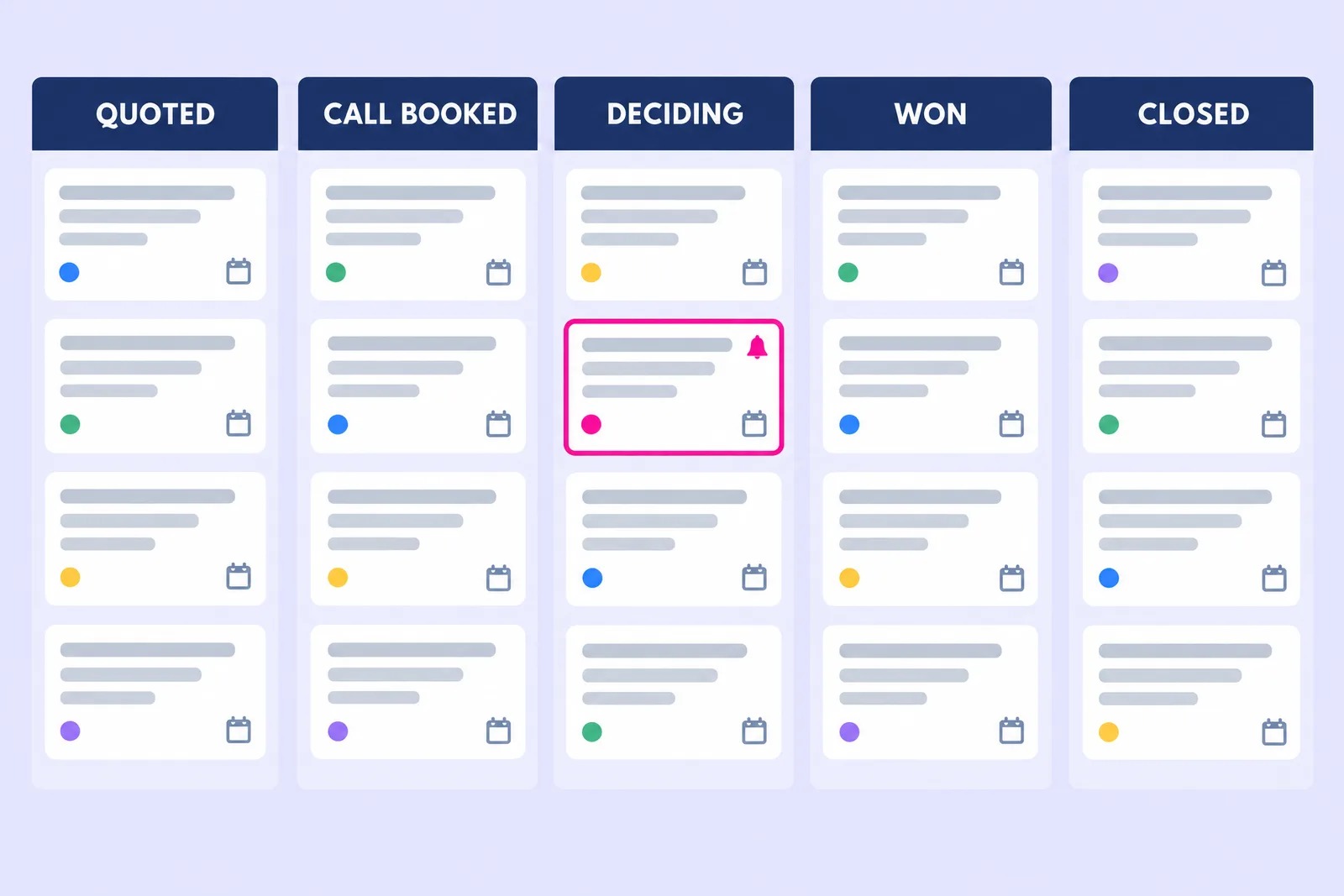
Put every open quote in one place with a stage and a next follow-up date, and let a system remind you. Follow-up that depends on memory works in a quiet week and falls apart in a busy one, which is exactly when losing work hurts most.
A good set-up has four parts:
- One list of open quotes. A job management tool, a CRM or, for a very small business, a shared spreadsheet. Every quote has a stage, a value and a next action date.
- Reminders tied to the buyer's date. When you log "deciding end of the month", the follow-up is set for you, so nothing relies on remembering it on a Friday afternoon.
- Drafted messages, approved by a person. Automation can draft the text or email for each stage from the quote details. A person checks it and presses send, and pricing, promises and anything sensitive stay with a human.
- An outcome on every quote. Won, lost or not yet. That gives you your real quote-to-win rate and the reasons behind it.
Where should a busy service business in any city start? With the quotes already sitting in your sent folder. List every open quote from the last month, give each a stage and a next date, and send the right message from the section above. For example, if you run a trades business in Cardiff or South Wales and quote from the van between jobs, the quickest win is usually a reminder on your phone and a ready-to-send text, rather than another piece of software to log into.
Once quote follow-up is running, our list of AI automation examples for small businesses covers the next workflows worth handing over.