


Plenty of small business websites open with a line that could belong to anyone: quality service, trusted experts, solutions tailored to you. A visitor reads it, learns nothing about what you would do for them, and goes back to the search results. A value proposition fixes that. It is one or two plain sentences that tell the right person what you do for them and why they should pick you.
This guide gives you a simple formula, worked examples for trades and professional services, a way to test your draft on real customers before it goes on your homepage, and the places it should appear once it is ready. If you would rather work it out with someone, our messaging and copywriting service starts at exactly this point.
What is a value proposition, in plain English?
A value proposition is a short statement of who you help, what you help them achieve and why they should believe you can do it. It is written for a stranger who has never heard of you and has a few seconds to decide whether to keep reading.
People often mix it up with two other things. A slogan is a memorable line built for repetition, and it can be playful or vague. Your brand positioning is the bigger decision about which market you serve and where you stand against the alternatives (we cover that in what brand positioning really means). The value proposition is the customer-facing sentence that comes out of that positioning, written so plainly that a customer could repeat it to a friend.
A working value proposition usually has three layers:
- A headline that states the outcome for a named type of customer.
- A supporting line that says how you deliver it, or what hassle you take away.
- Two or three proof points, such as reviews, accreditations, years trading, guarantees or results you can evidence.
Why does a value proposition matter so much on a website?
Visitors decide very quickly whether a page is worth their time, and the value proposition is what they use to decide. Jakob Nielsen's analysis of page dwell times at Nielsen Norman Group found that users often leave web pages in 10 to 20 seconds, and concluded that to hold attention for several minutes you must communicate your value proposition within 10 seconds. That analysis dates from 2011, and in my view the pressure has only grown as more browsing happens on phones.
It matters away from your website too. AI assistants and search engines describe your business using what you say about yourself across your site, your Google Business Profile and other listings. If every page describes you differently, the description they give gets muddled. One clear value proposition, repeated consistently, gives them a single story to tell (more on that in how to get your business recommended by ChatGPT).
I started my career in sales, and I still judge a value proposition with a sales test: could someone say this line out loud on a call without it sounding like a brochure? If they could not, it will struggle on a homepage as well.
What is a simple formula for writing a value proposition?
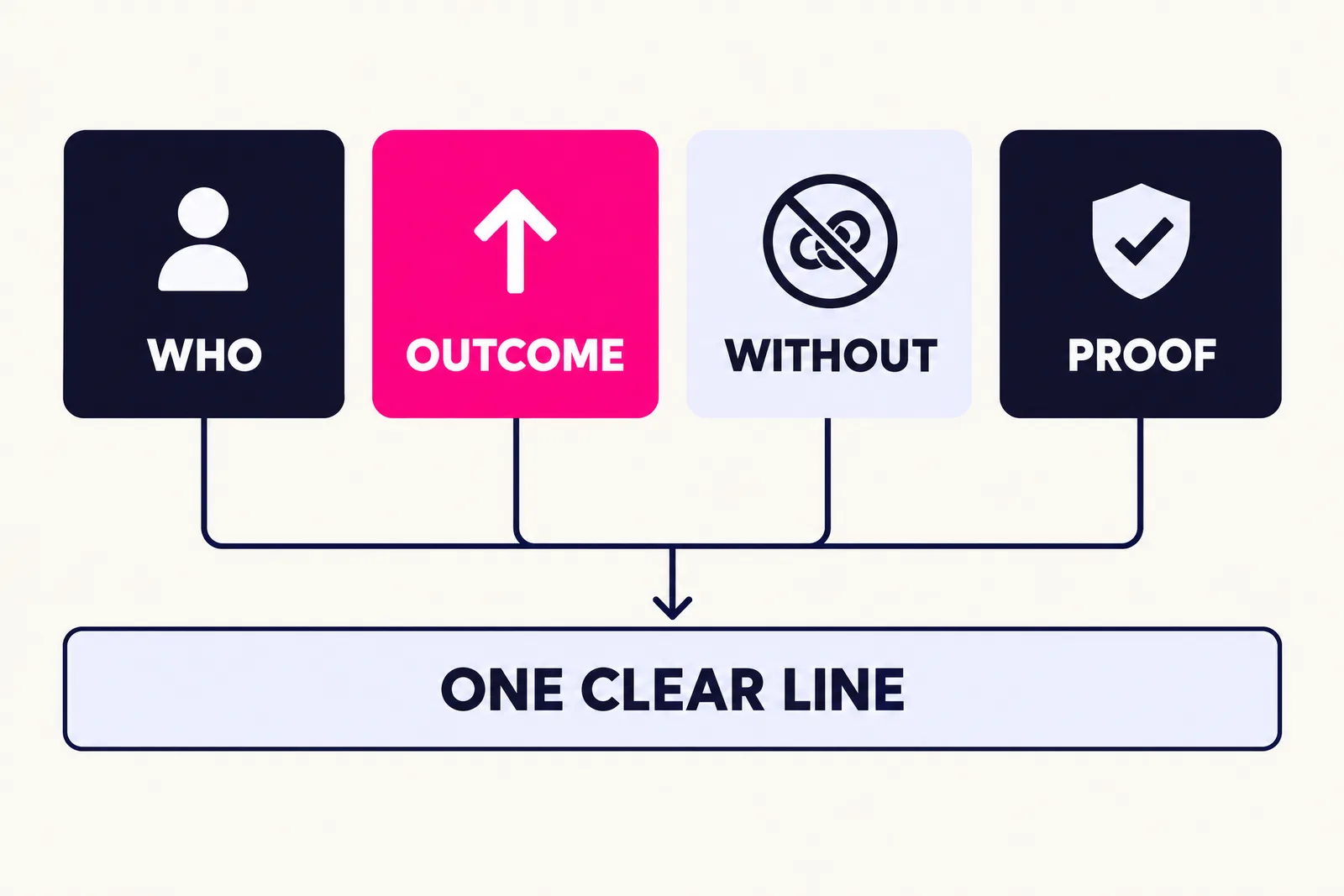
Use this: we help [who] get [outcome] without [the usual pain], then add one line of proof underneath. Four parts, each doing one job.
- Who. The specific customer you are best for. "Landlords with a portfolio of rental homes" tells the right reader far more than "homeowners and businesses". Narrowing it can feel risky, yet it is what makes the right people feel the line was written for them.
- Outcome. What changes for them, described as a result. "Boilers fixed before tenants complain" is a result a landlord can picture; "gas and heating services" is a list of activities.
- Without. The frustration they expect from the usual option, whether that is a competitor, doing it themselves or putting it off. This is where you show you understand their world.
- Proof. The evidence that makes the claim believable: reviews, accreditations, guarantees, a named process or results you can document.
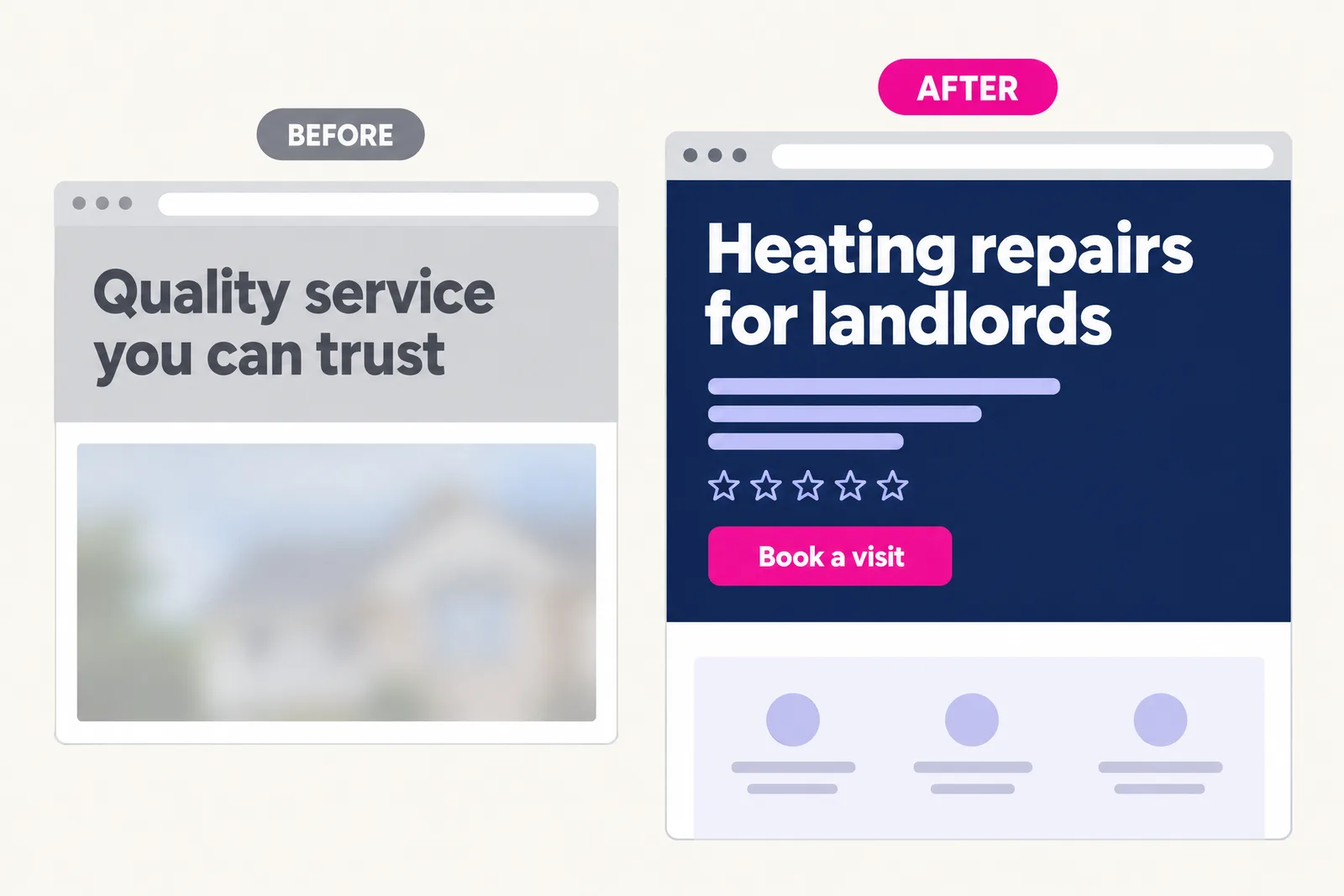
The formula is for drafting. Your final headline rarely keeps the words "we help". A finished version might read "Heating repairs for landlords, without chasing engineers", with the proof line underneath.
Worth knowing: if the only answer you can give for "who" is everyone, stop and make that decision first. A value proposition cannot do its job for a business that has not chosen its customer.
How do you work out what goes in each part?
Fill each part from your customers' own evidence, never from a brainstorm in the office. With your reviews and enquiries to hand, these five steps take an afternoon.
- Pick one customer type. Choose the customer you most want more of, ideally one who is profitable and whom you serve well. Write the value proposition for them first; other segments can have their own later. Strategyzer's Value Proposition Canvas is a useful prompt here, because it asks you to describe one customer segment by the jobs they are trying to get done, the pains in their way and the gains they want.
- List the alternatives they really compare you with. For many small businesses, the strongest competitor is the customer doing it themselves, or putting it off. Write down what is frustrating about each alternative. Those frustrations become your "without".
- Collect their words. Read your reviews, enquiry emails and notes from sales calls, and copy out the phrases customers use to describe the problem and the result. If a customer writes that they wanted someone who simply turns up when they say they will, that phrase will beat anything you invent at a desk.
- Gather your proof. List every piece of evidence you hold: review rating and count, accreditations, guarantees, years trading, before-and-after results. Only use what you could show someone on request.
- Draft three versions and cut. Write one that leads with the outcome, one that leads with the pain and one that leads with the customer type. Read each aloud and delete every word a customer would not use.
What does a good value proposition look like for trades and professional services?
A good one is specific enough that the wrong customer can tell it is not for them. The examples below are illustrations written for made-up businesses to show the formula in use. Swap in your own customer, outcome and proof, and only make claims you can back up.
| Business type | Vague version | Clearer version | Proof to add underneath |
|---|---|---|---|
| Heating engineer | Quality heating services you can trust | Heating repairs for landlords, without chasing engineers or tenants | Review rating, Gas Safe registration, the response promise you actually keep |
| Electrician | Professional electrical solutions for all your needs | EV charger installation for homeowners, with the paperwork handled for you | Relevant accreditations and photos of finished installs |
| Accountancy practice | Expert accounting tailored to you | Accounts and tax for limited company contractors, with one accountant who knows your business | Professional body membership and client reviews |
| Commercial cleaning company | Excellence in cleaning | Office cleaning for small teams, done out of hours so your working day is never interrupted | Insurance, staff vetting process and how long clients stay with you |
| IT support provider | Innovative IT solutions | IT support for small offices, with a named engineer who picks up the phone | Response times you measure and client reviews |
Look at what changed in each row. The clearer versions name a customer, describe a result that customer cares about and remove a familiar frustration. None of them use quality, solutions or excellence, because those words appear on so many websites that readers no longer register them.
Where this goes wrong: businesses with several services try to fit all of them into the headline. Lead with the service that brings the customers you want most, and let the rest of the page carry the others.
How do you test a value proposition on real customers?
Show it to people who match your customer and ask them to tell you, in their own words, what you do and who it is for. If they cannot, rewrite it. Testing costs almost nothing and catches most problems before they reach your homepage.
- The five-second test. Show the headline and supporting line to someone who fits your customer type for five seconds, then hide it. Ask what the business does, who it is for and why they might choose it. Repeat with a handful of people.
- The phone test. Use the line when you answer an enquiry or open a sales call. Notice whether people respond with a question about their own situation, or ask you to explain what you mean.
- The recent customer test. Ask a few recent customers why they chose you over the alternatives. If their reasons differ from your value proposition, they are probably right and your draft needs to move towards them.
- The live test. Run two versions as the headline of a paid search ad or an email subject line and compare the responses. Small numbers will not prove much statistically, but a clear gap is worth acting on.
Check the proof while you test. In the UK, the Advertising Standards Authority's CAP Code says that before publishing marketing, businesses must hold documentary evidence for objective claims that people are likely to take literally. Even a word like "best" can count as an objective claim depending on context, as the ASA explains in its guidance on matters of opinion. If you cannot evidence a claim, swap it for one you can.
Where should you use your value proposition?
Use it everywhere a new customer meets you for the first time, word for word or close to it. Consistency is what makes it stick, for people and for the AI tools that summarise businesses.
- Homepage hero: the headline and supporting line, with proof points directly beneath and one clear call to action. If your homepage gets visits but few enquiries, start with why your website isn't converting.
- Google Business Profile: the opening of your business description.
- LinkedIn: your company page tagline and the headline on your personal profile.
- Proposals and quotes: the opening paragraph, adapted to the client.
- Sales calls and networking: your answer to "so, what do you do?"
- Ads and emails: the starting point for headlines and subject lines.
- Briefs: the first line of any brief for your website or marketing (see how to brief your web designer).
How should a business serving one city or region adapt it?
Add the place where it helps the customer decide. If you serve a defined area, saying so tells the right people you will come to them and tells everyone else to look elsewhere, which saves both sides time. For example, for most service businesses in Cardiff and South Wales, "across Cardiff and the Vale" or "across South Wales" in the supporting line does more work than a list of every postcode you cover. Keep the place out of the headline unless being local is your main reason to be chosen.
What mistakes make a value proposition fail?
Most weak value propositions fail for one of five reasons, and each can be fixed in an hour.
- Listing services instead of results. A list of what you do tells the customer nothing about what changes for them.
- Writing for everyone. A line built to suit every possible customer has to stay vague, so nobody feels it was written for them.
- Industry jargon. Terms you use every day may mean nothing to the customer. If your reviews never use a word, your headline probably should not either.
- Claims without proof. Award-winning, leading and best all need evidence behind them, both to persuade and to stay within the advertising rules.
- Writing it once and forgetting it. Your best customers change as the business grows. Review the line whenever you add a service, change your prices or start winning a different kind of client.
Get this one line right and the rest of your website copy becomes easier to write, because every page has a single idea to support.