
Most leads that go cold were warm when they arrived. Someone filled in your form, asked for a price or rang while you were on a job. Then the reply came the next afternoon, or the quote went out and nobody chased it, and by the time you got back to them they had booked someone else.
I started my career in sales, including as a sales coach at the AA from 2005, before moving into websites and digital marketing. The habit I still see costing businesses the most work is the gap between an enquiry arriving and a person replying to it. This guide covers why leads go cold, what should happen in the first hour, how to stop quotes stalling in someone's inbox, and which parts of follow-up you can hand to automation while a person stays in charge of what gets sent. If you would rather have it built for you, our workflow automation service sets up exactly this kind of follow-up process.
Why do leads go cold?
Leads go cold because the business is slow to reply, gives the buyer no clear next step, or stops following up too early. The buyer still needs the job doing; it simply goes to whoever answered first or kept in touch.
- The first reply is slow. The enquiry lands in a shared inbox, on a phone that is in a van, or in a form notification nobody reads until the evening. Buyers often contact more than one business at once, and the first sensible reply sets the pace.
- The reply has no next step. "Thanks, we'll be in touch" leaves the buyer waiting with nothing to agree to. A reply that offers a call time, a visit slot or a question to answer keeps things moving.
- The quote goes out and nobody chases it. This is where most warm leads cool down. The buyer is comparing, busy or waiting on someone else, and silence from you reads as low interest.
- Follow-up lives in someone's head. If chasing depends on the owner remembering on a Friday afternoon, it happens in quiet weeks and disappears in busy ones, which are exactly the weeks the leads are coming in.
- The channel is wrong. Someone who messaged from their phone at 9pm may ignore a call at 10am and still reply to a text. Answer on the channel they chose before switching to yours.
Worth knowing: every one of these is a gap in the process between the enquiry and the person who should answer it, so a small amount of structure fixes most of them.
How fast should you respond to a new enquiry?
Acknowledge a new enquiry within minutes and have a person make contact within the hour during working hours. The research behind that is old, but it points one way.
A study published in Harvard Business Review audited 2,241 US companies by sending each one a web enquiry. 37% replied within an hour, 24% took more than 24 hours and 23% never replied at all. Among those that replied within 30 days, the average response time was 42 hours. A separate analysis by the same researchers, covering 1.25 million sales leads from 42 companies, found that companies contacting a lead within an hour were nearly seven times as likely to qualify it as those that waited longer, and more than 60 times as likely as companies that waited 24 hours or more (figures as reported by SmartCompany).
That data comes from 2011 and from the US, so treat the exact multiples with care. The direction still holds, and buyers now have far more options a tap away than they did then. In my experience, the first business to have a proper conversation with the buyer usually sets the terms for everyone else.
Where this goes wrong: businesses read "within the hour" as "reply instantly with anything". A fast reply that says nothing useful buys you a few minutes at most, so make the first human reply count.
What should happen in the first hour after an enquiry?
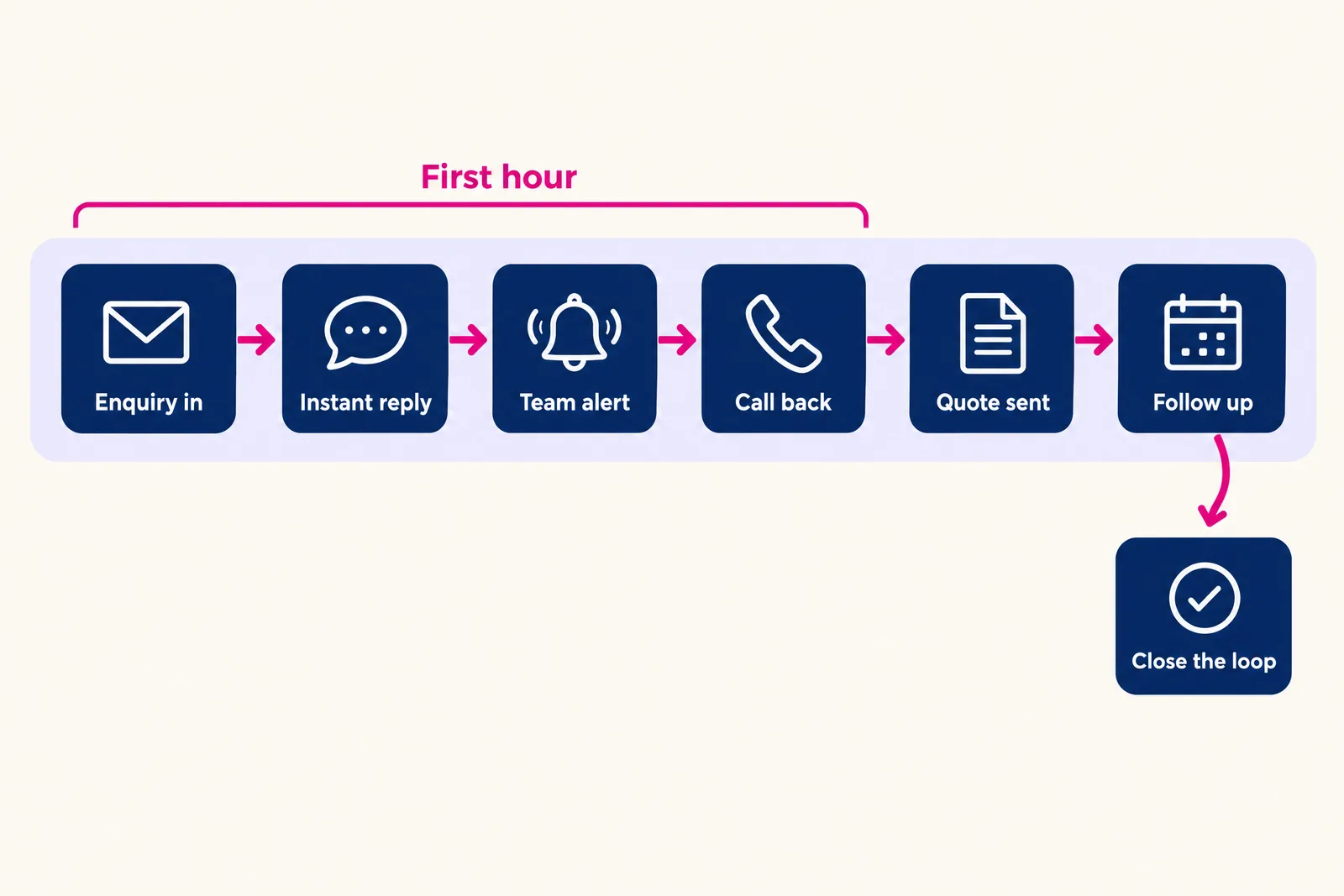
In the first hour, the buyer should get an honest acknowledgement, the right person should be alerted, and someone should try to speak to them and agree a next step. This is the sequence I recommend for most service businesses.
- Instant acknowledgement (automated). Within a minute, send a short email or text that says you have the enquiry, names who will be in touch and says when. Keep it human and specific. Outside working hours, say when you are back.
- Alert the right person. Route the enquiry by service or area to a named person, by text or mobile notification as well as email. A shared inbox that nobody owns is where enquiries go to wait.
- Call within the hour. A five-minute phone call clears up more than a day of emails. Have the enquiry details in front of you and one or two questions ready.
- If they do not answer, send a personal message. A short text or email from the person who called: who you are, why you rang, and two times you could speak.
- Agree the next step. End every first contact with something booked: a site visit, a call, a date for the quote. Put that date in your CRM or job system so it cannot be forgotten.
Best for: any business where a buyer asks for a price or a visit before committing, such as trades, professional services, clinics and B2B services.
How do you stop quotes going cold?
Send every quote with a date for the next conversation, then follow up on a fixed schedule until the buyer says yes, no or not yet. A quote with no follow-up plan relies on the buyer coming back to you, and busy people rarely do.
The schedule below is a sensible starting point for most service businesses. Stretch or shorten the gaps to suit your sales cycle: a boiler repair moves in days, a commercial fit-out in weeks.
| Touch | When | What it says | Channel |
|---|---|---|---|
| Quote sent | Same day as the visit or call | The price, the two or three things that drive it, and a booked time to talk it through | Email, with a call in the diary |
| Follow-up one | Two to three days later | Did the quote answer everything? Offer to talk through options or phasing | Phone, then text if no answer |
| Follow-up two | About a week after the quote | Something useful and new: a similar job, an answer to a common question, availability | |
| Close the loop | Around two weeks after the quote | A polite note that you will close the quote for now, with an easy way to reopen it | Email or text |
| Keep in touch | Occasional, after that | Seasonal reminders or relevant updates, only if they agreed to hear from you |
The close-the-loop message is the one most often skipped, and in my experience it is often the one that finally gets a reply. Something like: "I haven't heard back, so I'll assume the timing isn't right and close this for now. If anything changes, just reply to this email." It is polite, it respects their time and it tells you where you stand.
The lesson I took from sales and still use is that every follow-up should carry something new: an answer, an option or a date. "Just checking in" gives the buyer nothing to respond to.
What should you automate, and what should stay human?
Automate the timing, the reminders and the first drafts, and keep a person in charge of anything that commits you to a price, a date or a promise. That split gives you speed without sending something wrong in your name.
| Task | Who handles it | Why |
|---|---|---|
| Acknowledging a new enquiry | Automated | Speed matters and the message barely changes |
| Alerting the right person | Automated | Routing rules never forget or go on holiday |
| Logging the enquiry in your CRM | Automated | Saves admin and keeps the history in one place |
| Reminders to call or chase | Automated | The task appears on the right day for the right person |
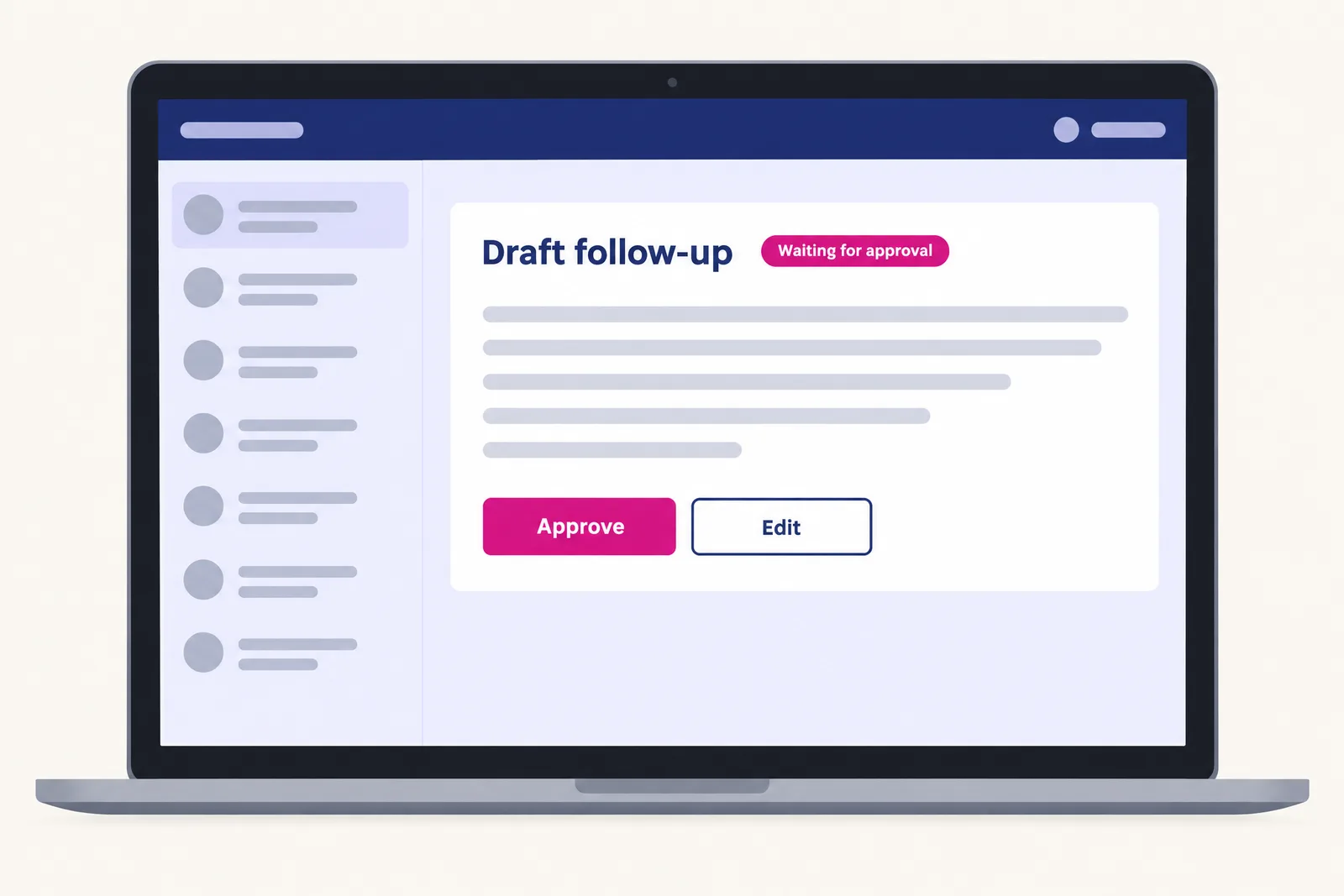
| Follow-up messages after a quote | AI drafts, a person approves | The draft uses the enquiry details; a person checks tone and facts before it goes |
| Pricing, discounts and scope changes | A person | These commit the business and need judgement |
| Complaints and unhappy replies | A person | Nobody wants an automated answer to a complaint |
The approval step is what makes this safe for a small business. A drafted message waiting in your inbox takes seconds to check, while a wrong message sent automatically to a customer can take a lot longer to put right.
You can usually build this with tools you already pay for: a CRM with tasks and email sequences, your email and text platform, and an automation layer connecting them to your website form. For more ideas on where to begin, see our AI automation examples for small businesses.
Where should a city-based service business start?
Start with the enquiries you already get: measure how long the first reply takes, then fix the first hour before you change anything else. Local service businesses compete on response as much as on price, because the buyer is usually choosing between a handful of nearby options found in the same search.
For example, for most companies in Cardiff and South Wales, that shortlist comes from Google Maps, a few local websites and a neighbour's recommendation. After we built the new website for Pest & Property Solutions, a Cardiff pest control business, it brought in 112 enquiries in its first 36 days, 82.7% of them from Google organic search. Those figures are Roddy Digital project data, published in our Pest & Property case study. Volume like that only pays if every enquiry gets a fast, consistent reply, which is why the follow-up process deserves as much attention as the website that produces the leads.
How do you know your follow-up is working?
Track four measures each month: time to first human response, contact rate, quotes with a next step booked, and win rate on quotes. If the first two improve, the last two should follow.
- Time to first human response. From form submission or missed call to the first real reply, leaving out the automatic acknowledgement.
- Contact rate. The share of enquiries where you had a real conversation.
- Quotes with a next step booked. Every quote should have a date attached.
- Win rate on quotes. Then look at the losses: did they go quiet, choose on price or choose someone faster?
If your website brings in traffic but few enquiries in the first place, start there: our guide on why a website isn't converting covers the fixes, and converting more enquiries into customers goes further on the sales side.
Can you keep emailing someone who asked for a quote?
Following up on a quote someone asked for is part of dealing with their enquiry. Sending them marketing emails later is different, and in the UK it needs either their consent or the soft opt-in under PECR.
The ICO's guidance on electronic mail marketing says negotiations for a sale include "requesting a quote or asking for more details about what you offer". To rely on the soft opt-in, you must collect the contact details directly from the person, only market similar products or services, offer an opt-out when you collect the details, and offer it again in every message after that. In practice that means a short opt-out line on your enquiry form and an unsubscribe link in any ongoing emails. This is general guidance, not legal advice.