

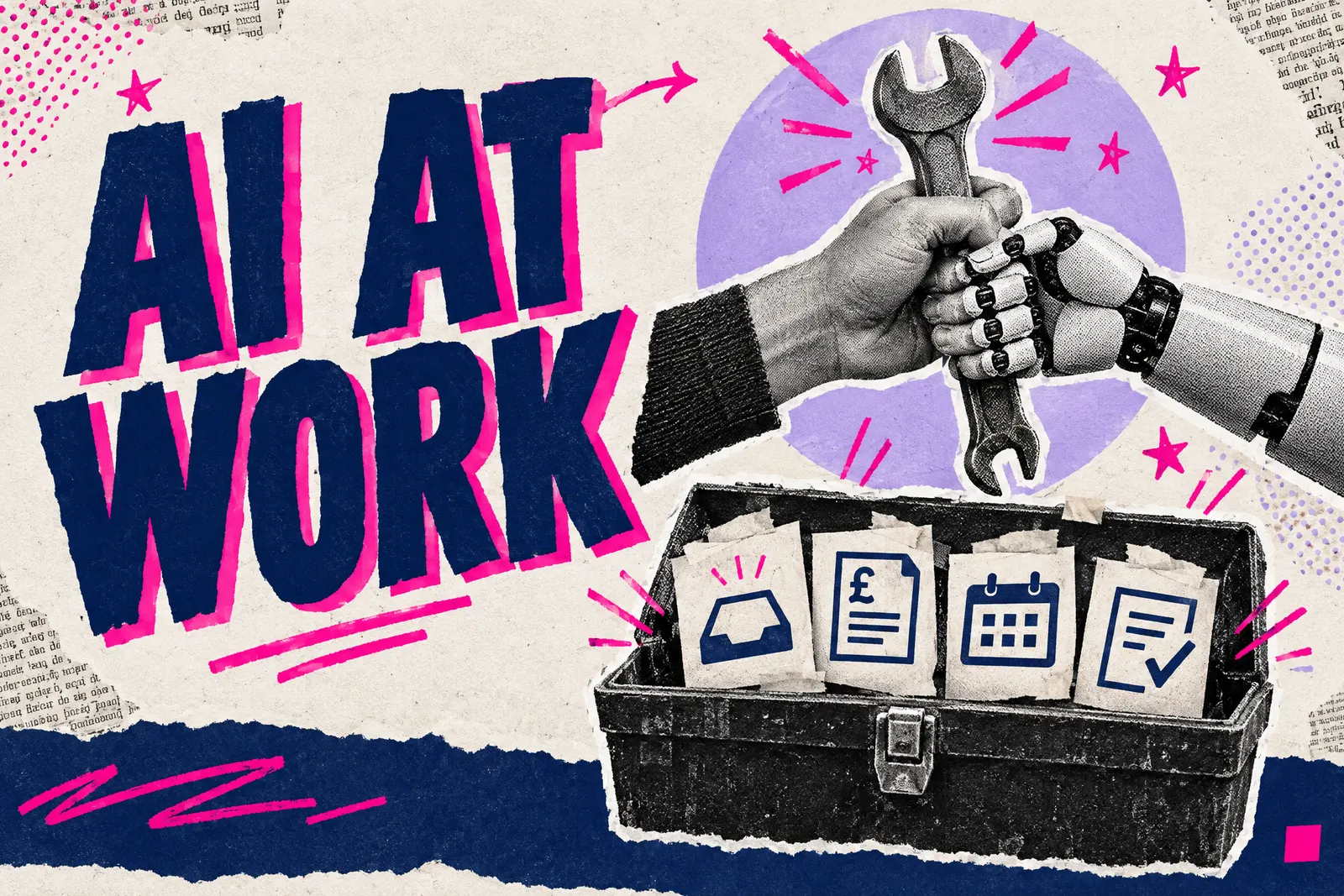
Most small business owners feel two things about AI at once: that they should be using it, and that they have no idea where to begin. The result is either paralysis or a drawer full of half-used tools. Both come from approaching it backwards. AI is not the starting point. The bottleneck is.
Start with the connected parts of your business. A business does not need "more AI", it needs less friction in the work that eats its time and caps its growth. Used well, AI and automation are leverage: they let a small team operate like a larger one, respond faster, and free the owner from the admin that keeps them stuck in the business instead of working on it.
This guide is the practical map: what AI can realistically do for a small business today, where to start, what to automate first, and how to use it to grow without burning out. Each section links to a deeper article in the cluster.
What can AI realistically do for a small business right now?
Set aside the hype. For a typical small business in 2026, the reliable wins fall into a few clear buckets: drafting and editing content, handling routine customer questions, summarising and organising information, speeding up research, and automating repetitive admin between your tools.
The honest framing is assistant, not replacement. AI is excellent at the first draft, the quick summary, the repetitive task and the always-on response. It still needs a human for judgement, relationships, taste and accountability. The businesses getting real value are not replacing people, they are removing the low-value work that stops their people doing the high-value work. We cover the concrete, where-to-begin version in AI and Automation for Small Business: Where to Actually Start.
Where should you actually start with AI?
Start with your bottlenecks, not with a tool. The simple method: list the tasks that take the most time or cause the most friction each week, pick the single most painful one, and find the simplest way to remove or speed it up. Prove the time saved on one workflow before adding another.
A practical priority order for most small businesses:
- Find your biggest time drains (admin, repetitive replies, content, data entry).
- Pick one with a clear, repeatable pattern, the best candidate for automation.
- Apply the simplest tool that solves it, not the most advanced.
- Measure the time saved, then standardise it into a repeatable process.
- Only then move to the next bottleneck.
This beats "trying AI" every time, because it ties every tool to a real result. Chasing tools for their own sake is how the drawer fills up with subscriptions you never use.
What should a small business automate first?
The best first candidates share three traits: they are repetitive, rule-based, and currently done by hand. Automate those and you get immediate, visible time back.
| Area | Common first automation | The payoff |
|---|---|---|
| Admin | Scheduling, reminders, data moving between apps | Hours back each week |
| Customer service | Instant replies to common questions, follow-ups | Faster response, no missed enquiries |
| Content | First drafts, repurposing, social scheduling | More output, less time per piece |
| Sales | Lead capture, qualification, CRM updates | Nothing falls through the cracks |
| Reporting | Pulling and summarising numbers | Decisions from data, not guesswork |
The principle is to automate the boring and the repeatable, and keep the human in the loop for anything involving judgement, money or relationships.
How does AI help you grow without burning out?
For most owners, growth and burnout arrive together: more work means more hours, until there are no more hours to give. AI and automation break that link by raising what you can deliver without raising what you personally have to do. That is the definition of leverage.
The shift is from doing the work to designing the systems that do the work. Automate the repeatable, delegate or templatise the rest, and protect your time for the few things only you can do. This is how a small team scales capacity without scaling stress or headcount. We go deep on the sustainable version of this in How to Scale a Small Business Without Burning Out.
A note on AI and your visibility
There is a second reason AI matters for small businesses in 2026, beyond internal efficiency. Your customers are now using AI tools to research and shortlist suppliers before they ever contact one. Whether ChatGPT, Perplexity or Google's AI Overview understands and recommends your business depends on how clearly and consistently you show up online. So AI is both a tool you use internally and a channel you need to be visible in. We treat that visibility side under the Demand & Content pillar, but it is worth knowing the two are connected.
The checklist
The AI starting-point checklist
| Step | The question | Done when |
|---|---|---|
| Identify | What eats the most time each week? | Top 3 bottlenecks listed |
| Prioritise | Which is repetitive and rule-based? | One workflow chosen |
| Apply | What is the simplest tool that solves it? | Tool live on that one task |
| Measure | How much time did it save? | Saving quantified |
| Standardise | Can we make it a repeatable process? | Documented and reused |
| Expand | What is the next bottleneck? | Move to the next, not before |
Key takeaways
- Start with your bottlenecks, not with a tool. The painful, repetitive task tells you what to automate.
- AI is an assistant, not a replacement: brilliant at first drafts, summaries, routine replies and admin.
- Automate work that is repetitive, rule-based and done by hand; keep humans on judgement, money and relationships.
- Used well, AI is leverage: it lets you grow capacity without growing hours or headcount.
- AI is also a visibility channel in 2026, as buyers use it to research and shortlist suppliers.