
Search for AI workshops in Cardiff and you will find university short courses, evening meet-ups and agency sessions, most described in roughly the same words. The choice that matters is the format. A group workshop, a private session for your team and one-to-one training for the founder each solve a different problem, and picking the wrong one is an easy way to spend money on AI training and see little change on Monday morning.
The demand is real. The Office for National Statistics found that 29% of UK businesses used at least one AI technology in June 2026, up 8 percentage points on a year earlier. Most of the people using it taught themselves: in research for The Access Group, 19% of employees who use AI at work had taken an AI course, while 70% were experimenting on the job.
This guide sets the three formats side by side, with who each suits, what you leave with and what it costs at our published rates. If you already know a group session is right for you, the formats and dates are on our AI workshops page.
What is the difference between an AI workshop and one-to-one AI training?
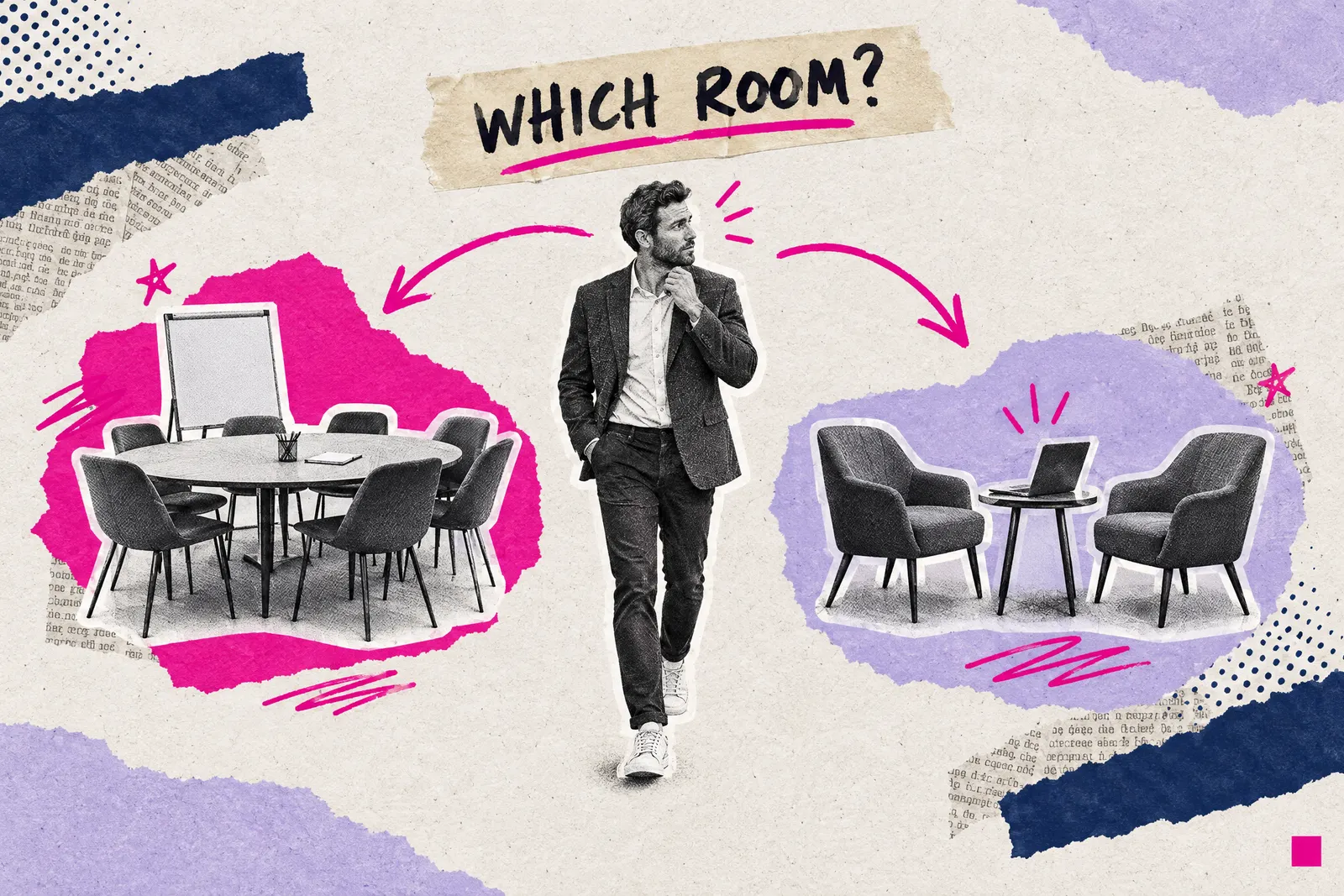
An AI workshop teaches a group a shared, practical method in a few hours. One-to-one training sets AI up inside one person's real work, on their own laptop and accounts. Between the two sits the private team session: a workshop built around one company's tools and workflows.
All three should be hands-on. What changes is how much of the session is about your business specifically, and how much you have built and running by the time you leave.
- Open workshop: a half-day group session with people from different businesses, using practical content that works in any industry.
- Private team session: a half day for your staff only, shaped by a short discovery call about your tools, sector and workflows.
- One-to-one training: a founder or owner-manager working with a trainer for anything from two hours to a full day, building their own set-up as they go.
If you want a wider view of what any good session should cover before you choose a format, read what good AI training for a small business should include.
How do open workshops, team sessions and one-to-one training compare?
Open workshops are the cheapest way in, team sessions train several people on your own workflows, and one-to-one costs more per head because everything is built on your own work. Here is how they line up at our published rates.
| Open workshop | Private team session | One-to-one training | |
|---|---|---|---|
| Who it suits | Owners and staff who want a practical start | Teams who share tools and processes | Founders and owner-managers of businesses with roughly five to fifty staff |
| Who is in the room | Eight to sixteen people from different businesses | Your team only | Just you |
| Where | Cardiff, on announced dates | Your premises or a venue anywhere in South Wales | Zoom, your office or our Cardiff office |
| Built around | General examples that work in any industry | Your tools, sector and workflows | Your own work, files and accounts |
| You leave with | A prompt or automation you built yourself, plus a 90-day plan | The 90-day plan, plus a written AI roadmap for the business within five working days | A working set-up on your own accounts, plus a recording, transcript and one-page summary within two working days |
| Price | From £300 per person | From £500 per person, with a minimum booking for smaller teams | £495 (two hours), £895 (half day) or £1,495 (full day), all + VAT |
Full details of each are on the AI workshops page and the one-to-one AI training page.
When is an open AI workshop the right choice?
An open workshop suits you when one or two people need a practical start and you want to see what AI can do for your business before committing more budget.
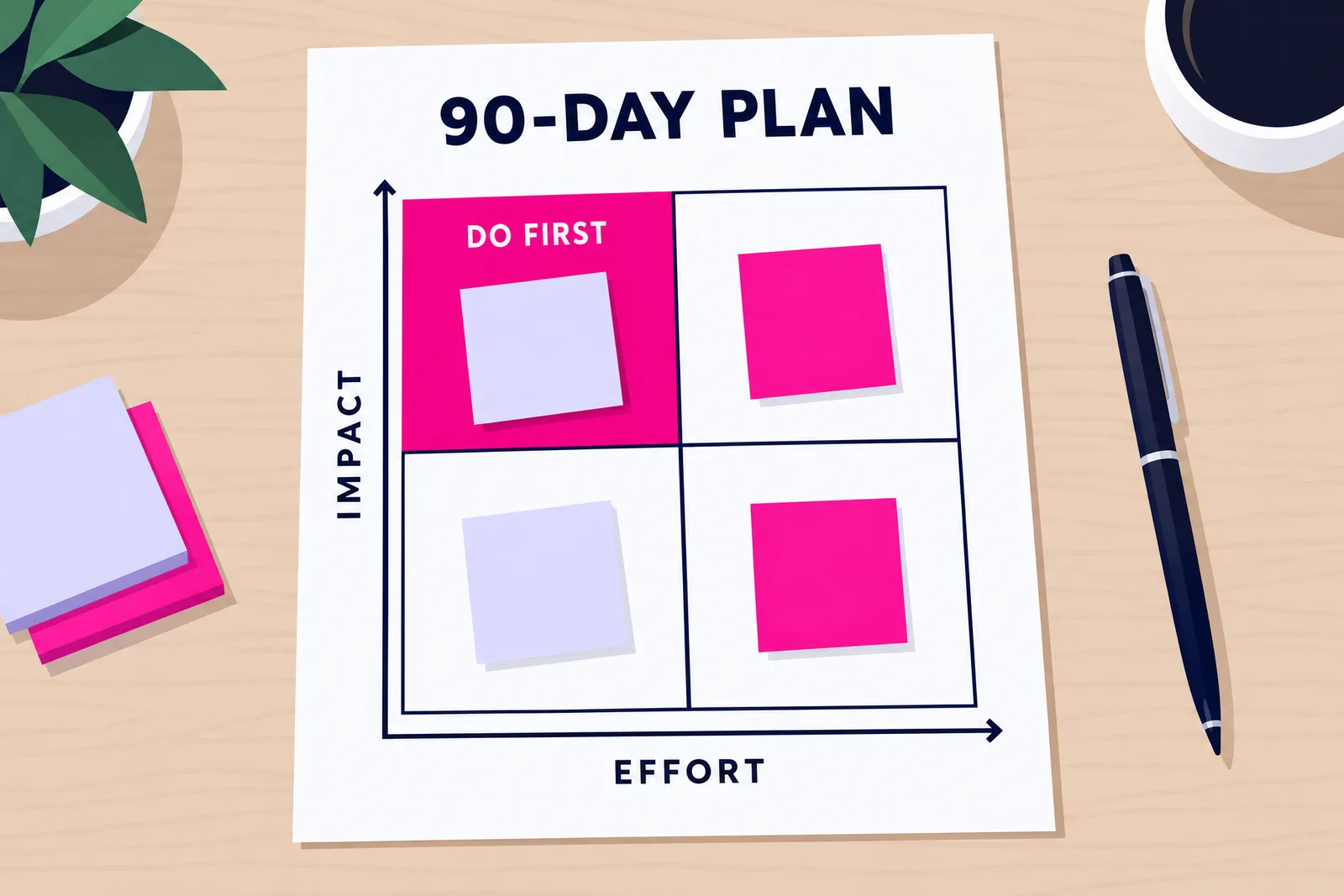
- What it is: a half day in Cardiff for eight to sixteen people, hands-on from the first hour. You find your bottleneck with a simple framework, see the current tool stack in live demos, build something yourself in a lab session and finish a 90-day action plan sorted by impact and effort.
- Best for: sole traders, owners of small teams, and the one person in a company who has been asked to look into AI.
- Watch out for: the content is general by design, so you do the work of applying it to your own business afterwards. A shared room is also the wrong place for confidential client files, so you practise on general examples.
- Cost: from £300 per person.
Whoever runs it, judge a workshop by one question before you book: what will I have built and working when I leave? If the answer is a set of slides, keep looking.
When does a private team session make more sense?
Book a private session when several people need the same skills and you want them practising on your own tools, processes and examples.
- What it is: a half day for your staff, shaped by a short discovery call, run at your premises or a venue anywhere in South Wales.
- Best for: teams that share an inbox, a CRM or a quoting process, where one agreed way of using AI saves everyone working it out separately.
- Watch out for: the session lands best when someone senior is in the room and has already decided which jobs AI is allowed to touch. Agree a simple AI policy first, even a one-page one.
- Cost: from £500 per person, with a minimum booking for smaller teams. It includes a written AI roadmap for the business within five working days.
Informal learning is probably happening in your team already. In the same Access Group research, 30% of employees using AI said they learn through tips shared by colleagues. A team session turns those scattered tips into one method that everyone uses, which also makes the results easier to check.
When is one-to-one AI training worth the extra cost?
One-to-one is worth it when the founder is the bottleneck and AI needs to fit how they actually run the business: their inbox, their documents, their decisions and their week.
I run these sessions myself. My background is in coaching (I started as a sales coach at the AA in 2005), and my view is that adults learn fastest on their own work, with someone beside them correcting in the moment. That is the whole design of the one-to-one format.
- What it is: two hours to a full day on your own laptop and accounts. The two-hour Starter covers a first agent task on real work, a master brief and first context file, and one connected tool. The half day adds a full set of context files about the business, two or three connected tools and one skill built and in use. The full day adds more skills, scheduled inbox triage and an afternoon run as a real workday inside the system.
- Best for: founders who already use ChatGPT or Claude, mostly as a search box, and want it doing real work.
- Watch out for: it is personal. It will not train your team on its own, and it is not an accredited qualification.
- Cost: £495, £895 or £1,495, all + VAT. Sessions run on Zoom, at your office or at our Cardiff office; travel costs may apply for sessions at your office, particularly outside South Wales.
You can see exactly what each level includes on the AI training for founders page.
How do you decide which format is right for your business?
Start with who needs to change how they work, then decide how much of the session has to be about your business specifically. Three questions settle it for most companies.
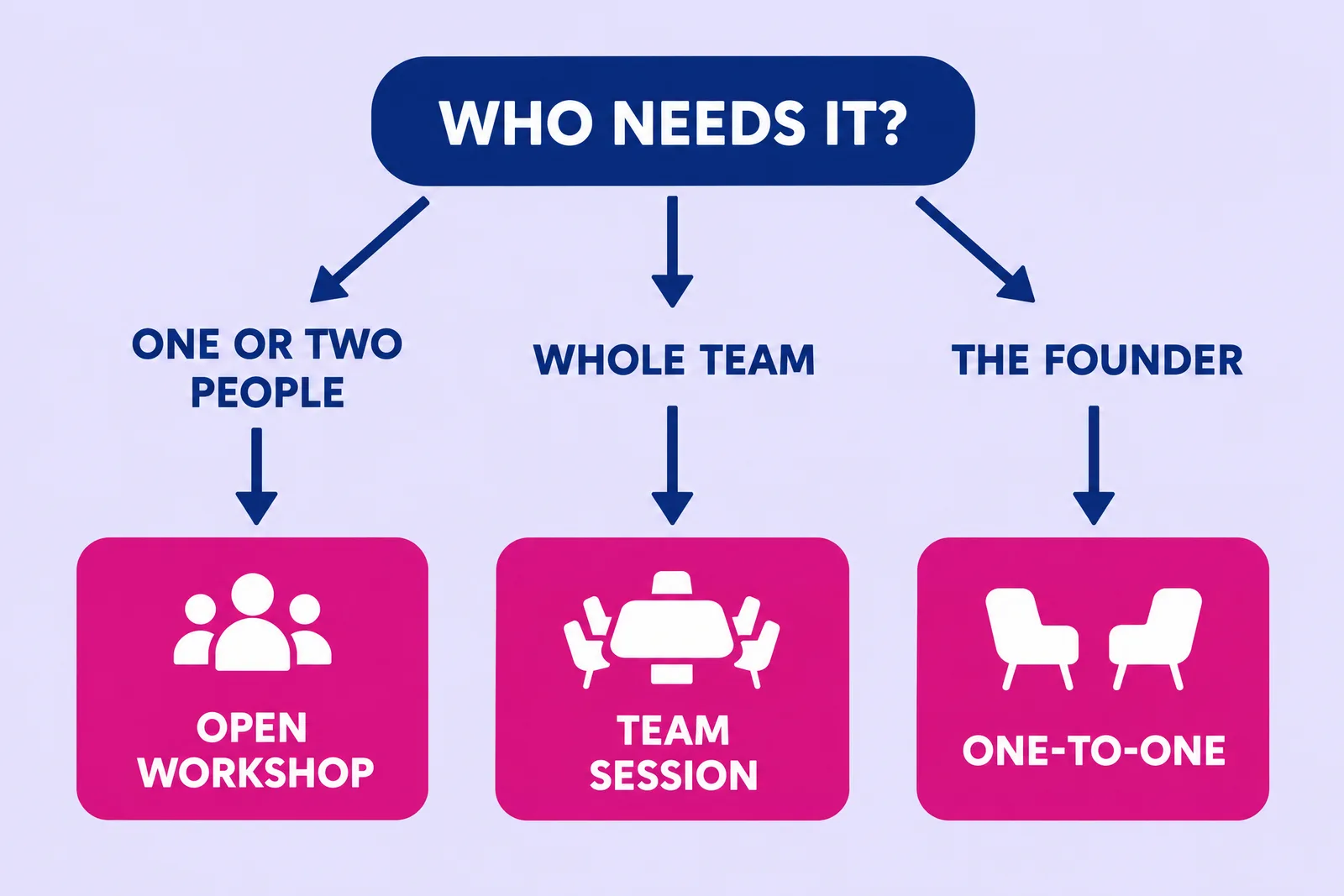
- Who needs it? One person exploring points to an open workshop. Several staff who share tools point to a team session. A founder whose time is the constraint points to one-to-one.
- How specific does it need to be? If a general method is enough to get started, a group works. If it has to run on your own systems and data, it needs to be private.
- What do you want running afterwards? One prompt or automation, a roadmap for the team, or a personal set-up that handles part of your week.
Where this goes wrong: booking a cheap group place for a founder who needs a set-up built around their own inbox and documents, or sending a whole team to a session before anyone has decided which tasks AI may touch.
Should the founder or the team be trained first?
In most owner-led businesses, train the founder first, then the team. The founder decides which jobs AI is allowed to do, what good output looks like and what stays human, and a team session moves much faster once those calls are made.
There are sensible exceptions. If the founder is already a confident user and the team is where the gap sits, go straight to a private session. If the budget only stretches to one place, send the person who will champion AI inside the business to an open workshop and let them bring the 90-day plan back.
Once the founder's own set-up is running, team support can follow on from it: a team foundations session, personal set-ups for key staff and monthly coaching. For ideas on which jobs to hand over first, see these AI automation examples for small businesses.
Is there funded AI training for businesses in Wales?
Some funding exists, and it is worth checking before you pay in full. In January 2026 the Welsh Government announced £2.1 million to help Welsh businesses adopt AI, including £1 million for AI upskilling through the Flexible Skills Programme, where employers pay 25% of AI training costs instead of the usual 50%.
The same package included £600,000 for a Business Wales AI awareness and adoption programme, and £500,000 for in-person AI workshops for tourism and events businesses, run with the Hartree Centre Cardiff Hub and Cardiff University.
Worth knowing: eligibility depends on the course and on your business, so speak to Business Wales before you assume a session qualifies. Our workshops and one-to-one sessions are not accredited qualifications, and we make no claim that they are eligible for funding.
How do you get the most out of any AI training session?
Bring real work. The sessions that change how people work are the ones where everyone arrives with two or three tasks they repeat every week and leaves with at least one of them handled differently.
- Pick your tasks in advance: quotes, follow-up emails, meeting notes, weekly reports or anything else you do on repeat.
- Check which AI tools the business already pays for, and make sure you can log in to them on the day.
- Agree what information can and cannot go into AI tools before the session, so nobody has to guess in the room.
- Book thirty minutes in your diary the following week to use what you built while it is fresh.
Best for results: treat the 90-day plan or written summary as the real product of the session. The hours in the room start the habit; the follow-through over the next few weeks is where the time savings show up. For a wider starting point, our guide to practical AI for small business covers the first steps in more depth.