


Plenty of customers now ask search engines and AI assistants full questions: "do I need planning permission for a garden room in Cardiff?", "how much does a boiler service cost?", "who does same-day key cutting near Pontcanna?". Answer engine optimisation (AEO) is the work of making your business the source those answers come from.
The way those answers reach people has changed quickly this year. Ofcom research published in April 2026 found that 54% of UK adults use AI tools such as ChatGPT, Copilot or Gemini. Inside Google, the "People also ask" boxes now mostly show AI-generated answers: AlsoAsked's analysis of 19.2 million English-language results, reported by Search Engine Roundtable, put the share at 97% in the first week of September 2026, up from 86% in August. Google also stopped showing FAQ rich results on 7 May 2026, which removes one of the tactics many AEO offers were built around.
This guide covers what an AEO service in Cardiff should include, how it fits with SEO and GEO, what an answer-first page looks like in practice, the questions to ask a provider and how to measure results. If you want a quick read on where you stand first, our free AI visibility check scores your business against 15 signals.
What does an AEO service actually do?
An AEO service makes your business the clearest, most quotable answer to the specific questions your customers ask, wherever they ask them. That covers Google's AI Overviews and "People also ask" boxes, AI assistants such as ChatGPT, Copilot and Gemini, and voice assistants that read out a single reply.
The work itself is practical. Someone finds the questions that lead to enquiries, rewrites the pages that should answer them so the answer comes first, keeps your business details identical everywhere they appear, adds structured data where it is accurate and useful, and checks every month whether you are being quoted. If the term is new to you, our explainer on what answer engine optimisation is covers the basics.
At the end of each month you should be able to see the question list, the pages that changed, the listings that were corrected and a record of where you were cited. If a provider cannot show you those, it is hard to know what you are paying for.
How does AEO fit alongside SEO and GEO?
AEO sits between SEO and GEO and shares most of its work with both. SEO earns rankings for searches, AEO earns the quoted answer to a specific question, and GEO earns a mention when an AI tool summarises or recommends businesses. The same strong pages and consistent facts feed all three.
Google's own guide to optimising for its generative AI features, updated in July 2026, says that optimising for generative AI search is still SEO. The lines have blurred further since "People also ask" became largely AI-generated, because those question boxes are now AI answers themselves.
| SEO | AEO | GEO | |
|---|---|---|---|
| Main aim | Rank pages for searches | Be the quoted answer to a specific question | Be named when AI tools summarise or recommend |
| Where it shows | Google and Bing results, the map pack | AI Overviews, "People also ask", assistant and voice replies | ChatGPT, Gemini, Copilot, Perplexity, AI Mode |
| Core work | Technical health, content, links, local listings | Question research, answer-first pages, structured data, consistent facts | Access for AI crawlers, consistent listings, reviews and mentions |
| What to measure | Rankings, clicks, enquiries | Citations for a fixed question set, AI impressions | Share of AI answers that name you |
Worth knowing: because the overlap is so large, most businesses are better served by one joined-up piece of work than by three separate retainers. Our guide to GEO services in Cardiff covers the recommendation side in more detail.
What should an AEO service include?
A complete AEO service covers five pieces of work: question research, answer-first pages, accurate structured data, consistent local details and citation tracking. Each should appear in a proposal as something you can see and check.
- Question research. What it is: a list of the real questions your customers ask before they buy, gathered from your inbox, call notes and reviews, plus "People also ask", Search Console queries and Bing's grounding queries, then grouped by service. Best for: deciding which pages to fix first. Watch out for: question lists pulled entirely from a keyword tool, which miss the awkward questions that decide a sale, such as price, timing and what happens if something goes wrong.
- Answer-first pages. What it is: your service, location and pricing pages rewritten so each question gets a direct answer in its opening one or two sentences, followed by the detail. Best for: the pages closest to an enquiry. Watch out for: hundreds of thin question pages created for every variation, which help nobody and dilute the pages that matter.
- Structured data. What it is: accurate schema markup describing your business, services and opening hours, matched to what is visible on the page. Best for: making the facts about your business unambiguous. Watch out for: anyone still selling FAQ schema as a route to extra space in Google. That feature has gone, as the section below explains.
- Consistent local details. What it is: your name, address, phone number, hours, services and areas checked and matched across your website, Google Business Profile, Bing Places, Apple Business Connect and the directories in your sector. Best for: any business with local customers. Watch out for: old addresses and numbers left on directories years ago, which give answer engines two versions of the truth.
- Citation tracking. What it is: a fixed set of questions checked every month across Google and the main assistants, plus Google's and Microsoft's AI reports, recording where your pages are cited. Best for: showing whether the work is having an effect. Watch out for: a single screenshot of an assistant naming you, presented as a result.
Ask any provider, including us through Roddy Digital's AEO service, to show where each of these sits in their proposal and who does it.
What does an answer-first page look like?
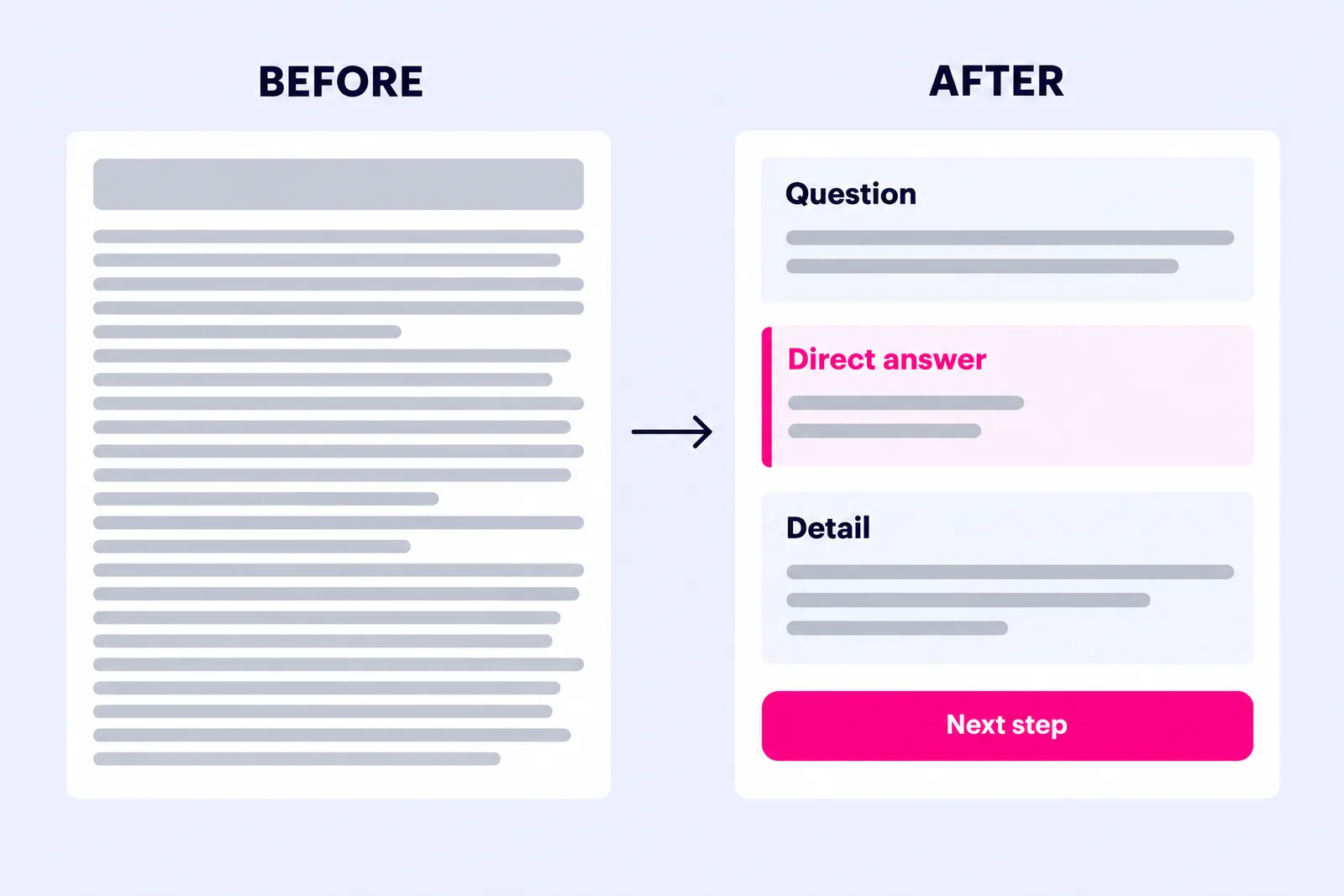
An answer-first page puts a plain, direct answer immediately under each question, then gives the detail, the proof and the next step. It reads well to a person in a hurry and gives an answer engine a clean passage to quote.
Take a hypothetical example: an emergency electrician in Cardiff whose customers often ask "do you charge a call-out fee?". A typical version of that page opens with a paragraph about experience and values, mentions call-outs halfway down and never gives a straight answer. The answer-first version is built like this:
- Question as the heading: "Do you charge a call-out fee in Cardiff?"
- Direct answer in one or two sentences: whether there is a fee, what it covers, and whether it comes off the bill if the customer goes ahead with the work.
- Detail: how evening and weekend calls differ, which areas are covered and how quickly someone usually arrives.
- Proof: a short review that mentions a call-out, or an accreditation the business actually holds.
- Next step: one clear way to book, with the phone number written as text so it can be read and quoted.
Where this goes wrong: businesses avoid a straight answer on price or timing because "it depends". It usually does, so say what it depends on and give a range where you can. An honest "from" price or typical timescale helps the reader decide, and gives an answer engine something concrete to quote.
Visible FAQs still earn their place on these pages. Keep them to the questions the rest of the page has not already answered, and make each answer self-contained so it still makes sense when lifted out on its own.
Does structured data still matter now FAQ rich results have gone?
Yes, as a way of describing your business accurately. What FAQ markup can no longer do is win extra space in the results: Google stopped showing FAQ rich results on 7 May 2026 and has since removed the feature's documentation, so the expandable questions under a listing that many AEO packages promised are gone.
Google's AI optimisation guide states that structured data is not required for generative AI search and that there is no special schema to add for it. It still recommends structured data as part of normal SEO, because it supports eligibility for the rich results Google continues to show.
In practice, a sensible AEO service will:
- Mark up your business accurately: organisation or local business details, services and opening hours that match your website and listings exactly.
- Stop selling FAQ markup for search appearance: removing existing FAQ markup is rarely a priority, but paying for more of it to win space in Google no longer makes sense.
- Treat AI-only files with care: Google says it does not use llms.txt or similar files for Search. They may matter to other services, but they are no substitute for clear pages.
Worth knowing: if an AEO proposal still leads with FAQ schema, ask when it was written. It is a quick way to tell whether a provider is keeping up.
Which questions should you ask an AEO provider?
Ask where their questions come from, what they will change on your site in the first month and how they will show you citations. The answers quickly separate practical work from repackaged SEO.
| Question to ask | A good answer sounds like | A red flag |
|---|---|---|
| Where will the question list come from? | Your enquiries, calls and reviews, plus search data, grouped by service | A keyword tool export with no input from you |
| Can you show me one of our pages rewritten answer-first? | A sample rewrite of a real page before you sign | Only examples from other sectors |
| What structured data will you add, and why? | Accurate business and service markup that matches the page | FAQ schema sold as a way to win more space in Google |
| Which answer engines will you check, and how often? | Google plus the assistants your customers use, every month, with repeat runs | One check per tool, or no named tools |
| How will you report citations? | A fixed question set, Search Console and Bing AI reports, and enquiries | A single visibility score you cannot inspect |
| How does this fit with our current SEO? | A clear split of what overlaps and what is new | A separate audit that repeats work you already pay for |
| Who owns the pages and listings? | You do, with every login in your business's name | Accounts held by the provider |
Treat any guaranteed featured answer or AI placement as a red flag. Google's guidance says no third-party tool has access to its internal ranking or AI systems, and no outside agency controls what an assistant says on a given day.
How should you measure AEO results?
Measure citations: how often your pages are quoted or linked as the source of an answer, across a fixed list of questions, month on month. Rankings still matter, but they will not tell you whether yours was the page quoted.
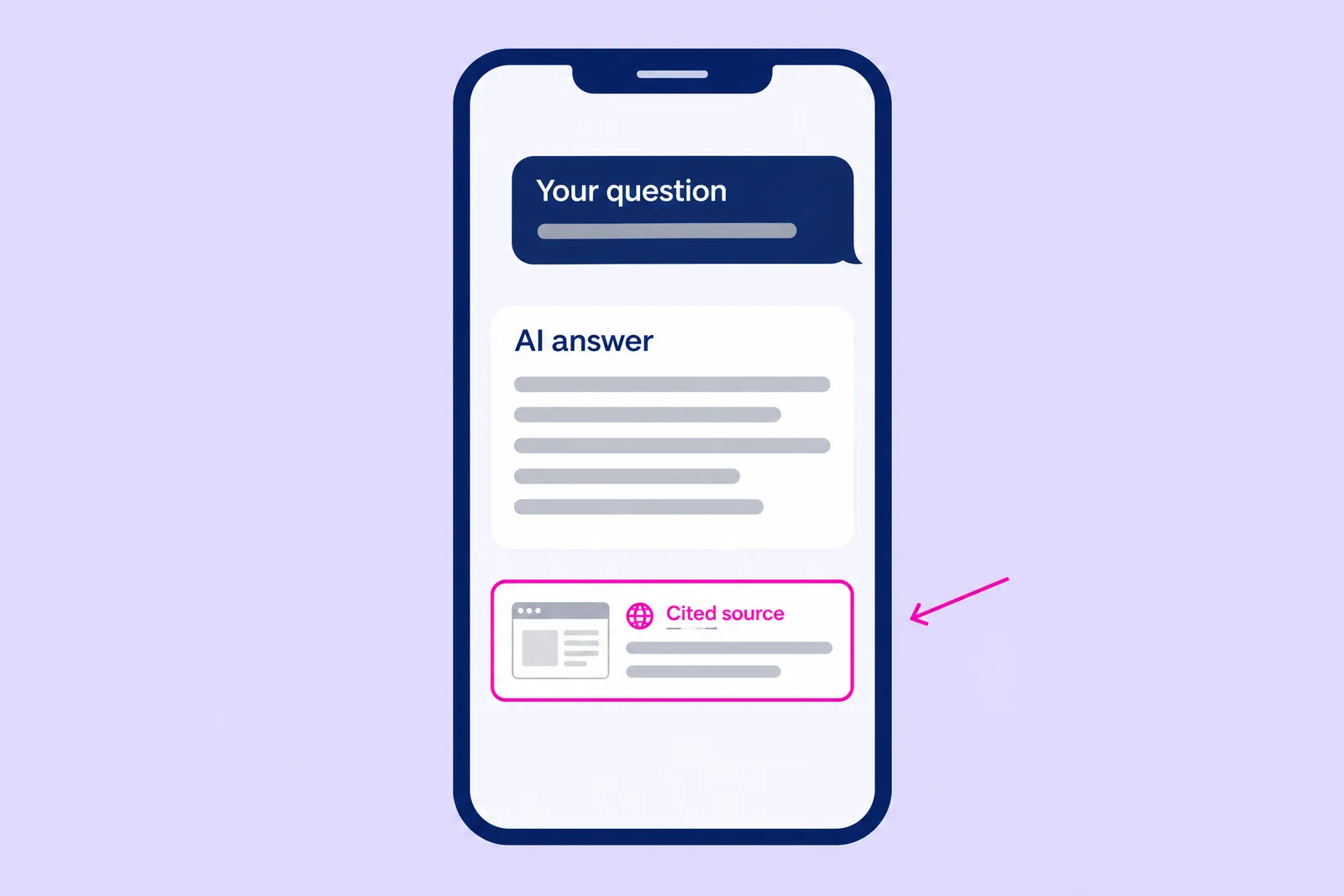
Four sources give you a reliable picture:
- Your question set: the questions from your research, checked monthly in Google and the assistants your customers use. Run each question more than once, because AI answers vary from run to run, and log whether you were cited, which page was used and who else appeared.
- Google Search Console: the generative AI performance report, available to all websites since 31 August 2026, shows impressions in AI Overviews and AI Mode by page. It shows no clicks or queries, so read it as a visibility signal.
- Bing Webmaster Tools: Microsoft's AI Performance report, in public preview since February 2026, shows how often your pages are cited in Copilot and other AI answers, and the grounding queries behind those citations. For AEO, those grounding queries are a ready-made list of questions you are already trusted to answer.
- Your enquiries: ask every new enquiry how they found you, and add an AI assistant as an option on your enquiry form.
Give it three months before you judge it. Some fixes land quickly: OpenAI says robots.txt changes reach its search systems in around 24 hours. Rewritten pages and corrected listings take longer to change what answer engines say about you.
What should AEO look like for a Cardiff business?
For a Cardiff business, AEO starts with the local questions that include a place, a timescale or a price, such as "can someone fix a leaking roof in Whitchurch this week?" or "how much is a family law consultation in Cardiff?". Those questions sit closest to an enquiry, so they should shape your page list.
Three local details carry extra weight. First, the facts about your business need to match everywhere: your website, Google Business Profile, Bing Places and Apple Business Connect, plus Cardiff and Welsh directories and trade bodies. Second, areas: if you cover Penarth, Barry, Caerphilly or the Vale of Glamorgan, say so in plain sentences on the pages that answer the questions; a list of place names in the footer tells an answer engine very little. Third, local answers: deal with the questions specific to working here, such as parking and access in the city centre or how quickly you can reach the outskirts.
Organic search still carries a lot of weight for local businesses. For Pest & Property Solutions, a Cardiff pest control company whose new site we launched in June 2026, 82.7% of enquiries in the first 36 days came from Google organic search (our own figures, set out in the Pest & Property case study). Our guide to SEO in Cardiff covers that side, and in my view a Cardiff AEO service that ignores it is missing its foundation.
How should an AEO service be priced?
Expect the price to follow the scope of work, and ask for it in parts so you can compare quotes. A useful split is question research and audit, page rewrites, listings and structured data, and monthly tracking and reporting. That shows whether you are paying for work or for software, and where an AEO quote overlaps with SEO you already pay for.
A monthly AEO service suits businesses whose customers ask a lot of questions before they buy, such as professional services, trades, clinics and hospitality. If you have a small site and a handful of services, a one-off round of question research and page rewrites may be all you need, followed by a quarterly check of the same questions.