

If your business does not show up when someone nearby searches for what you sell, the cause is rarely bad luck or a lack of budget. Google is trying to answer one question for every search: which result is the most relevant, credible and useful for this person, in this place, right now? Getting found means giving it clear, consistent evidence that the answer is you.
The page that evidence lands on has changed a lot. A Google results page in 2026 can hold an AI Overview, the map pack, ads, a "People also ask" box and the classic blue links all at once, and Ofcom found that about 30% of UK searches now show an AI Overview. That changes where the clicks go. The groundwork Google rewards has stayed remarkably stable.
I have spent fifteen years building websites and running digital marketing, for national brands and small local companies, and the businesses that get found consistently do the same handful of things well. This guide sets them out in plain English, with a realistic timeline and a list of things you can do this week.
How does a small business actually get found on Google?
By building four layers of signals that together tell Google you are relevant, credible and close to the person searching. I call it the findability stack. Most businesses have one or two layers by accident. The ones that turn up for the searches that matter have built all four on purpose.
- A findable website. Fast, technically sound and structured so Google can crawl it, read it and understand what you do and where you do it.
- Relevant content. Pages that match the words and questions your customers actually type.
- Authority and local signals. Reviews, a complete Google Business Profile, consistent contact details, and mentions or links from other credible sites.
- Answer readiness. Clear, structured, quotable information that AI Overviews, AI Mode and tools like ChatGPT can lift and cite.
Each layer depends on the one beneath it. Great content on a site Google cannot crawl goes nowhere, and a stack of reviews will do little for a profile listed under the wrong category. Build the layers in order and the effort compounds.
Before you change anything, see what Google sees. Search your main service plus your town in a private browser window and note whether you appear in the map, the organic results or neither. Then check Google Search Console, which is free, for the searches that already show your site. That is your baseline.
What does Google need from your website?
Before Google can rank a page it has to find it, crawl it and index it. Plenty of small business sites fall at this hurdle: pages blocked by a setting left over from the build, or a domain move without redirects. The page indexing report in Search Console shows exactly which pages Google has and has not indexed, and why.
Once Google can read the site, speed and usability matter. Google's Core Web Vitals guidance asks for the main content to load within 2.5 seconds, for the page to respond to a tap or click in under 200 milliseconds, and for a layout shift score under 0.1. In plain terms, you need a site that feels instant on a mid-range phone on mobile data, because that is how most of your customers will first meet it.
Structure matters as much as speed. These are the practical rules I build to on every website design project:
- One page per service. A single "Services" page that gives eight offers a paragraph each leaves Google very little to match. A dedicated page for each service, with real detail, typical costs where you can share them and answers to common questions, gives it something specific for every search.
- Say where you work. Your town and the areas you cover belong in the copy and page titles wherever they are true.
- Write a unique page title and meta description for each page. They are what people see in the results, so treat them like the sign above your door.
- Link your pages together. Internal links help Google discover pages and understand which ones matter most.
- Make contact obvious. Phone number, enquiry form and opening hours visible on every page, so the traffic you earn turns into enquiries.
That last point is where visibility becomes revenue. Our guide to building a website that generates enquiries covers the conversion side in detail.
How do you know what to write about?
Write in the words your customers use. A plumber's customers search "boiler not firing up" and "emergency plumber near me"; very few type "domestic heating diagnostics". An accountant's prospects ask "do I need to register for VAT" long before they search for "compliance services". Match their language and you become the relevant result.
You probably already have most of the right topics. Three places to look this week:
- Your inbox and phone. Write down every question a customer or prospect asked in the last month. Each one is a potential page, section or FAQ.
- Search Console. The performance report lists the real searches that already surface your site. Queries with plenty of impressions and few clicks point to pages worth improving.
- Google itself. Search your core service and read the "People also ask" box and the related searches at the foot of the page. That is Google showing you what people want to know.
Then answer those questions properly. A good service page explains what the service is, who it suits, how it works, what affects the cost and what happens next. A good article answers one question thoroughly and links to the service it relates to.
Google's core updates keep reinforcing this. The March 2026 core update finished rolling out on 8 April, according to Search Engine Journal, and Google described it as an update to better surface relevant, satisfying content.
How do you win local search and the map pack?
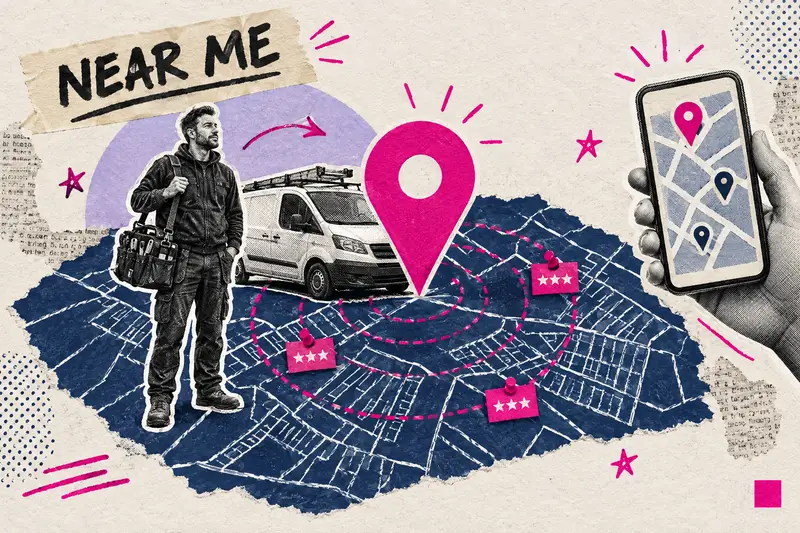
For any business serving a local area, the Google Business Profile is as important as the website and sometimes more so, because it powers the map pack and most "near me" results. Google says local results are based mainly on relevance, distance and how well known a business is, and that there is no way to request or pay for a better local ranking. Distance you cannot change. The other two you can work on every week.
- Complete every field. Primary and secondary categories, services, hours, description, service areas and real photos. Google states that businesses with complete and accurate information are more likely to show in local results.
- Gather reviews continuously. Google's same guidance says more reviews and positive ratings can help local ranking. Recency matters to customers as well: BrightLocal's 2026 Local Consumer Review Survey of US consumers found 74% look for reviews written in the last three months.
- Reply to every review. In the same survey, 89% of consumers said they expect business owners to respond.
- Keep your name, address and phone number identical on your website, your profile and every directory listing. Inconsistent details weaken the signals pointing at you.
- Post updates and fresh photos of recent work so the profile looks active and current.
Here is what that looks like in Cardiff. We built a new website for Pest & Property Solutions, a Cardiff pest control company, which went live in June 2026 and brought in 112 enquiries in its first 36 days. 82.7% of those enquiries came from Google organic search, and the business now averages about four enquiries a day from organic traffic. Its 344 Google reviews do a lot of the convincing once people land. For trades and other call-out businesses, the full local playbook is in Local SEO for Tradespeople.
How do AI Overviews and AI Mode change getting found?
They change where the clicks go. Google's AI Mode, a conversational search tab, launched in the UK in July 2025. When Pew Research tracked real browsing behaviour, users who saw an AI summary clicked a traditional result in 8% of visits, against 15% when no summary appeared, and clicked a link inside the summary itself in just 1% of visits.
People are also asking AI assistants directly. Ofcom reports that ChatGPT received 1.8 billion UK visits in the first eight months of 2025, and BrightLocal found 45% of US consumers now use ChatGPT and similar tools for local recommendations, up from 6% a year earlier.
The reassuring part is that Google's own guidance for site owners says there are no additional requirements or special optimisations needed to appear in AI Overviews or AI Mode. A page must be indexed and eligible to show a snippet, and the usual good practice applies. So the work in the sections above is also the work for AI search. Three habits make it count for more:
- Question-led structure. Use the questions people ask as headings and answer each one in the first sentence or two underneath.
- Specific, quotable facts. Prices from, areas covered, accreditations, typical turnaround. Vague copy gives an AI system nothing to cite.
- Consistency everywhere. Your website, Business Profile and directory listings should describe the same business in the same terms. Google's guidance specifically mentions keeping Business Profile information current.
We call the combined approach SEO, AEO and GEO. If you want a quick read on where you stand, our free Cited AI visibility check scores 15 signals that affect whether AI tools can find and recommend your business.
How long does it take to get found on Google?
Longer than ads, and the results last far longer. Google's Maile Ohye put it plainly: in most cases an SEO will need four months to a year to implement improvements and then see the potential benefit. Google is equally blunt that no one can guarantee a #1 ranking, so treat any promise of one as a warning sign.
| Stage | What usually happens |
|---|---|
| First few weeks | Technical fixes, a completed Business Profile and fresh reviews; map pack visibility is often the first thing to move |
| First few months | Google re-crawls improved pages; early ranking movement on less competitive searches |
| Four months to a year | Service pages and articles settle into stronger positions; organic enquiries become dependable |
| Beyond a year | Visibility compounds as content, reviews and links build on each other |
The pace depends on competition. Ranking for a specialist service in a market town is quicker than ranking for a crowded service across a whole city. The pattern that holds everywhere is that organic visibility keeps working after the effort is done, whereas paid ads stop the day the budget does.
What can you do this week to get found on Google?
- Search your main service and town in a private window and note exactly where you appear.
- Set up or check Google Search Console, submit your sitemap and look at the page indexing report.
- Open your Google Business Profile and fill every empty field, including services and service areas.
- Send your direct review link to every customer you served in the last month.
- Pick the three questions customers ask most and make sure each has a clear answer on your site.
- Check your name, address and phone number match exactly across your website, profile and the main directories.
None of these costs anything but time, and together they strengthen every layer of the stack.