

Website development is the part of a new website you never see and always feel. It decides whether your enquiry form reaches the right person, whether pages load quickly on a phone in a car park in Canton, and whether the site is still secure and up to date a year after launch. Design gets the attention in most Cardiff website conversations. The build is where projects quietly succeed or fail.
This guide covers what website development includes, how to choose a platform, what a site should connect to, how long a build takes, what it costs and the questions worth asking a developer before you sign. If you want to see how we package all of this into a fixed monthly price, our website packages set out exactly what is included.
What does website development cover for a Cardiff business?
Website development covers everything that turns an agreed design into a working, fast, secure site: choosing the platform, building the pages, connecting forms and tools, setting up tracking, hosting, and keeping it patched after launch.
For a typical service business, a sound build includes:
- Platform and build: the system the site runs on and pages built from reusable templates, so adding a new service page later does not mean starting from scratch.
- Forms and integrations: enquiries, bookings and payments flowing into the tools you already use.
- Performance: optimised images, clean code and caching so pages load quickly on mobile data.
- Search foundations: sensible URLs, page titles, structured data, an XML sitemap and redirects from any old pages.
- Tracking: GA4 and Google Search Console set up so you can see which pages produce enquiries.
- Hosting, security and care: SSL, backups, updates and someone responsible when something breaks.
We have written a separate explainer on the difference between website development and website design if you are trying to work out which skills a project needs. This article stays on the build side.
Which platform should your website be built on?
Pick the platform that fits what the site needs to do in two years, then check you will own it and can move it if you change developer. For most service businesses that means WordPress or a well-built hosted platform; custom builds earn their cost only when the site does something genuinely bespoke.
For context, W3Techs data reported by Search Engine Journal in November 2026 puts WordPress on 39.2% of all websites, with Shopify on 5.4%, Wix on 4.2% and Squarespace on 2.4%. Popularity is useful because it means plenty of developers and plugins. It is not a reason on its own to choose a platform.
WordPress
An open-source content management system you can host anywhere. Best for: service businesses that want lots of pages, a blog and full control over search set-up. Watch out for: plugin sprawl. Every plugin is code someone else maintains, and each one needs updating.
Hosted website builders (Wix, Squarespace and similar)
All-in-one platforms where hosting, security and updates are handled for you. Best for: small brochure sites run by the owner. Watch out for: limits on integrations and speed tuning, and moving away later usually means a rebuild.
Shopify
A hosted ecommerce platform. Best for: businesses whose main job online is selling products. Watch out for: monthly app costs that add up, and less flexibility for content-led service pages.
Custom or headless builds
A site written in a modern framework, often with content managed separately. Best for: sites that behave more like software, with customer logins, quoting tools or complex data. Watch out for: higher build cost and a dependency on developers who know the stack. If your project is heading this way, our guide to what a web app costs in the UK is the better starting point.
What should a new website connect to?
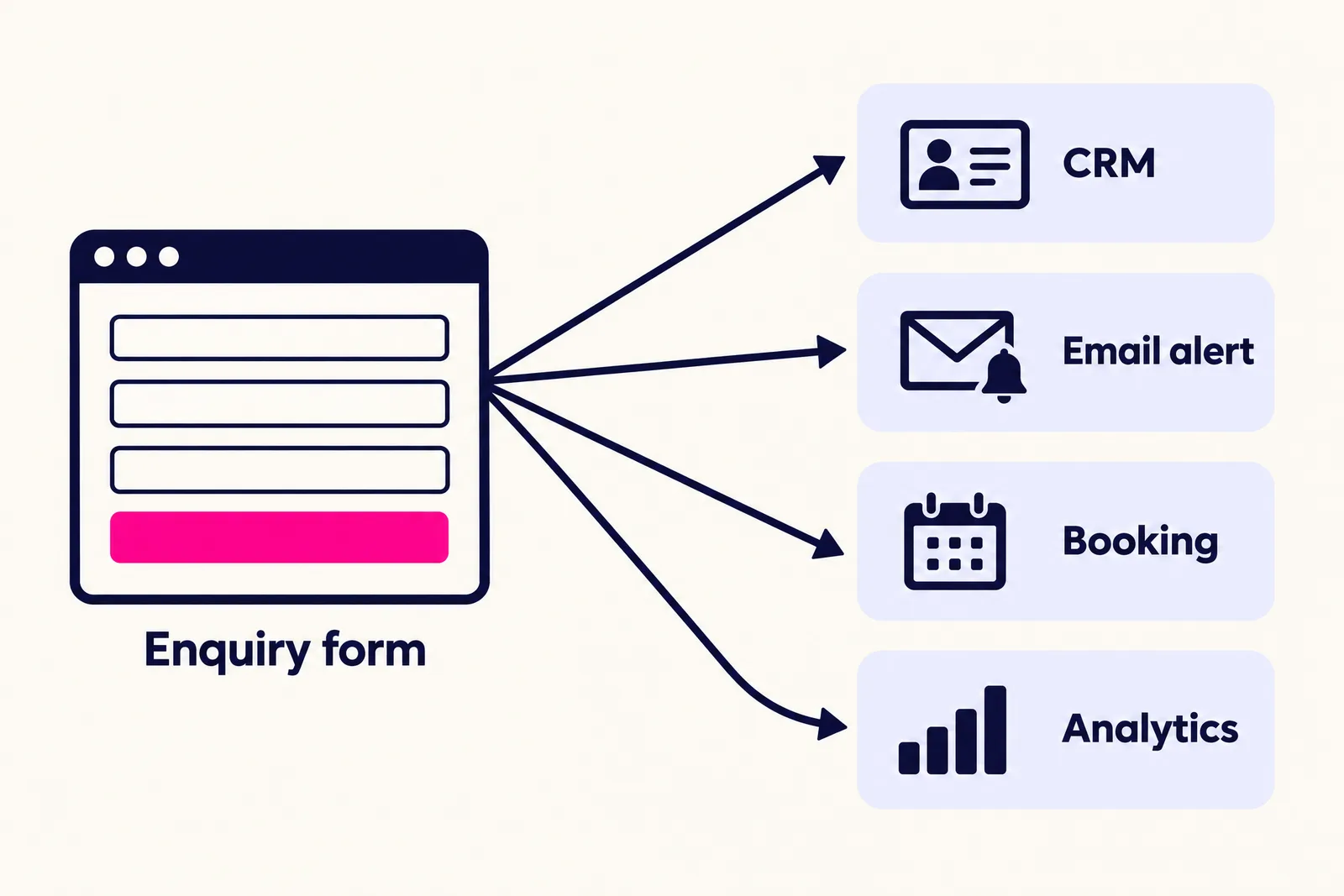
A business website should pass every enquiry straight into the systems that act on it: your CRM or enquiry list, an instant alert to whoever responds, your booking tool if you take appointments, and analytics so you can see where the enquiry came from. A form that only sends an email to one inbox is the weakest link in most small business sites.
The integrations worth scoping at the start:
- Forms to CRM: each enquiry lands as a record with the page it came from, ready for follow-up.
- Alerts: an email or text to the person who answers, so new enquiries are seen within minutes.
- Bookings and payments: a calendar or deposit step where it saves a phone call.
- Analytics events: form submissions and phone clicks tracked as conversions in GA4.
- Google Business Profile: consistent name, address and phone details, with the site linked from the profile.
Where this goes wrong: integrations bolted on after launch. When forms, tracking and alerts are planned in the build, they get tested properly. When they are added later, enquiries go missing and nobody notices until a customer chases.
How fast, secure and compliant should a new website be?
A new website should meet Google's Core Web Vitals, follow accessibility good practice, handle cookies lawfully and be kept patched. Google's Web Vitals guidance sets the targets: the main content should load within 2.5 seconds (Largest Contentful Paint), the page should respond to taps within 200 milliseconds (Interaction to Next Paint), and layout shift should stay at 0.1 or less.
Ask any developer how they will measure those numbers, on real mobile devices as well as a fast office connection.
Accessibility
The strict accessibility regulations apply to public sector websites, but GOV.UK guidance is clear that all UK service providers must make reasonable adjustments under the Equality Act 2010. In practice that means readable contrast, proper headings, alt text, labelled form fields and a site that works with a keyboard. It also tends to make the site clearer for everyone.
Cookies
The ICO now recognises a statistical purposes exception for analytics used only to improve your site, provided you explain it clearly and give people a simple, free way to object. Advertising cookies still need consent. A developer should set this up deliberately, so a consent banner is not just copied from another site.
Security
On WordPress in particular, the risk sits in add-ons. Patchstack found that 91% of new WordPress vulnerabilities reported in 2025 were in plugins. Fewer, well-maintained plugins and a clear update routine matter more than any single security tool.
How long does website development take?
A well-scoped business website can go from kick-off to launch in about a month; our packages commit to going live in 30 days. Larger sites, ecommerce builds and anything with custom features take longer, and the timeline depends as much on how quickly content and decisions arrive as on the build itself.
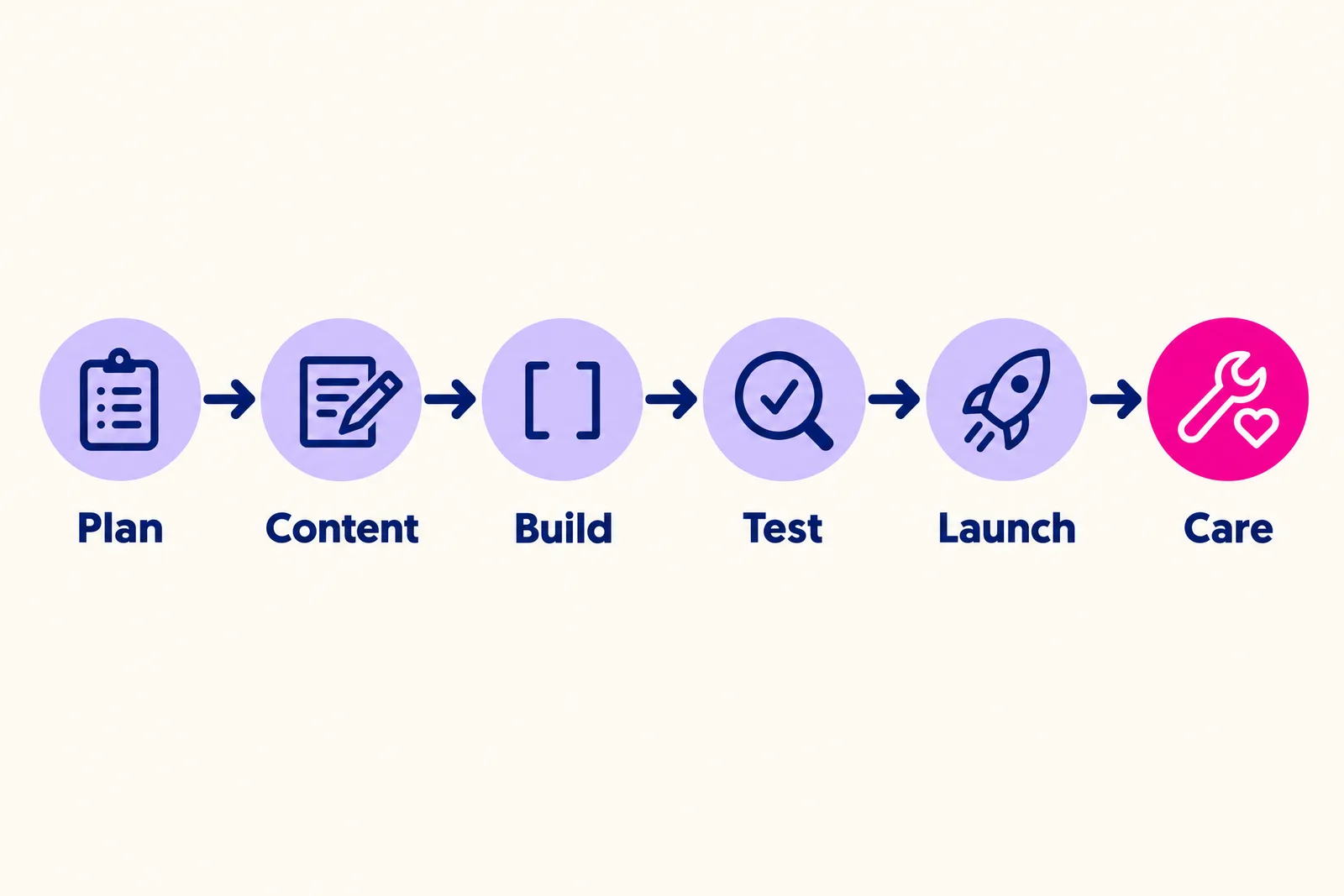
Most builds move through six stages:
- Plan: agree goals, pages, integrations and who signs off what.
- Content: write and gather copy, photos, reviews and case studies.
- Build: develop templates and pages, connect forms and tools.
- Test: check every form, every device, speed, redirects and tracking.
- Launch: switch the domain, submit the sitemap, watch for errors.
- Care: updates, backups, fixes and improvements from week one.
Content is the stage I see hold up the most projects, so start writing before the build begins. Have access to your domain registrar, Google Business Profile and any existing analytics ready on day one. If you are replacing an old site, our website redesign checklist covers the redirects and baselines to sort first.
What does website development cost in Cardiff?
Cost depends on page count, platform, integrations and whether ongoing care is included. Our fixed-scope packages run from £350 to £1,000 a month + VAT on a 12-month term, with design, build, copywriting, hosting and care included. One-off builds from freelancers and agencies are priced differently, and we have compared the options in our guide to how much a website costs in Cardiff.
| Package | Pages | Price (+ VAT) | Best for |
|---|---|---|---|
| Kickstart | Up to 10 | £350 a month | A focused service business that needs a site which produces enquiries |
| Accelerate | Up to 25 | £650 a month | Several services or locations, each with its own page |
| Launch Pad | Up to 50 | £1,000 a month | Larger sites with broad service and location coverage |
Every package includes design and build, copywriting, on-page SEO foundations, GA4 and Search Console, Google Business Profile set-up, hosting, SSL, security and backups, with the site live in 30 days. Development work outside a package, such as a new integration, is billed at £95 an hour + VAT.
Worth knowing: when you compare quotes, check what happens after launch. A cheaper one-off build that leaves hosting, updates and fixes to you often costs more over two years once you add those back in.
What should you ask a website developer before you sign?
Ask who owns the site and domain, who keeps it updated, how enquiries will reach you and what happens if you part ways. The answers tell you more about a developer than their portfolio does.
- Who owns the domain, the content and the site? The domain should be registered in your business's name, with access you hold.
- What platform will you use, and why for us? Listen for a reason linked to your goals.
- Where will it be hosted, and who applies updates? Get a named person or team and a routine.
- How will form enquiries reach us, and how will you test that? Ask to see the test on launch day.
- How will you measure speed and accessibility? Expect Core Web Vitals figures measured on mobile and a short accessibility check.
- What is included in care, and what is billed by the hour? Small changes, plugin updates and fixes should be spelt out.
- How are backups taken, and how quickly can you restore one? A backup nobody has tested is a hope.
- If we leave, what do we take with us? You should be able to move the site and its content without starting again.
Where should a Cardiff business start with website development?
Start with the job the website has to do, usually producing enquiries from local search, then work back to the build that supports it. Write down your services, the areas you cover and where enquiries need to go, and give that to every developer you speak to so the quotes are comparable.
For most companies in Cardiff and South Wales, that means a fast site with a page for each service and the areas you serve, forms wired into a simple follow-up process, and a Google Business Profile linked to it. When we rebuilt the site for Cardiff pest control company Pest & Property Solutions in June 2026, it produced 112 enquiries in its first 36 days, with 82.7% coming from Google organic search. Those figures are first-party data from the project, set out in our Pest & Property case study. The build behind it followed the basics in this guide: fast pages, a page for each service, tracking from day one and forms routed straight to the team.
If you are weighing up options, book a Zoom call and we will tell you plainly which platform and package fits, including when a simpler option would do the job.