
Search for website design in Cardiff and you get a page of agencies, freelancers and builders who all promise beautiful, bespoke, results-driven sites. From the outside they look much the same. The difference shows up six months after launch, when one site is bringing in steady enquiries and the other is a good-looking brochure that nobody finds.
I have spent more than twenty years in sales and marketing, fifteen of them in websites and digital marketing, and I now run Roddy Digital, an AI-first agency in Pontcanna. So read this knowing I am one of the options on your list. This guide sets out what good website design looks like in 2026, a ten-minute test you can run on any designer's past work, the questions worth asking before you sign, and what a fixed-scope package should include. If you want to see how ours compare, our website packages are published with prices.
What does good website design look like for a Cardiff business in 2026?
Good website design in 2026 means a site a customer can understand, trust and contact you from on a phone within a few seconds. Looks still matter, because people judge quickly, but a good-looking site that loads slowly or hides the phone number loses the enquiry anyway.
When you look at any designer's work, these are the qualities to check for:
- Built for the phone first. Ofcom's Online Nation report, published in December 2025, found UK adults spend an average of four and a half hours online a day, and most of that time is on a smartphone. A site should be designed and tested on a phone before anyone admires it on a desktop monitor.
- A first screen that answers three questions: what you do, where you do it, and what the visitor should do next.
- Fast in real use. Google's Core Web Vitals treat a page as good when its main content appears within 2.5 seconds, it responds to a tap within 200 milliseconds and the layout barely shifts as it loads (a layout shift score of 0.1 or less), measured across at least 75% of real visits.
- Usable by everyone. The Equality Act 2010 applies to private businesses as well as public bodies, and disability charity Scope points out that it covers websites and apps. WCAG 2.2, the current W3C accessibility standard, is a sensible benchmark: readable contrast, pages that work with a keyboard, clearly labelled forms and buttons large enough to tap.
- Written so search engines and AI tools can quote it. Ofcom found roughly three in ten searches now show an AI Overview, and Google launched AI Mode in the UK in July 2025. A page for each service, with clear headings and direct answers to the questions customers ask, gives both something to work with.
- An enquiry path with no dead ends: a phone number you can tap, a short form, a clear message once it is sent, and an alert that reaches you quickly.
- Proof that feels real and local: genuine reviews, photos of your own team and work, and named projects.
Worth knowing: none of this needs an unusual design. Most of it comes from decisions made before anyone opens a design tool, such as what each page is for, what it says and what you want the visitor to do next.
How do you compare website design options in Cardiff?
You have four realistic routes in Cardiff: a DIY website builder, a freelance designer, an agency on a one-off project, or a monthly fixed-scope package. Each suits a different business, so compare them on the same points before you compare prices.
| Route | What it is | Best for | Watch out for |
|---|---|---|---|
| DIY website builder | A template platform you set up and edit yourself | Very early businesses with more time than budget | Your hours, your copy, and search set-up that is often left half done |
| Freelance designer | One person who designs and builds the site | A small, clearly defined site where you already have the words | Gaps in copy, search and support, and what happens when they are busy or move on |
| Agency, one-off project | A team that designs and builds, then hands over or quotes for support separately | Larger or more complex sites with a capital budget | Ongoing costs for hosting, changes and support that sit outside the quote |
| Monthly fixed-scope package | Design, build, copy, hosting and support for a set monthly fee over a fixed term | Businesses that want the cost spread and one team responsible after launch | The term length, what the scope covers and what costs extra |
For current price ranges on each route, see our guide to what a website costs in Cardiff. For the freelancer or agency question in more depth, see website designer vs web design agency.
How can you test a web designer's work in ten minutes?
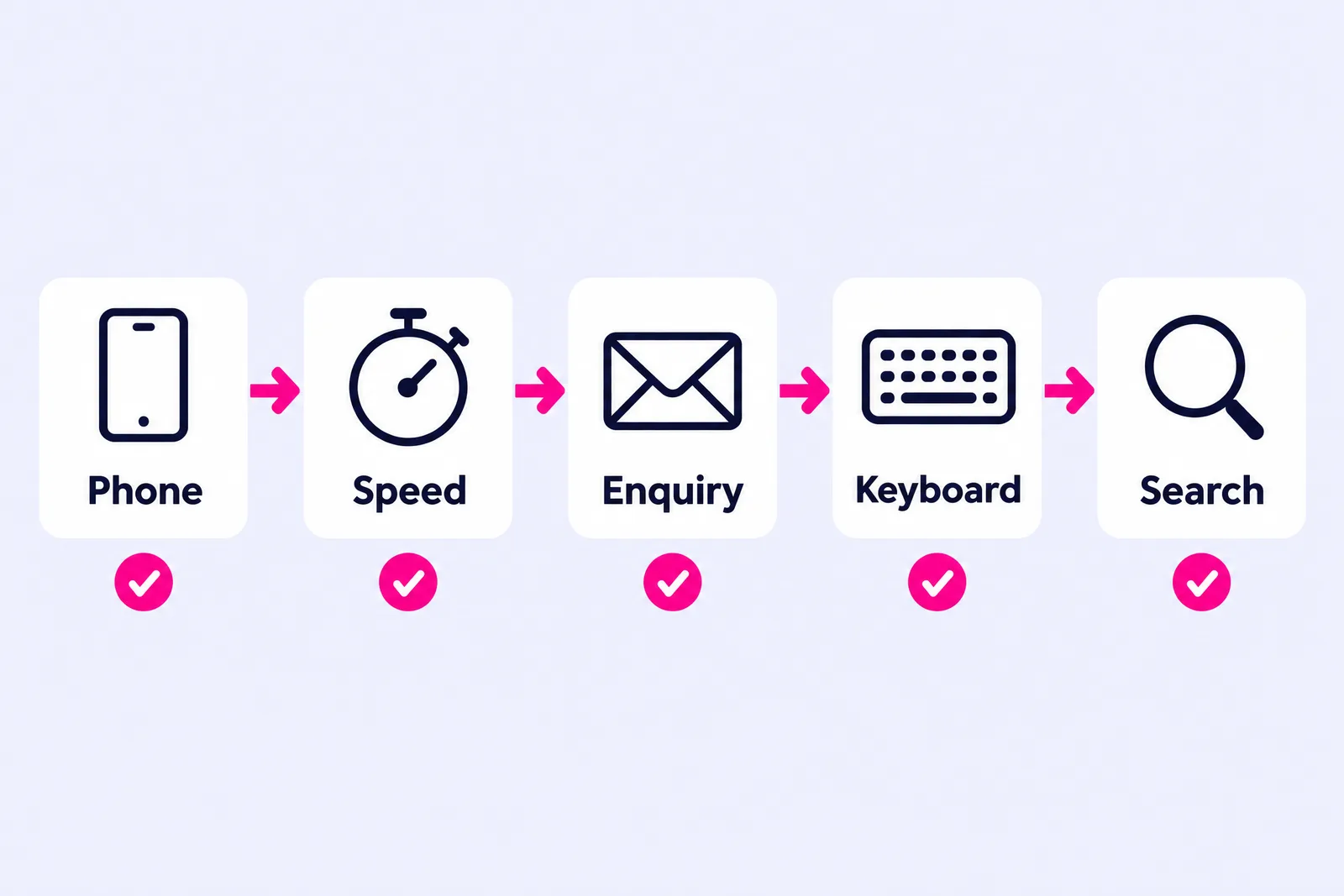
Pick two live sites from the designer's portfolio, ideally for businesses like yours, and check them the way a customer would. A live site lets you test what a screenshot cannot: how quickly it loads, how easy it is to get in touch and how it behaves on a phone.
- Open it on your phone. Within a few seconds, can you tell what the business does, where it works and how to get in touch? Can you read the text without zooming?
- Check the speed. Run the address through Google's free PageSpeed Insights and look at the Core Web Vitals assessment at the top, which uses real visitor data when Google has enough of it. A pass there tells you more than the headline score.
- Follow the enquiry path. Tap the phone number, find the form and count the fields. You are checking how easy it is to get in touch, so there is no need to send anything.
- Try it with a keyboard. On a laptop, press Tab to move through the page. Can you see where you are, and can you reach the menu and the form? It is a rough check, but it catches a lot of basic accessibility problems.
- Search for the business. Google its name, then its main service and town. Does the result show a sensible title and description, and does the site appear for what the business sells? Rankings depend on more than design, so treat this as a signal rather than a verdict.
If a site launched years ago and has been changed by other people since, ask about that before you judge the designer on it.
What should you ask a website designer before you sign?
Ask the questions that decide whether the site will bring in work and stay yours: who writes the words, how you will know it is working, what happens to your existing search traffic, who owns what and what support looks like after launch.
- Who writes the copy, and is it included? The words do most of the selling. If you are expected to supply them, plan the time now, because it is the part that most often holds a launch up.
- How will we know it is working? Expect Google Analytics 4 and Search Console to be set up, along with enquiry tracking for form submissions and phone taps, so you can count enquiries rather than visits.
- What happens to my old pages? If you are replacing a site, ask for a redirect plan that maps every old address to its new one, so you keep the search visibility and links the old site earned.
- Who owns the domain, the site and the content? Your domain should be registered in your business's name with you holding the login. Ask what you can take with you if you leave.
- What is in scope, in writing? Pages, rounds of changes, the timeline and anything charged as an extra.
- What happens after launch? Hosting, security, backups and updates, plus who fixes things when something breaks and how quickly.
- Can I speak to a client? A short call with a business similar to yours tells you more than any testimonial on their site.
Where this goes wrong: comparing quotes on price and portfolio alone. Two quotes can sit far apart because one includes copywriting, tracking and hosting and the other leaves them for later.
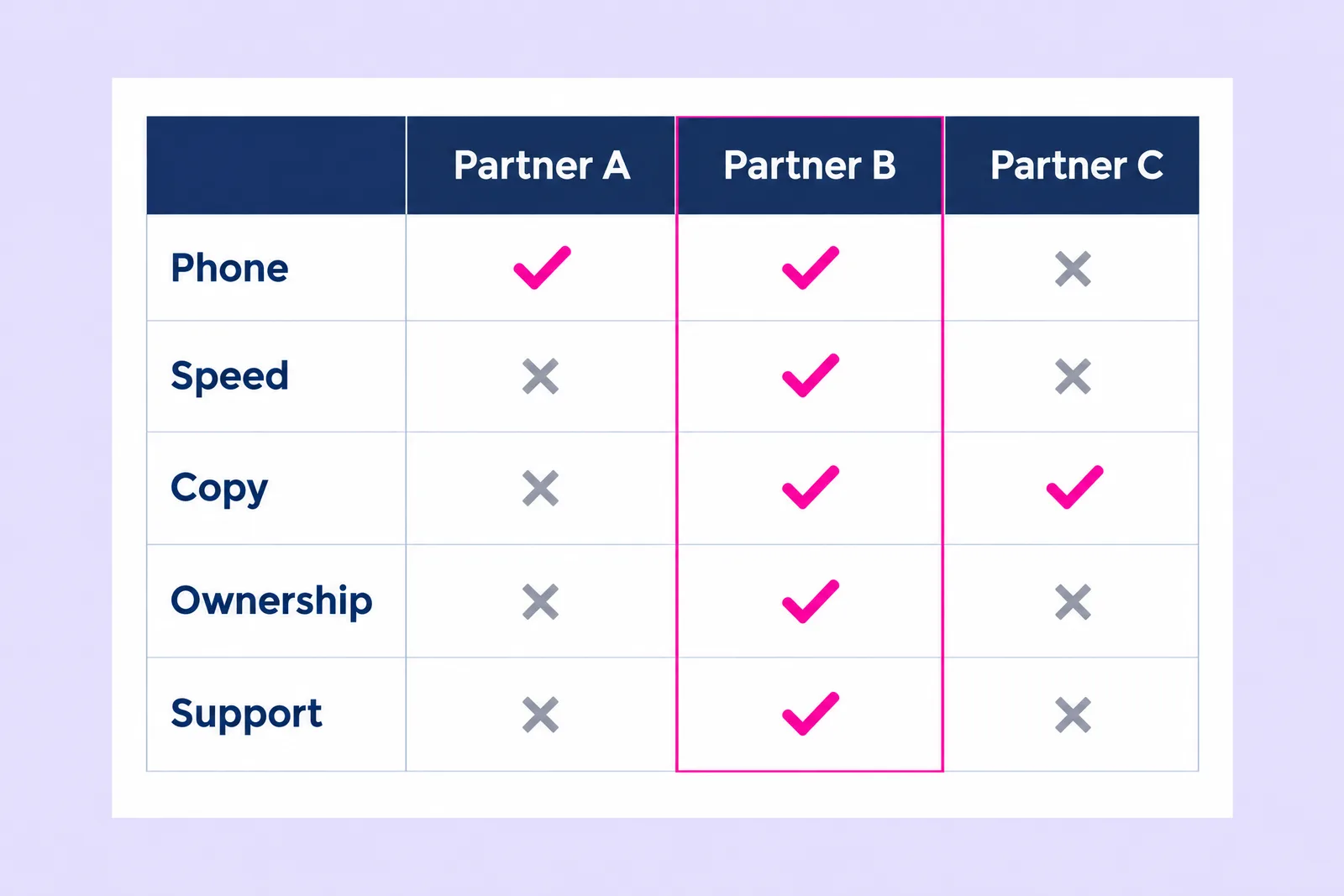
Put your shortlist side by side on one scorecard: one row for each check from the ten-minute test and the questions above, one column for each partner. If you have not briefed anyone yet, our guide on how to brief a web designer will help you get quotes you can compare like for like.
What should a fixed-scope website package include?
A fixed-scope package should list the pages, the work and the running costs in one place, so the price you agree is the price you pay. At a minimum, look for design and build, copywriting, search foundations, tracking, hosting, security and backups, with a clear launch timeline.
Our own website design packages work this way. Each runs on a 12-month term with a fixed scope, and the site goes live in 30 days.
| Package | Pages | Price |
|---|---|---|
| Kickstart | Up to 10 | £350 a month + VAT |
| Accelerate | Up to 25 | £650 a month + VAT |
| Launch Pad | Up to 50 | £1,000 a month + VAT |
Every package includes design and build, copywriting, on-page SEO foundations, Google Analytics 4 and Search Console, Google Business Profile set-up, hosting, SSL, security and backups. Optional extras are a blog (2 articles a month for £220, or 4 a month for £400) and Google Business Profile management at £95 a month.
Best for: businesses that want the cost spread across the year and one team responsible for the site after it goes live. If you would rather pay for the build once and handle hosting and support yourself, a one-off project may suit you better, and that is a perfectly reasonable choice.
Where should a Cardiff business start with a new website?
Start with the work you want more of and the areas you want it from, then build the site around those pages. In Cardiff, that usually means a page for each core service, honest area pages and a Google Business Profile that matches the site exactly.
- One page per core service, each answering the questions customers ask before they call: what is included, how it works, roughly how long it takes and who it suits.
- Area pages only where you really work, whether that is Pontcanna and Llandaff, Penarth and Barry, or Caerphilly and Newport. Each needs content specific to that area, such as jobs you have done there, so it reads as more than a copy with the town name swapped.
- The same business name, address and phone number on the site, your Google Business Profile and your main listings.
- Real photos of your team, vans, premises and finished work around the city, which build more trust than stock images.
- An early decision on Welsh-language content, based on how many of your customers would use it.
Getting these basics right is what lets a local site earn enquiries from search. The new site we built for Pest & Property Solutions, a Cardiff pest control company, went live in June 2026 and brought in 112 enquiries in its first 36 days, with 82.7% of them coming from Google organic search. Those are our own figures from a Roddy Digital client project, set out in the Pest & Property case study.