

Ask five developers what a web app costs and you will get five versions of "it depends". That is true, and no help at all when you are trying to set a budget. So here are the real 2026 numbers, what moves them, and the question worth asking before you spend anything: should you build this at all?
I have spent more than twenty years in sales and marketing, much of it sitting between business owners and the people building their software, and the expensive mistakes are nearly always made before a line of code is written. If you already know you need something bespoke, our web application development service starts with exactly the scoping covered below.
What does a web app cost in the UK in 2026?
A first version of a custom web app usually lands in the tens of thousands of pounds, and a full production platform can run well into six figures. The clearest published benchmark I have found this autumn is Magora's UK software development pricing page, updated on 13 October 2026, which sets out typical UK market ranges like this:
| Stage | What you get | Typical UK range |
|---|---|---|
| Discovery sprint (about two weeks) | Scope, architecture and a costed plan | £8,000 to £30,000 |
| Startup MVP | One or two core journeys, working in production | £25,000 to £80,000 |
| Full production web or mobile project | Backend, admin area, integrations and full testing | £50,000 to £300,000+ |
| Maintenance retainer | Fixes, updates and security patches | £2,000 to £12,000 a month |
That is one London agency's view of the market, and the same page publishes its own lower bands (an MVP from £10,000, for example), so use the table to sense-check quotes rather than as a price list. A quote outside it is possible; you should simply understand why.
Worth knowing: the build is only part of the bill. Hosting, monitoring, security updates and small improvements carry on for as long as people use the app, so budget for the year after launch as well as the launch itself.
What makes a web app cost more?
Time is the cost. Almost every quote is a number of people multiplied by a number of days, so anything that adds days adds pounds. For a sense of the day rate, IT Jobs Watch puts the median UK software engineer contract rate at £550 a day in the six months to 10 November 2026, with the middle 80% of advertised rates between £357 and £750. As illustrative arithmetic only, a first version needing 30 developer-days at that median comes to £16,500 of developer time, before design, testing or project management.
The things that add days fastest:
- User types: customers, staff and admins each need their own screens, permissions and testing.
- Integrations: every connection to another system (payments, your CRM, accounting software) adds work, and Magora estimates each one adds 5 to 15% depending on how well that system is documented.
- Platforms: a web app plus native iOS and Android apps costs far more than a web app alone.
- Compliance: regulated data in finance or health adds work an ordinary internal tool does not need, which Magora puts at 25 to 40% extra.
- Vague scope: if nobody can say exactly what version one does, the quote will carry a buffer or the budget will run out halfway.
- Deadlines: squeezing the same work into fewer weeks means more people working in parallel, and that costs more.
For reference, our own rate is £95 an hour + VAT.
When is off-the-shelf software the better buy?
Buy when a tool already does most of the job and the job is not what sets you apart. Booking, invoicing, email marketing, CRM, project management and HR are solved problems, with mature products you can be using this week for a monthly subscription. Configuring one of those well almost always beats building your own.
Build when the process is how you win: the way you quote, schedule, match or deliver is genuinely different, and squeezing it into someone else's software would blunt the thing customers choose you for. Build too when you are stitching several tools together with spreadsheets and copy and paste, and the stitching has become the job.
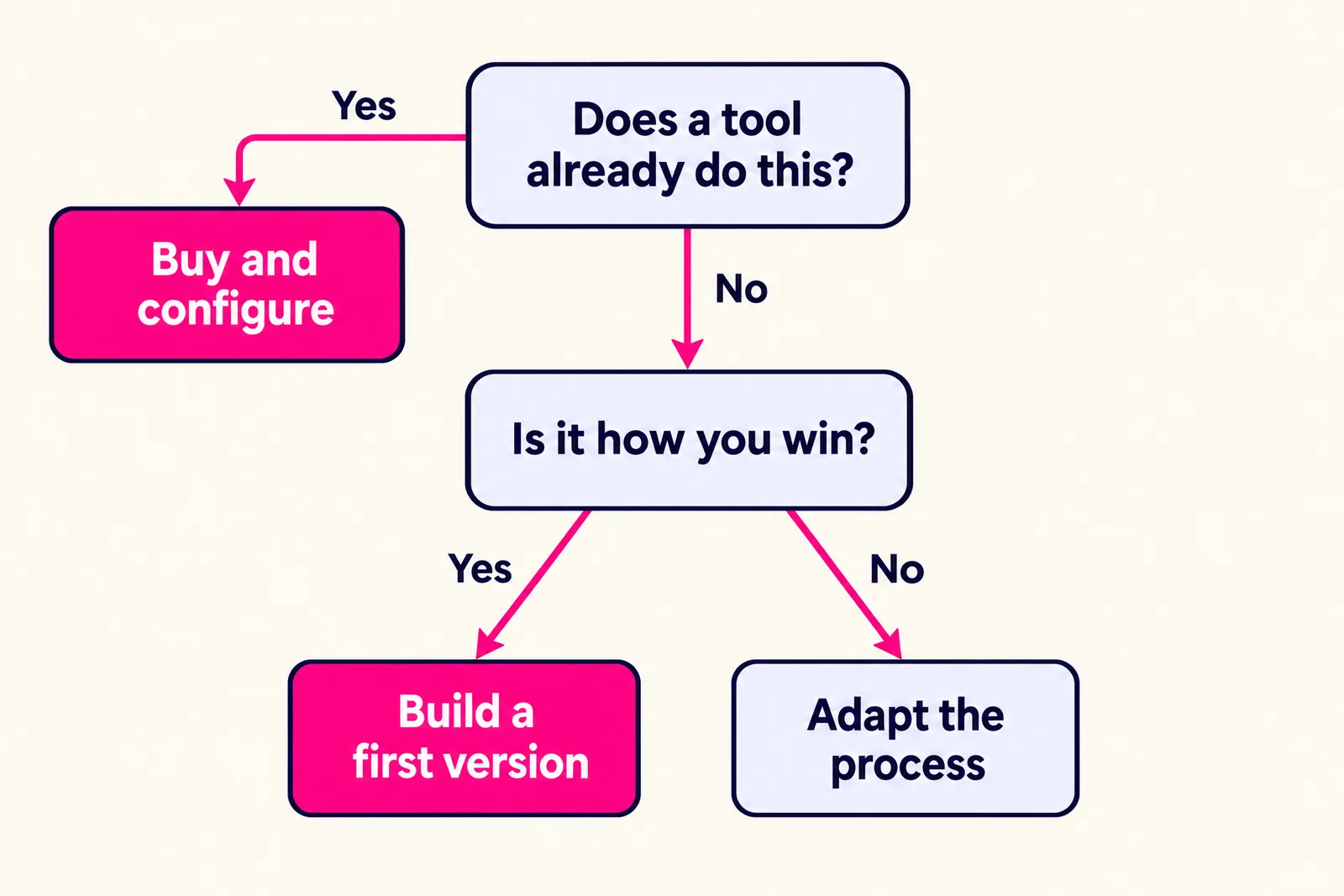
Where this goes wrong: a business commissions a bespoke CRM because the standard one feels cluttered, when an afternoon of configuration would have fixed it. There is also a middle route. Connecting the tools you already pay for with workflow automation often removes the copy and paste for a fraction of the cost of a build.
How do you scope a first version without overspending?
Scope the smallest version that proves the app earns its keep, then build in stages. A good first version does one job for one type of user, end to end, well enough to use every day.
- Write down the single outcome it must deliver (for example, a customer books and pays without a phone call).
- List every user type, then cut to the one that matters most for that outcome.
- Map that user's journey step by step, and mark anything not needed on day one as "later".
- Name each system it must connect to, and check those systems have proper APIs before anyone quotes.
- Ask for a fixed price for that fixed scope, plus a separate quote for support after launch.
- Agree how you will judge it after a few months of real use, before you approve phase two.
A short paid discovery phase is usually money well spent here, because it turns a wish list into a scope someone can price honestly. If you are briefing a developer for the first time, the same principles as briefing a web designer apply. And if what you need is really a better website with forms and a booking flow, read website development vs website design first: that is a different, and usually much cheaper, project.