
If you have asked three web companies for quotes, you have probably heard "designer", "developer" and "design and build" used as if they mean the same thing. They do not, and the gap between them is where a lot of website projects go wrong: a beautiful design that nobody can build on budget, or a well-built site that never persuades anyone to get in touch.
I have spent fifteen years in websites and digital marketing, and the clearest way I can put it is this: design decides what the site should do for the visitor, and development makes sure it actually does it. This guide sets out who does what, compares the two side by side, and shows when your project needs real development work, such as a web app or an integration with your CRM. If you already know you need something beyond a standard website, our web application development page explains how we scope that work.
What is the difference between website design and website development?
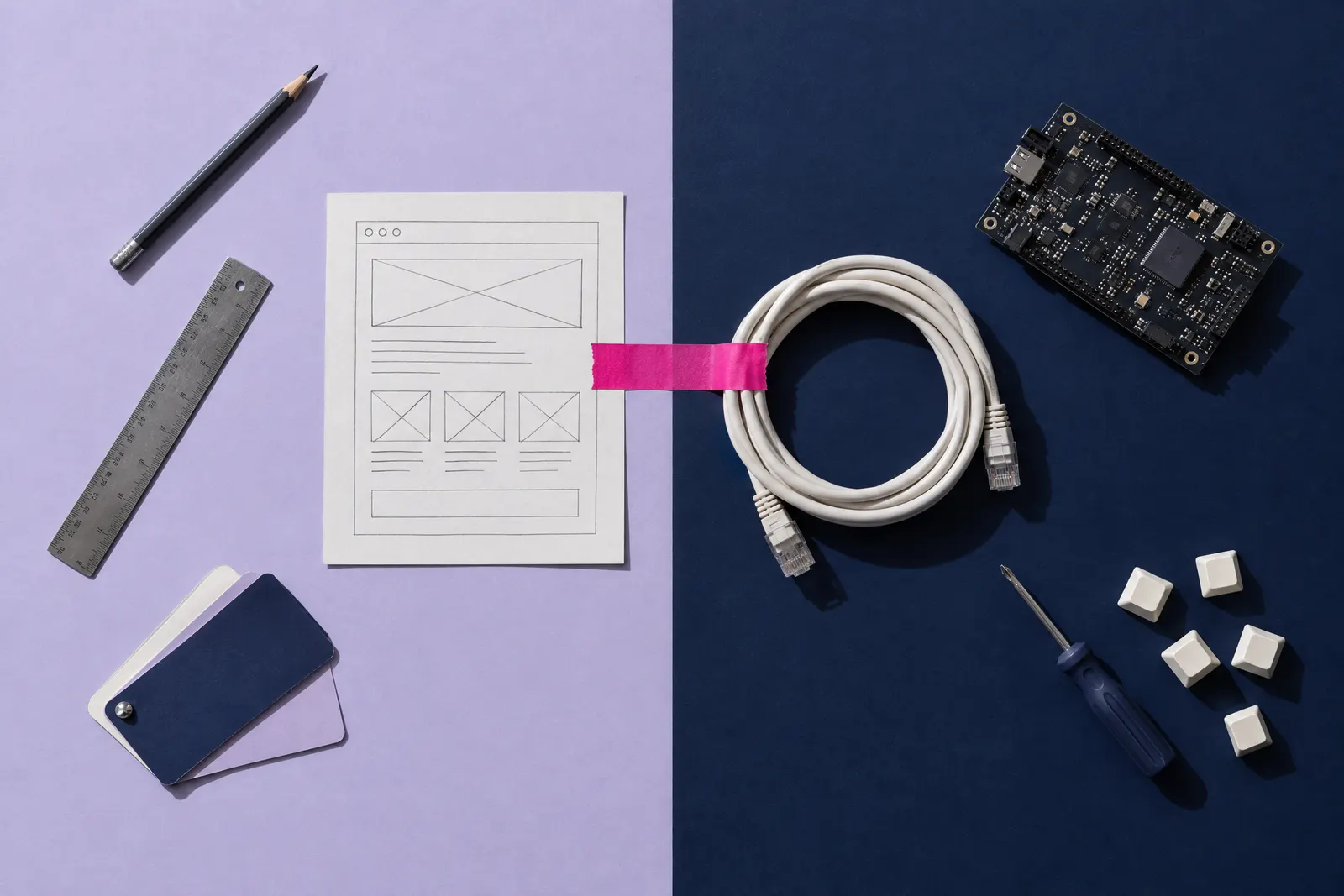
Website design is the planning and visual side: what goes on each page, in what order, how it looks and how a visitor moves from landing to enquiring. Website development is the technical side: the code, content management system, hosting, integrations and performance that make the design work in a real browser on a real phone.
A useful way to picture it is an architect and a builder. The architect works out how people will use the building and draws it. The builder makes it stand up, plumbs it in and gets it signed off. You can have a brilliant drawing that never gets built properly, and you can have solid construction of a layout nobody wanted. A good website needs both, with the two people talking to each other from the start.
Worth knowing: on smaller websites one person or one team often does both. That works well, as long as you know which skills you are paying for and both are properly covered.
What does a website designer actually do?
A website designer decides how the site should work for the visitor and what it should look like. On a good project that starts well before anyone picks colours.
- Structure and user journey: which pages you need, what goes on each one, and the route a visitor takes from first click to enquiry.
- Wireframes: simple layouts showing where headlines, proof, calls to action and forms sit, agreed before visual design starts.
- Visual design: type, colour, imagery, spacing and reusable components, built from your brand so every page looks like the same business.
- Messaging hierarchy: what the visitor should read first, second and third. Strong designers work closely with whoever writes the copy, because a layout without real words is guesswork.
- Mobile layouts: how every page behaves on a phone, which is where many visitors will first judge you.
Designers typically work in tools such as Figma and hand over a set of page designs plus a component library. Where this goes wrong: a designer who only produces attractive screens, with no thought for how content will be edited, how forms will be handled or how the site will load on a slow mobile connection.
What does a website developer actually do?
A website developer turns the design into a working site and keeps it fast, secure, accessible and easy to update. Developers usually split into front-end (what you see in the browser) and back-end (the server, database and anything behind a login), though many do both.
- Front-end build: turning designs into clean, responsive code that behaves properly on every screen size.
- Content management: setting up the system you use to edit pages, add articles and change prices without calling anyone.
- Performance: Google measures real-world page experience through its Core Web Vitals. The current "good" thresholds are a Largest Contentful Paint within 2.5 seconds, an Interaction to Next Paint of 200 milliseconds or less and a Cumulative Layout Shift of 0.1 or less. Interaction to Next Paint became a Core Web Vital in March 2024, and heavy scripts and plugins are a common reason sites struggle with it.
- Accessibility: making the site usable with a keyboard or a screen reader. If you sell to consumers in the EU, the European Accessibility Act has applied since 28 June 2025 and can reach UK businesses too, with WCAG 2.2 as the reference standard.
- Integrations: connecting forms to your CRM, bookings to your calendar, payments to your accounts, and the whole site to GA4 and Search Console.
- Security and hosting: SSL, updates, backups and a hosting set-up that copes on a busy day.
Watch out for: a developer handed a design with no context, who builds exactly what is on the screen and nothing about the journey, the edge cases or the content that will change next month.
How do website design and development compare side by side?
Design and development answer different questions, so they need different skills and produce different deliverables. The table sets them out next to each other.
| Website design | Website development | |
|---|---|---|
| Question it answers | What should the site do for a visitor, and how should it look? | How does the site work, load and connect to the rest of the business? |
| Main outputs | Sitemap, wireframes, page designs, component library | Working code, content management system, integrations, hosting set-up |
| Typical tools | Figma, design systems, clickable prototypes | Code editors, frameworks, a CMS, version control |
| Judged on | Clarity, trust and how many visitors enquire | Speed, uptime, accessibility and accurate data passed to other systems |
| Goes wrong when | It ignores content, mobile and build constraints | It ignores the visitor journey and the brand |
| Matters most for | Brochure and lead generation sites where trust wins the enquiry | Bookings, portals, calculators, ecommerce and CRM integrations |
When do you need a developer rather than just a designer?
You need serious development the moment your website has to do more than show pages and send a form: logging people in, taking bookings, calculating a quote, storing customer data or talking to another system. At that point you are building a web application, or a website with application parts, and development usually becomes the larger share of the project.
Signs your project has crossed that line:
- Customers need to log in to see orders, documents, progress or invoices.
- You want a quote builder, calculator or configurator that updates the price as people choose options.
- Enquiries should land in your CRM with the right fields, owner and follow-up task, rather than sitting in an inbox.
- Bookings need to check live availability in a calendar or job management system.
- Staff copy data between the website and another tool by hand every week.
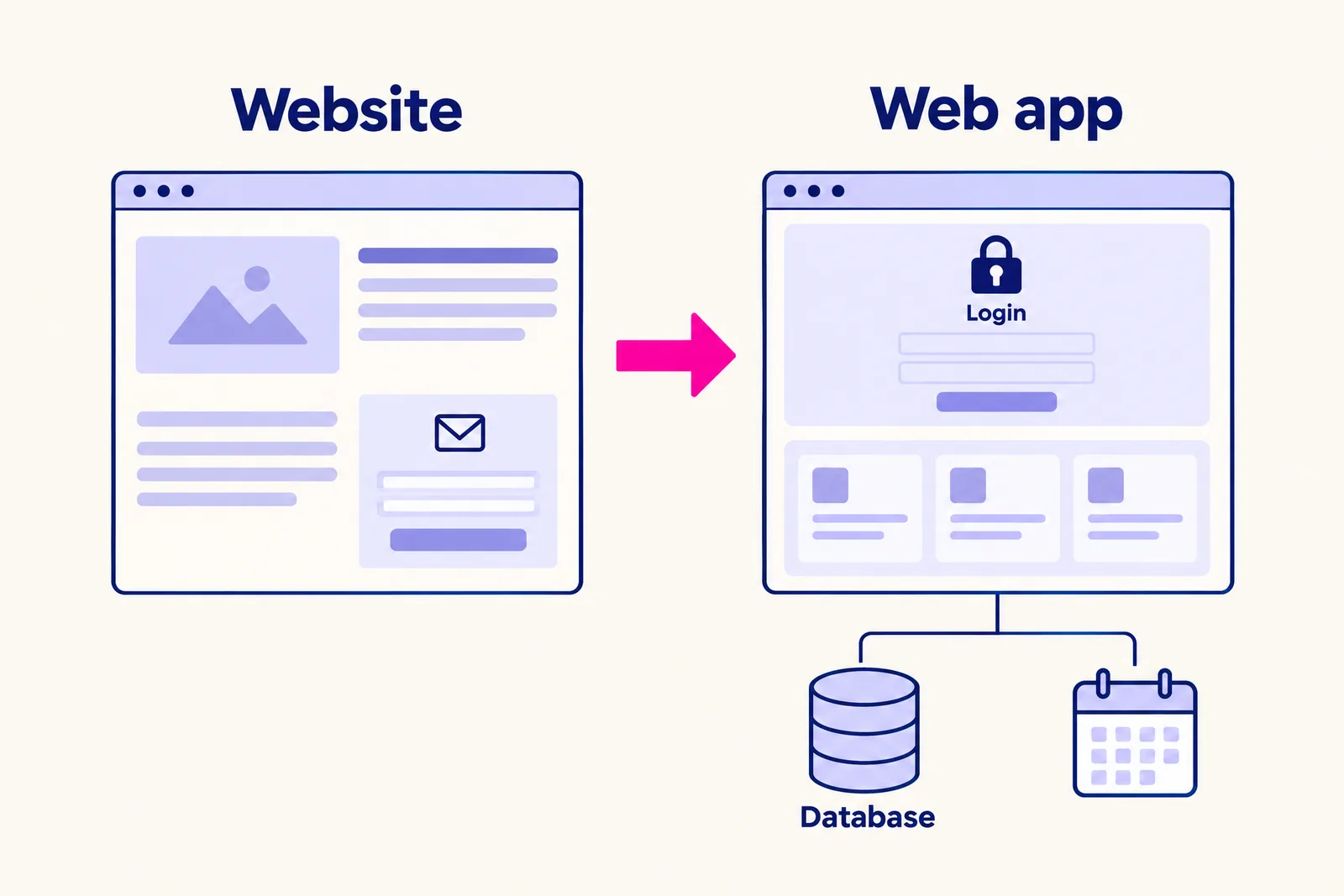
Use this as a rough guide to where the effort will sit.
| Project | What it involves | Where most of the effort sits |
|---|---|---|
| Brochure site for a local service business | A handful of pages, an enquiry form, a link to your Google Business Profile | Design and copy, on a solid standard build |
| Lead generation site with service and location pages | Page templates, tracking, landing pages, forms into email or a CRM | Roughly even between design and development |
| Booking or quote site | Live availability, pricing logic, confirmations | Development, with design keeping the flow simple |
| Customer portal or internal tool | Logins, permissions, a database, dashboards | Development, with product design for each screen |
| Website connected to CRM and automations | Form routing, lead assignment, follow-up sequences | Development and automation set-up |
If your project sits in the last three rows, ask any supplier how they handle back-end work, data and security before you look at visual concepts, because that is where the cost and the risk sit. And if the real job is moving data between tools you already use, workflow automation may be a better starting point than a rebuild.
How should design and development work together?
Design and development work best as one team from the first workshop, with the developer reviewing wireframes before visual design starts and the designer checking the build before launch. Design comes first in the order of work, and the conversation runs both ways throughout.
- Discovery: agree the goal of the site, who it is for and what an enquiry or sale looks like. The developer flags every system it must connect to.
- Structure and wireframes: the designer maps pages and journeys; the developer checks that forms, integrations and content types are realistic.
- Visual design: the designer builds the look and a component library, so the developer can build reusable parts instead of one-off pages.
- Build: the developer builds, connects and tests; the designer reviews each template on real devices.
- Launch and aftercare: tracking, speed and accessibility checks, then ongoing updates as the business changes.
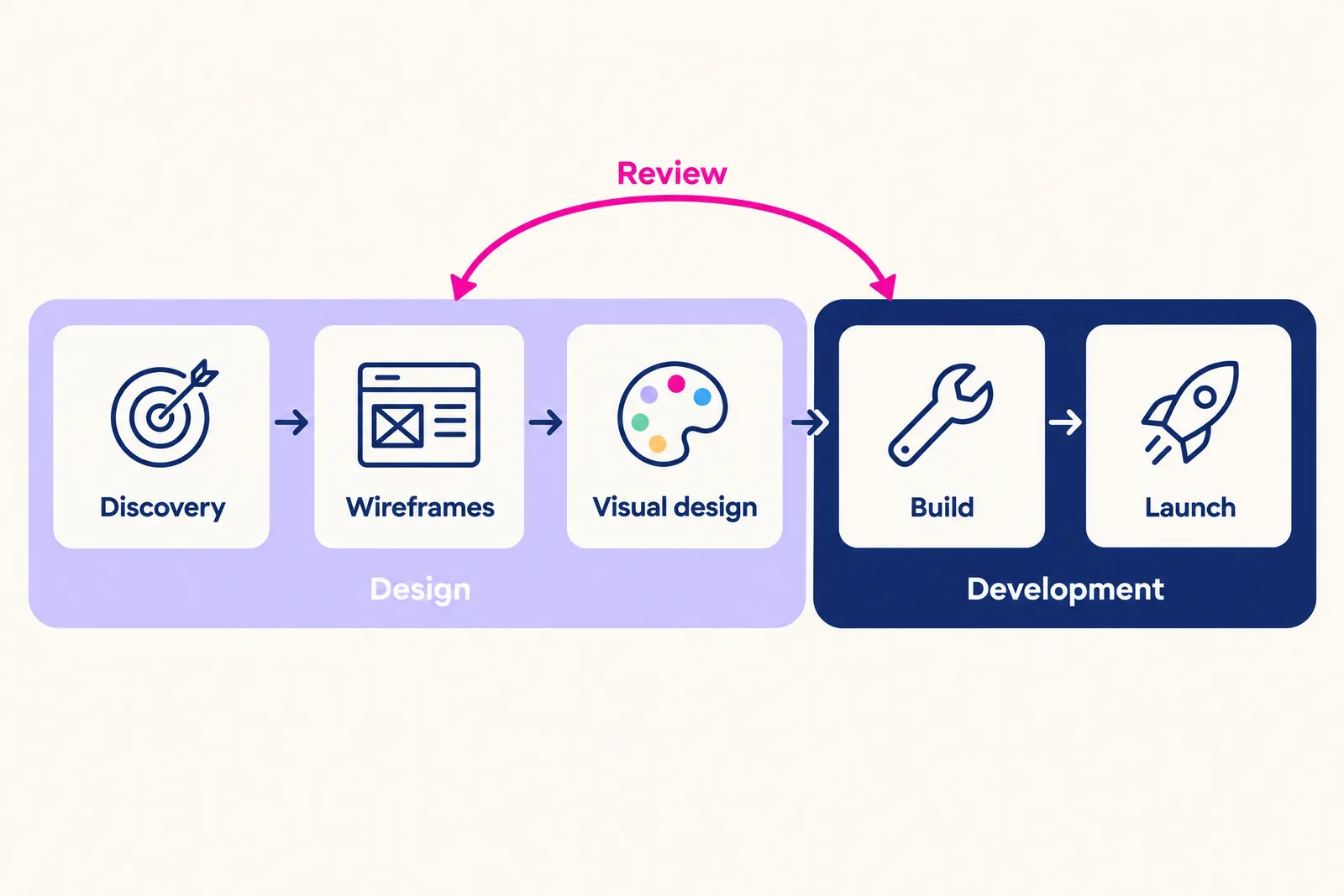
The handover between visual design and build is the step I see go wrong most often. A finished design gets passed across, questions come back a fortnight later, and the budget goes on rework. Keeping both disciplines in the same conversation removes most of that.
It is also why our website packages put design and build together under one fixed scope: Kickstart, Accelerate and Launch Pad all include design and build, copywriting and on-page SEO foundations, and go live in 30 days. If you are briefing a separate designer and developer instead, our guide on how to brief your web designer covers what to put in writing.
Where should a city-based business start when choosing between a designer and a developer?
Start by writing down what the website must do for the business over the next twelve months, then hire for that list. Being local helps most with understanding your market and your search competition; the design and build itself can run perfectly well over Zoom.
For example, for most service companies in Cardiff and South Wales, the list is short and practical: show up in local search, look credible next to competitors, and turn visitors into calls and form enquiries. That needs strong design, sharp copy and a clean standard build. Pest & Property Solutions, a Cardiff pest control company, had 112 enquiries in the first 36 days after its new site went live in June 2026, with 82.7% of them coming from Google organic search (figures from our Pest & Property Solutions case study). A Cardiff manufacturer wanting a trade portal, or a clinic wanting online bookings tied to its practice software, has a development project and should hire for that first.
Whichever you need, ask to see work that matches your project type, ask who will actually design and who will build, and ask how changes are handled after launch. If you are still choosing between a freelancer and a team, our comparison of a website designer vs a web design agency walks through the trade-offs.