

If you run a small business in Cardiff and you have about £1,000 to put into online marketing, there is no shortage of places to spend it. Every directory, ad platform and agency has a suggestion. What decides whether the money works is the order you spend it in.
I have spent more than twenty years in sales and marketing, fifteen of them in websites and digital marketing, and the pattern I see most often with smaller budgets is money going into ads or boosted posts before the basics are ready to catch the people those channels send. Clicks arrive with nowhere useful to land, and the owner concludes that online marketing does not work for their kind of business.
This guide sets out a priority order for a small budget, what each step costs, what to expect and when, with Cardiff examples throughout. If you would rather have the whole thing planned and run for you, our Demand & Content service is built for exactly this.
Where should a Cardiff business spend its first £1,000 on online marketing?
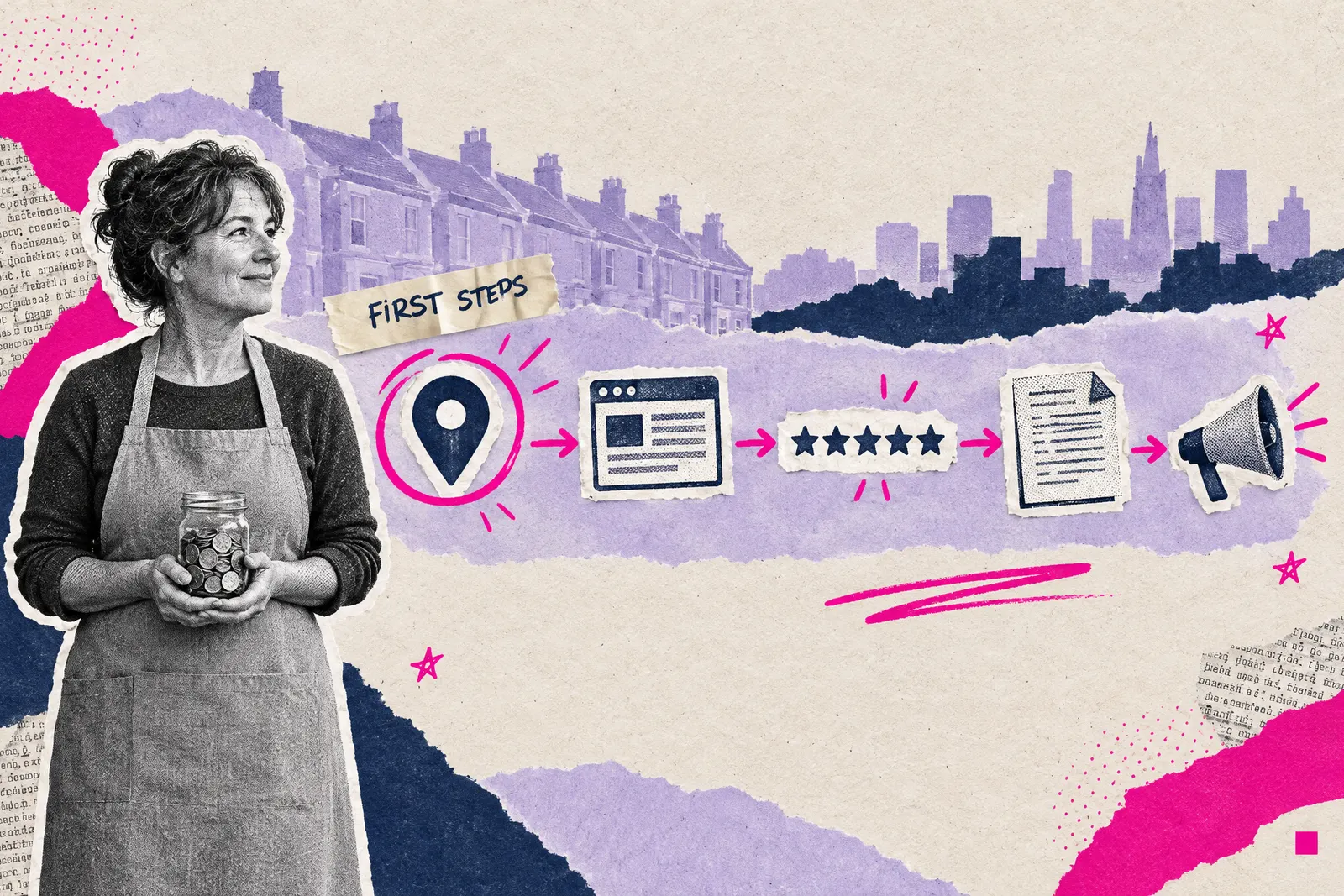
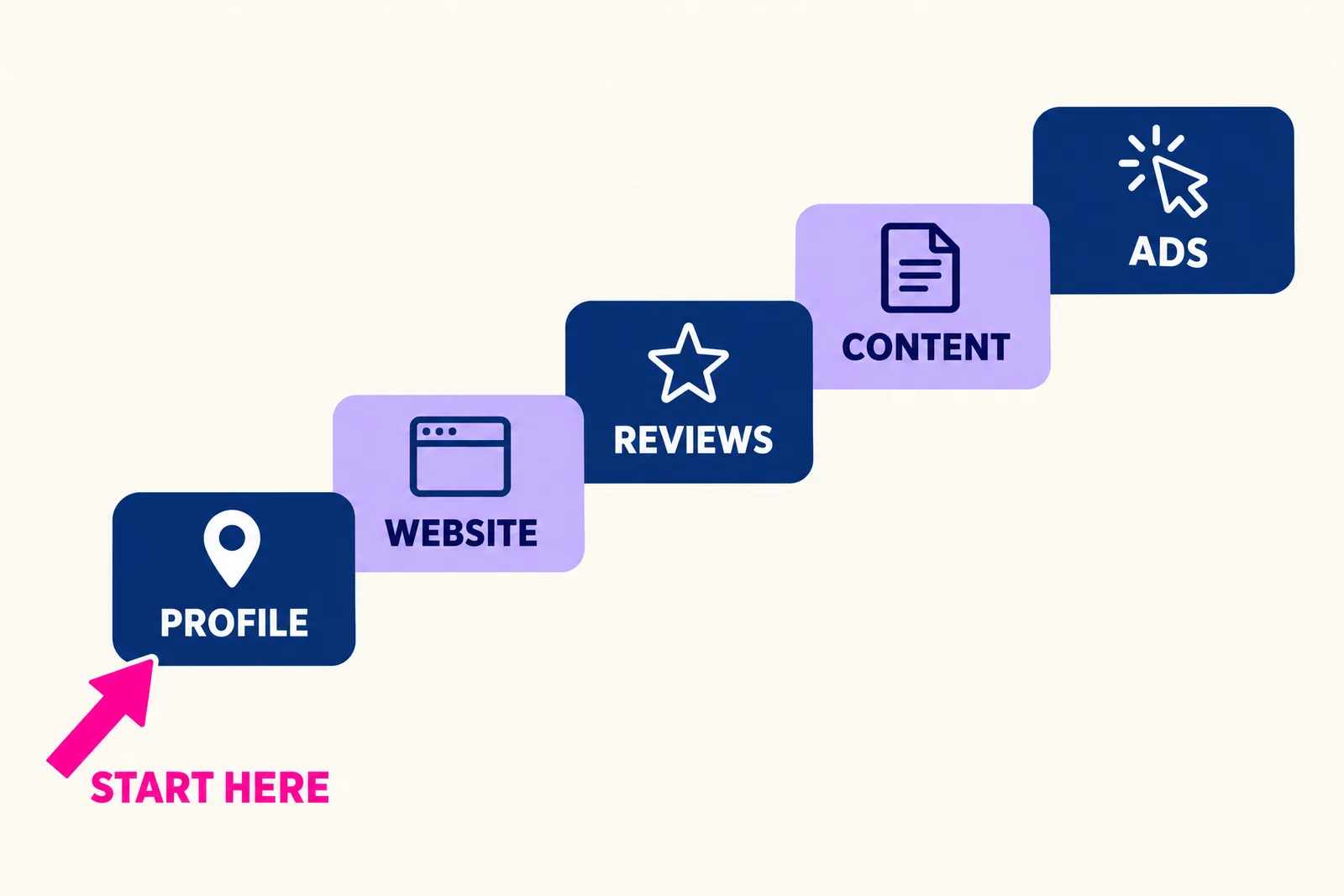
Spend it in five steps, in this order: your Google Business Profile, your website, your reviews, a small amount of useful content, then a test of Google Ads. The first and third steps cost mostly time. The money goes on the website, the content and the ad test.
The reason for the order is simple: each step improves the return on the one after it. A complete Business Profile with good reviews makes your listing more likely to be chosen, whether someone finds it through a map search or an ad. A website that converts gives every paid click a better chance of becoming an enquiry. Content gives Google and AI search tools something specific to show when people ask questions about your service.
Here is how I would split £1,000 for a typical local service business. Treat it as a starting point and move money between rows to suit your situation.
| Step | What you are paying for | Suggested share of £1,000 |
|---|---|---|
| 1. Google Business Profile | Your time to claim, verify and complete it | £0 |
| 2. Website fixes | Mobile contact options, service pages, speed and tracking | £350 |
| 3. Reviews | Your time, plus printed review cards with a QR code | £50 |
| 4. Content | Two to four genuinely useful pages or articles | £300 |
| 5. Google Ads test | One tightly targeted campaign for one month | £300 |
| Total | £1,000 |
Step 1: How do you set up a Google Business Profile that wins local searches?
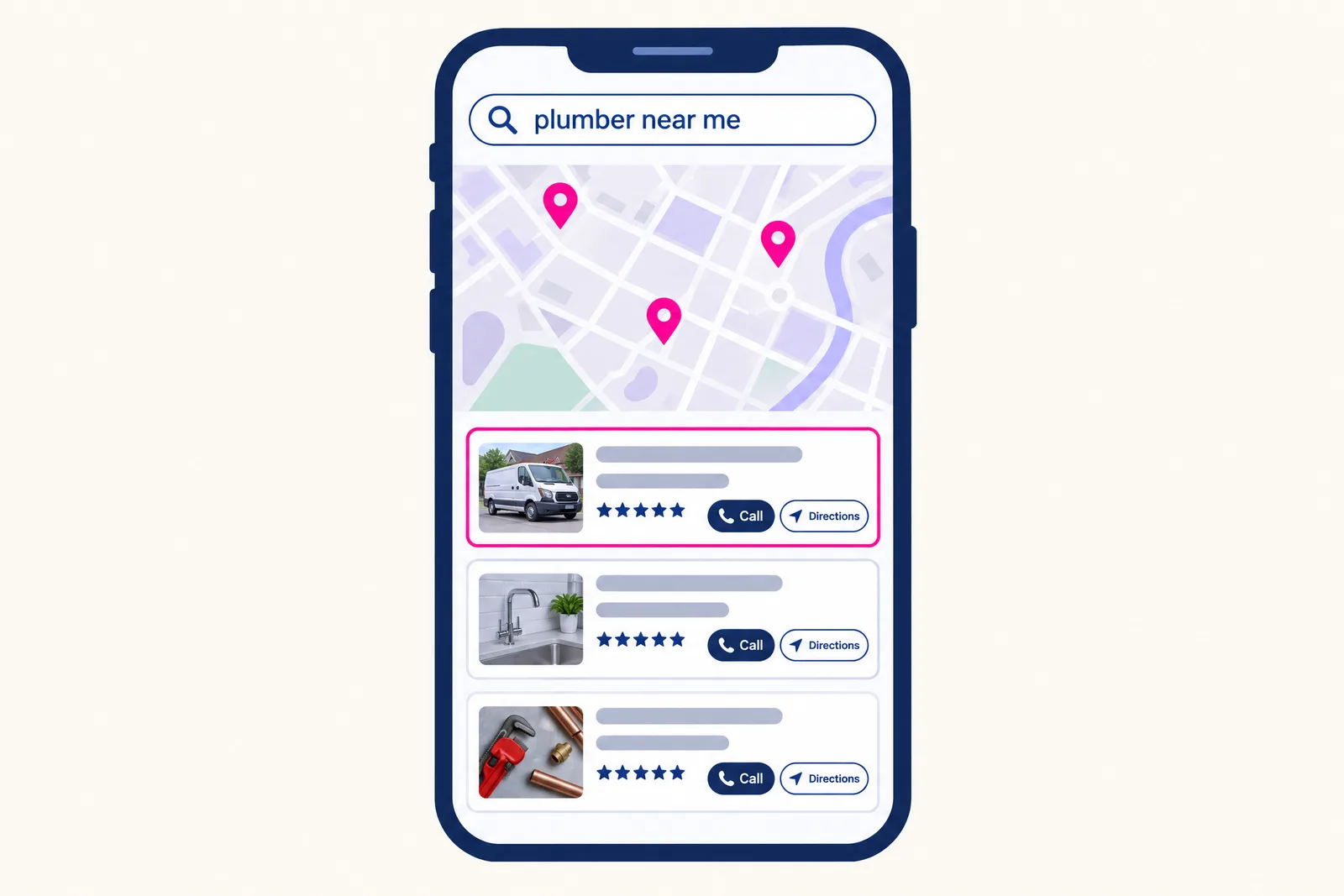
Claim, verify and complete your profile before you spend a penny anywhere else. It is free, and for anyone searching for a local service it is often the first thing they see about you, sitting above the websites in the results.
Google says local results are based mainly on relevance, distance and prominence (how well known a business is), and that prominence draws partly on reviews and on how many websites link to you. It also states plainly that there is no way to request or pay for a better local ranking. That makes this the one place where a small budget competes on equal terms with a large one.
Work through it in this order:
- Choose the primary category that matches the service people search for most, then add secondary categories only where they are true.
- Fill in every field: hours, service areas, phone, website, a list of services with short descriptions, and any attributes that apply.
- Add real photos of your work, your team and your premises or van. Stock images add nothing.
- Reply to every review, good and bad, in a calm and specific way.
- Post an update when something changes: a new service, seasonal hours, a recent job.
Where this goes wrong: businesses stuff keywords into their business name or list an address they do not trade from. Both go against Google's guidelines for representing a business and put the whole profile at risk.
Step 2: What website fixes should come before any paid marketing?
Fix whatever stops a visitor becoming an enquiry. On a small budget that usually means four jobs, and they are worth far more than a cosmetic refresh.
- Contact that works on a phone: a tap-to-call number, a short form and a reply time you can keep.
- One page per main service, saying who it is for, the areas you cover and what happens after someone gets in touch.
- Speed: compress oversized images and remove plug-ins and pop-ups you do not need.
- Tracking: Google Analytics 4 and Search Console set up, with form submissions and calls counted as conversions, so you can see which channel produces enquiries.
£350 covers around three hours of focused work at our rate of £95 + VAT, which is usually enough for the contact and tracking jobs plus a service page or two if the site is in decent shape. If it is not, our guide to why a website gets traffic but no enquiries will help you decide whether to fix or replace it.
Worth knowing: tracking matters most of the four. Without it, you will reach step 5 with no way of telling whether the ad money worked.
Step 3: How do you get more Google reviews without breaking the rules?
Ask every happy customer, at the moment the job is finished, with a direct link. A steady flow of genuine reviews feeds your local ranking, and it is one of the first things people compare when choosing between three businesses on a map.
Google lets you create a review link or QR code from your Business Profile. Put the link in your job-completion text or email and on your invoice, and print the QR code on a small card you hand over at the end of a visit. In my experience, the fewer taps between the request and the review box, the more people follow through.
Two sets of rules matter here. Google strictly prohibits offering incentives, such as discounts or free extras, in exchange for reviews. In the UK, the Competition and Markets Authority published new fake reviews guidance in April 2025 and has since opened investigations using its newer consumer protection powers. So ask every customer, offer nothing in return, and never write or buy reviews.
Step 4: What content is worth paying for on a small budget?
Pay for two to four pages that answer the questions customers ask before they buy. Leave a regular social media schedule for later: on £1,000 it spreads too thin to make a difference.
Good first pieces for a local service business:
- A page for each service you most want more of, if step 2 did not already cover it.
- A clear "what does it cost" page, even if it gives ranges and explains the factors that change the price.
- Plain answers to the three questions you are asked most often on the phone.
- A short write-up of a real recent job, with the customer's permission.
This content now does two jobs. Ofcom's December 2025 research found that about 30% of searches now show AI overviews, and those summaries draw on pages that answer a question directly. In my view, a page that opens with a plain answer gives those tools the best chance of using it. Our explainer on answer engine optimisation covers how to write for this.
Step 5: When should you switch on Google Ads, and how far will £300 go?
Switch ads on once the first four steps are done and tracking is working. Then run one campaign, for one service, in the areas you most want work from, for a full month.
Google Ads charges per click, and costs vary widely by sector. Whito's indicative UK cost-per-click figures for 2026, which it describes as estimates drawn from benchmarks and agency data rather than an official survey, put home services at an average of £3.20 a click and legal services at £8.25. Here is roughly what that means for a £300 test:
| Sector (indicative average cost per click) | Approximate clicks from £300 |
|---|---|
| Education and training (£2.40) | About 125 |
| Healthcare and dental (£2.80) | About 107 |
| Home services (£3.20) | About 94 |
| Legal services (£8.25) | About 36 |
To spend £300 across a month, set an average daily budget of just under £10. Google explains that a campaign can spend up to twice its average daily budget on a given day, but for most campaigns you will not pay more than 30.4 times the daily budget in a month (the average number of days in a month).
Keep the test tight: a handful of specific search terms, your service area set by radius or postcode, and every ad pointing at the matching service page rather than your homepage.
Best for: services people search for when they need them now, such as emergency repairs, where the searcher is ready to call. For considered purchases, treat a month of ads as research into which search terms bring enquiries.
What results can you realistically expect, and when?
If it is set up well, the ad test is the step most likely to produce measurable enquiries within the first month. The profile, reviews and content build more slowly, but they keep working after you stop paying for them, while ads stop the day the budget does.
For a sense of where the slower steps lead when they are done properly: Pest & Property Solutions, a Cardiff pest control company, launched a new site with us in June 2026. In its first 36 days it took 112 enquiries, 82.7% of them from Google organic search, and the business has 344 Google reviews. Those figures come from our own reporting for the client, and the Pest & Property case study sets out what was involved. It was a larger project than a £1,000 budget, and a review count like that takes time to earn, but it shows what the same order of work adds up to.
Measure the same few things every month:
- Enquiries by source: calls, forms and messages.
- Business Profile calls, website clicks and direction requests.
- New reviews and your average rating.
- Cost per enquiry from the ads.
If a number has not moved after a fair trial, move the money to the step that is working.
How does this work for a business in Cardiff?
Cardiff rewards being specific about where you work. Plenty of people search by neighbourhood as well as by city, and a business that names the parts of Cardiff it covers gives both Google and customers a clearer picture.
For example, a plumber based in Canton who covers Pontcanna, Llandaff and Grangetown should set those areas in the Business Profile service area and mention them naturally on the service pages, with real jobs as examples. A café in Roath will get more from photos, accurate opening hours and reviews than from articles. A professional services business in Cardiff Bay that sells to other companies may get more from a strong case study and a well-kept LinkedIn presence than from map listings.
Two local points are worth adding. If you serve Welsh-speaking customers, say so on your profile and website, and consider a Welsh version of your key pages. And Business Wales lists digital support for businesses in Wales, including free online data protection training and an AI skills pilot relaunched in October 2026, so check what is on offer before paying for training. Our guide to winning the map pack in Cardiff goes deeper on the local search side.
What should you not spend your first £1,000 on?
Avoid anything that spends the budget before the basics are ready to catch the results. The usual culprits I see:
- Paid directory listings and "featured" placements that promise top positions. Check whether the directory itself shows up for your searches before you pay.
- Boosted social posts with no clear audience or offer. Reach is cheap to buy, and on its own it rarely turns into enquiries.
- A full website redesign on £1,000. It will be rushed or left unfinished, and the money does more fixing what you have.
- SEO contracts with long tie-ins and no clear list of monthly deliverables.
- Anyone guaranteeing a number one ranking. Google says no one can pay for a better local ranking, so no one can honestly promise one.