

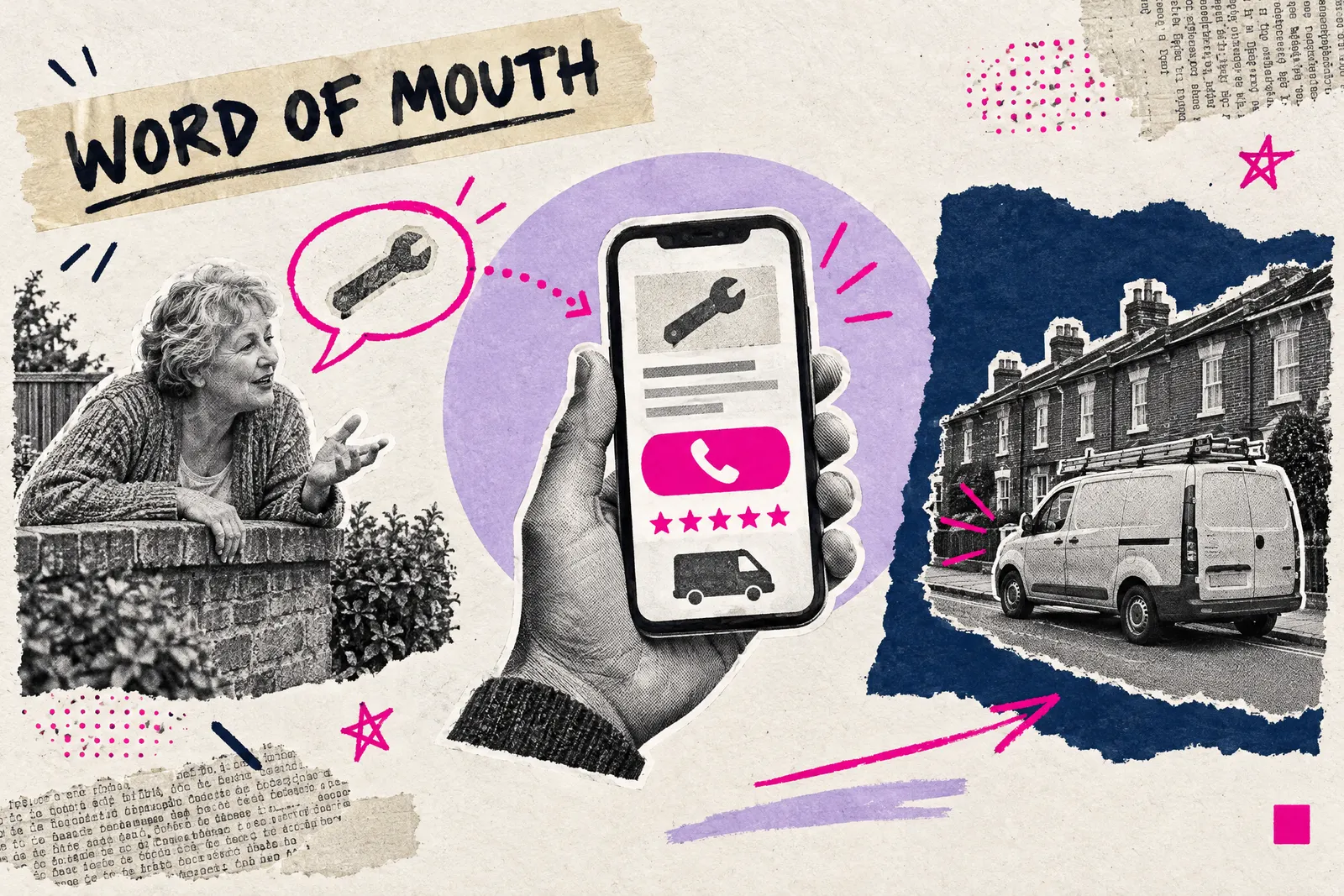
There is a belief that runs deep in the trades: "I get all my work by word of mouth, so I do not need a website." For years that was close enough to true. In 2026 it quietly costs jobs, for one simple reason. The referral still Googles you.
When a neighbour recommends you, the next thing that customer does is look you up. If they find a fast, credible site with real reviews and photos of your work, the job is as good as booked. If they find nothing, or a dated page that will not load properly on their phone, doubt creeps in at exactly the wrong moment, and a competitor who does show up gets a second look. Word of mouth is still how many good trades win their work, and in 2026 it almost always passes through a search bar on the way.
I have spent fifteen years building websites and running digital marketing, and I started my career in sales. From both sides the pattern looks the same: the business that is easiest to check out and easiest to contact wins more of the work it is offered. This article covers what has changed, how a website compares with a Business Profile, Facebook page or lead site, what a trades website must do, and whether it is worth it for a small operator.
Do tradespeople still need a website in 2026?
Yes. Even a warm referral checks you online before making contact, and what they find decides whether they ring. BrightLocal's 2026 Local Consumer Review Survey found that after reading positive reviews, the most common next step for consumers (54%) is to visit the business's website, up from 32% when the question was last asked in 2019. The survey panel is American, but the behaviour will be familiar to anyone who has hired a trade: read the reviews, then look at the website to check they do the job you need, in your area.
Without a website, that second check has nowhere to land. You are relying on a short profile description and whatever a directory happens to say about you to close the decision.
A website also widens who can find you. Referrals only come from people who already know you or someone you have worked for. A site that ranks for "boiler repair Cardiff" or "electrician Newport" reaches people with a problem today who have never heard of you.
What has changed for trades customers?
Three shifts have made a website essential.
Search is local and mobile. Ofcom's Online Nation 2025 research found UK adults spend an average of four and a half hours online a day, most of it on a smartphone. People stand in the kitchen, type "emergency electrician near me" and choose from whoever appears in the map and the results. Searches like that carry high intent: the person usually wants someone soon.
AI is summarising the options. The same Ofcom research found about 30% of UK searches now show an AI Overview, and Google's AI Mode launched in the UK in July 2025. BrightLocal found 45% of US consumers now use ChatGPT and similar tools for local recommendations, up from 6% a year earlier. These tools build their answers from what is published about you. A trade with a clear website stating services, areas, accreditations and reviews gives them plenty to work with. A trade with only a sparse listing gives them very little.
The bar for trust has risen. In the same BrightLocal survey, 68% of consumers said they would only use a business with four stars or more, and 74% look for reviews from the last three months. Reviews, photos of real jobs and a professional site now do the job a good reputation used to do on its own.
Is a Google Business Profile or Facebook page enough?
Both are worth having, and neither does the full job alone. Your Google Business Profile is essential for the map pack, and we cover setting it up properly in Local SEO for Tradespeople. A profile, though, gives you a short description, a services list and photos, laid out the way Google chooses. A Facebook page mostly reaches people who already follow you, on a platform whose rules and reach you do not control.
A website is the one place you own outright. It lets you:
- Give each service its own page, so you can appear for specific searches like "consumer unit replacement" as well as "electrician".
- Build pages for the towns you serve, with real jobs and reviews from each.
- Explain your process, guarantees, accreditations and typical pricing in your own words.
- Capture enquiries through a form that lands in your inbox, day or night.
- Give Google and AI tools a detailed, consistent source to quote. Google's guidance for site owners says its AI features rely on the same fundamentals as normal search: indexed pages, important content in text form and up-to-date Business Profile information.
The profile and the website work best together. The profile gets you seen in the map; the website answers the questions that turn a look into a call.
What must a trades website actually do?
Looking good is the starting point. A trades website has one job: turn a visitor into an enquiry with the least possible friction. That means loading fast on a phone, ranking in local search and making contact effortless. Here is the checklist we build to.
| Feature | Why it wins jobs |
|---|---|
| Fast, mobile-first pages | Most customers are on a phone, and slow sites lose them |
| Click-to-call on every page | A tap to call captures the moment someone decides to act |
| Quick quote or callback form | Catches people who would rather type than ring |
| A page for each service | Matches specific searches and answers specific questions |
| Local area pages | Gets you into "near me" and town-specific searches |
| Live Google reviews | Provides the social proof that closes the decision |
| Gallery of real, recent jobs | Proves quality far better than stock photos |
| Accreditations and guarantees | Answers the "can I trust them in my home?" question |
On speed, Google's Core Web Vitals guidance asks for the main content to load within 2.5 seconds and for the page to respond to a tap in under 200 milliseconds. A site built on a heavy template with sliders and pop-ups rarely manages that on a phone.
Get these right and the site earns its keep. If your current site has visitors but few enquiries, the cause is usually somewhere in this table, and we cover the wider diagnosis in Why Your Website Isn't Converting.
Are directories and lead-generation sites a better option?
They can be a useful extra source of work, especially when you are starting out. The trade-off is that you rent access to customers. Directories and lead platforms charge a membership fee, a fee per lead, or both, depending on the platform, and the customer often sees your competitors listed alongside you, which pushes the conversation towards price.
Your own website builds an asset. Every review, photo and page you add makes it stronger, enquiries come straight to you, and there is no fee per lead. Google states there is no way to request or pay for a better local ranking, so a strong position is earned and stays yours as long as you keep it up. The sensible approach for most trades is to treat directories as a top-up while the website and Business Profile become the main source of work.
Is a website worth it for a small trade?
Work it out on your own numbers. Take the value of an average job and the margin you make on it, then compare that with the monthly cost of the site. Our Kickstart website package is £350 a month plus VAT for up to 10 pages on a 12-month term, live in 30 days. It includes the design and build, copywriting, on-page SEO foundations, GA4 and Search Console, Google Business Profile set-up, hosting, SSL, security and backups. Run the sum with your own figures: for many trades, the break-even is a small number of extra jobs a year.
Here is a Cardiff example. Pest & Property Solutions, a pest control company in the city, launched its new website with us in June 2026. It brought in 112 enquiries in its first 36 days, 82.7% of them from Google organic search, and now averages about four enquiries a day from organic traffic. Its 344 Google reviews do a lot of the convincing once people land. The Pest & Property case study shows how it was put together. Results depend on your market and the work put in, but it shows what a fast, well-structured site can do for a South Wales service business.
If you need more room, Accelerate is £650 a month plus VAT for up to 25 pages, and Google Business Profile management can be added for £95 a month. See how we approach websites for trades businesses.
How do you get started this week?
- Search your trade and town in a private browser window and note who appears in the map and top results.
- Open the top three competitors' websites on your phone and note how quickly you could call each one.
- Claim or check your Google Business Profile and fill every field.
- Gather 20 to 30 of your best photos of real jobs, noting the town for each.
- List every service you offer and every town you want more work in. That list is the outline of your website.
- Ask your last ten customers for a Google review using your direct link.
Do those six things and you will have the raw material for a site that books jobs, whoever builds it.