
It is one of the most common questions a small business owner asks: should my limited marketing time go into writing content or into social media? Behind it sits a real worry that whichever you pick, you are missing out on the other, and that you cannot do both well.
The two do different jobs, and the businesses that get the most from them run them as one connected routine. This guide sets out what each one is good at in October 2026, now that AI answers sit on top of Google results and organic reach on social keeps shrinking. It covers how the two work together, how much time each needs, and a straight recommendation on where to start.
What is the difference between content marketing and social media?
Content marketing means publishing useful material on your own website, such as articles, guides, FAQs, case studies and short videos, that answers the questions your buyers ask. Its job is to be found when someone goes looking, whether they type into Google or ask an AI assistant.
Social media means posting on platforms such as LinkedIn, Instagram, Facebook and TikTok to stay visible to people who follow you, or might. Its job is to keep you in mind between buying moments and to show the personality and proof behind the business.
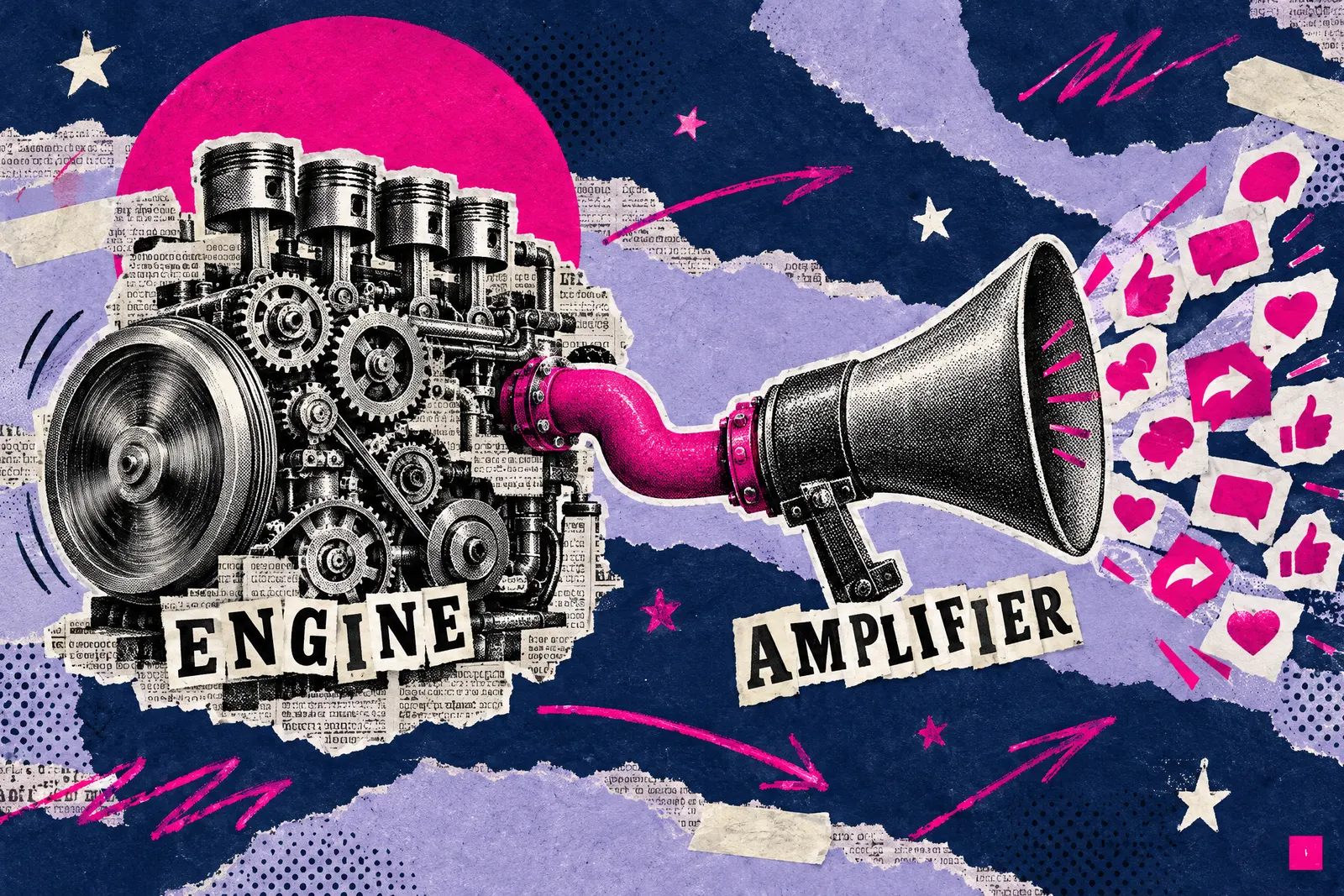
A useful way to picture it: content is the engine and social is the amplifier. Content produces durable assets that keep generating visibility and enquiries. Social takes that substance and pushes it in front of people today. Judging one against the other misses the point, because each makes the other work harder.
What does content marketing do for a small business in 2026?
Content attracts people who are actively searching for what you offer, and it keeps doing so long after you publish. A genuinely useful article can rank and bring in enquiries for years, which steadily lowers your cost per enquiry. That compounding effect is its defining advantage.
The search results page has changed around it. Google says AI Mode passed one billion monthly active users after expanding globally (Google), and AI Overviews now sit above many results. Pew Research found that people clicked a traditional result on 8% of Google visits where an AI summary appeared, against 15% where none did (Pew Research Center). Fewer clicks raises the bar for content in two ways. Your pages need to be the source the AI summary draws on, and the visitors who do click need a clear reason to get in touch.
Google's guidance stays consistent through its regular core updates, including the one completed in early June 2026 (Search Engine Land): reward helpful, people-first content. In practice that means question-led headings, a direct answer near the top, specifics only you can give (prices, timescales, local knowledge, real examples), and a named author with genuine experience. You can see how visible your business already is to AI tools with our free AI visibility check.
Content also feeds everything else. One strong article becomes several social posts, a section of an email and an answer your team can send to customers. The trade-off is patience: it takes months to build momentum, and it rewards consistency more than bursts of effort. We cover the search side in detail in how to get found on Google.
What does social media do for a small business?
Social media keeps you front of mind between buying moments and builds trust through consistency and personality. It is where people get a feel for who you are, see finished work, and stay aware of you until the day they need you. It is also where referrals check you out: someone hears your name from a friend, then looks at your recent posts to decide whether to call.
Its weakness is reach. Socialinsider's analysis of more than 870,000 brand posts published between January 2025 and August 2026 found Instagram reach down 14% year on year, with Facebook pages reaching only a low single-digit percentage of their followers (Socialinsider). You are also building on rented land: the platform owns the audience and can change the rules overnight.
So social is strong for attention and relationships, and weak at capturing active demand on its own, because it reaches people while they are scrolling. They are rarely searching for a solution at that moment. For founder-led service businesses, LinkedIn is often the exception worth the effort, because the people you want to work with are there and your own name carries the trust.
How do content marketing and social media compare side by side?
| Factor | Content marketing | Social media |
|---|---|---|
| Main job | Capture active, searching demand | Build awareness and relationships |
| Lifespan | Can keep working for months or years | Fades quickly once the feed moves on |
| Ownership | Lives on your website, so you own it | The platform owns the audience |
| Speed to results | Slower, builds over months | Faster, but short-lived |
| Visible in AI answers | Yes, if it is clear, specific and well structured | Rarely, and only indirectly |
| Best for | Enquiries, search visibility, AI citations | Reach, trust, staying front of mind |
| Cost over time | Falls as content compounds | Stays constant, as each post must be replaced |
Neither column wins outright. They are different tools, and the table shows why relying on only one leaves a gap.
How should content and social media work together?
Use content as the foundation and social as the amplifier, with a simple two-way flow between them. Create the substantial, searchable asset once, then break it into several social posts to reach people who are not searching yet. In the other direction, use social to spot what your audience actually cares about, and write your next piece of content around it.
A practical monthly rhythm:
- Write one strong article that answers a question customers genuinely ask before buying.
- Cut it into four or five social posts, each making one point from it, with a photo of real work where you can.
- Put the web address on the post itself or the final slide of a carousel, so interested readers can find the full article.
- Watch which points get comments, saves and messages.
- Let that feedback choose next month's article.
Connected this way, as one demand and content system pointing at a website that converts, you build a pipeline you own.
What should a small business actually write about?
The best topics come straight from your inbox and your phone. Every question a customer asks before buying is a piece of content waiting to be written. Five types work for almost any service business:
- Cost guides. What the job typically involves, what changes the price and how to compare quotes. These are the pages buyers look for most and owners are most nervous about publishing.
- Process explainers. What happens from first call to finished job, how long each stage takes and what the customer needs to do.
- Problem pages. The symptoms that make someone search, such as a damp patch, a slow website or a cash flow squeeze, and what to do about them.
- Comparisons. Option A against option B, written honestly, including when you are not the right choice.
- Case studies. A real job with the starting point, what you did and what changed, with the client's permission.
Each of these also breaks down naturally into a run of social posts, using the monthly rhythm above.
How much time should a small business spend on each?
Less than you might fear, if the time is protected. Two realistic plans:
- One hour a week. Spend three weeks of the month on one article (outline, draft, edit and publish), and the fourth week turning it into social posts and scheduling them. You end the year with twelve useful articles and a steady social presence built from them.
- Three hours a week. Two articles a month, two or three social posts a week drawn from them, and half an hour replying to comments and messages, which is where social turns into conversations.
AI tools can speed up research and first drafts, but the specifics that make content worth reading (your prices, your process, your local knowledge) have to come from you. If you have no time at all, hand the writing over. On our website packages, a blog bolt-on adds two articles a month for £220 or four for £400, and our content marketing service covers strategy and distribution as well.
So where should a small business focus first?
Here is the straight answer: for most small businesses, start with content as the foundation, then add social to amplify it. Content captures the people already looking for you, it compounds so your effort keeps paying off, and it gives you the substance that makes social worth doing. Leading with social alone tends to mean lots of activity and little lasting return.
The exception is a business whose customers decide quickly on looks and mood and genuinely live on one platform. Take two Cardiff examples. A wedding venue in the Vale of Glamorgan or a restaurant in Cardiff Bay sells on atmosphere, and its customers browse Instagram for ideas, so leading with social makes sense. An accountant in Cardiff, a drainage company in Newport or a roofer in Caerphilly gets hired when someone has a problem and searches for help, so content and local SEO should come first. Even for the venue, content is what stops you starting from zero every month.
Build the engine first, then turn up the amplifier.