
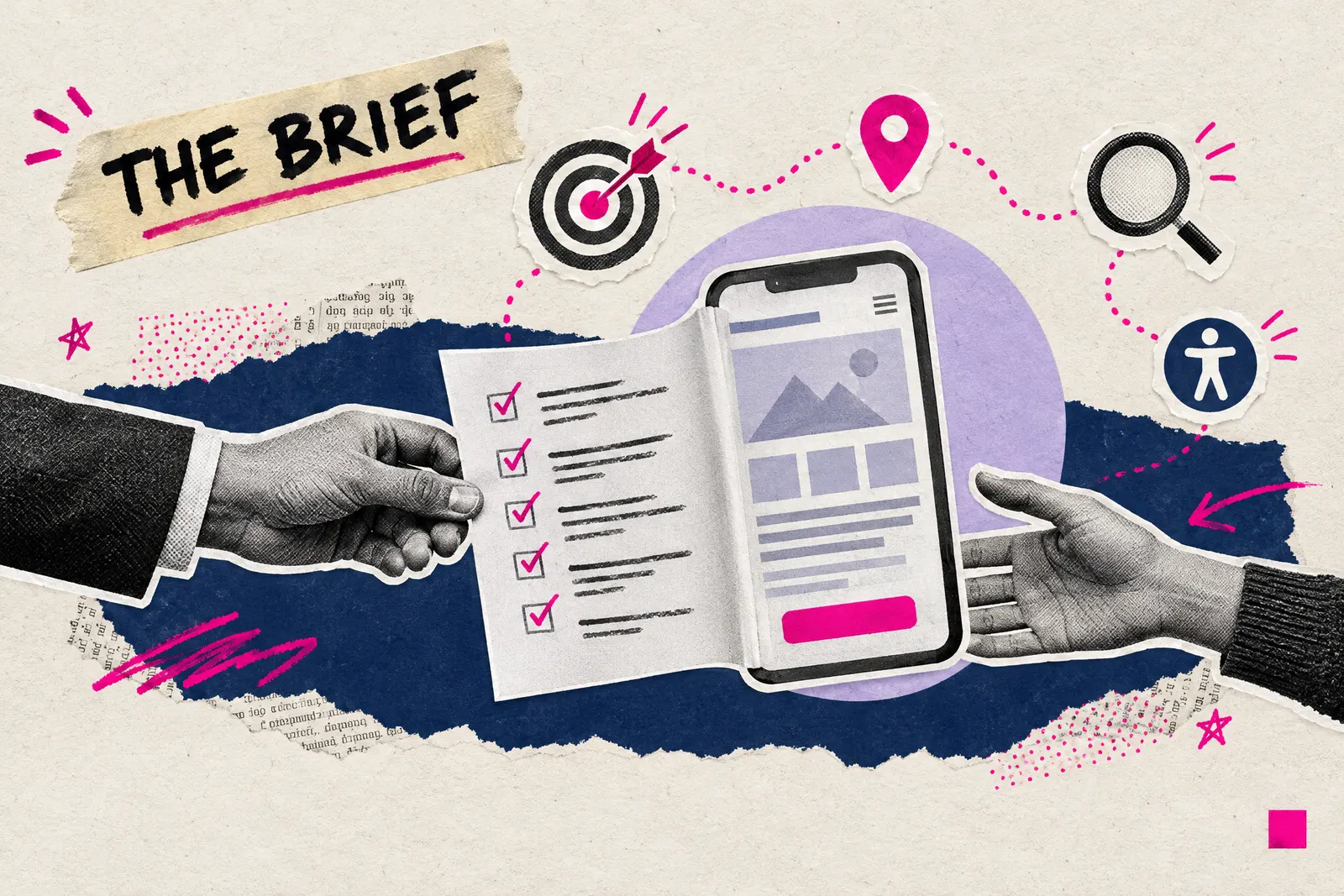
The quality of a website is largely decided before anyone designs a page. It is decided in the brief. Give a designer a clear, outcome-led brief and you get a site built to perform. Give them "make it modern and clean, here are some sites I like" and you get a guess, because that is all they have to work with.
Over fifteen years of website projects, the brief is the part I have seen owners rush most often, and it is entirely in your control. A good one removes ambiguity, cuts revision rounds and gets everyone agreeing what the site is for. This guide covers what to include, what people forget, what a 2026 brief needs to say about search, AI and accessibility, how to judge the designs you get back, and a one-page template you can copy today.
Why does a web design brief matter so much?
Because the website you get is only as good as the thinking behind it. A strong brief saves time, avoids costly back-and-forth and produces a site built around results. A weak brief tends to produce a nice-looking site that does not bring in enquiries, which is the most common and most expensive outcome in web projects.
The cost of a poor brief is hidden but real. It shows up as revision rounds that drift over budget, a launch date that slips, and a finished site everyone is mildly disappointed by because nobody agreed what "good" meant at the start. An hour spent on the brief is far cheaper than a month of corrections.
A brief also protects you. When a design comes back, you can hold it against the goal you wrote down and keep the conversation away from taste. If a fixed-scope package is involved, it settles what is in and out before work begins.
What should a website brief include?
A good brief covers eight essentials. Notice that most of them are about your business and your customers rather than the design. That is deliberate: your job is to define the problem clearly, and the designer's job is to solve it.
| Section | What to give the designer | Why it matters |
|---|---|---|
| 1. Goal | What the site must achieve: enquiries, sales or bookings | Every page is designed towards one outcome |
| 2. Audience | Who your customers are and what worries them | The site speaks to them, in their language |
| 3. Primary action | The single most important thing a visitor should do | Focuses every page on one clear conversion |
| 4. Positioning | Why customers choose you over the alternatives, plus your proof | The site can say why you, beyond what you do |
| 5. Content | Who writes the copy, and what photos, reviews and case studies exist | Content is the usual cause of late launches |
| 6. Must-haves | Essential pages, features and integrations such as booking or payments | Avoids scope surprises later |
| 7. Measurement | How you will know it worked: forms, calls, bookings tracked in GA4 | Turns "I like it" into evidence |
| 8. Examples | Three or four sites you like, and specifically why | Shows taste and intent without dictating design |
The detail that makes the difference is the "why" in your examples. "I like this site" tells a designer nothing. "I like how this one makes the offer obvious on the first screen" tells them exactly what to aim for. If you are unsure how to answer the positioning row, read what brand positioning really means before you write the brief.
What do business owners most often leave out of a brief?
The goal. Many briefs describe what the site should contain but never say what it is for. Finish this sentence before anything else: "This website will be a success if it ___." More enquiries? More online bookings? More qualified sales calls? Name it.
The audience. It is easy to brief a site for yourself, in your own language, around what you find impressive. Define who the site is actually for and what they are worried about when they land on it, and brief for them.
The call to action. If you do not decide the one thing you want a visitor to do, the site will ask them to do everything, and they will often do nothing. Pick the primary action and make it the spine of the brief.
Who owns the content. A designer can build a beautiful template in a fortnight and then wait two months for copy and photos. Say who is writing the words, who signs them off, and whether you have real photography. Our website packages include copywriting for exactly this reason.
What should a 2026 brief say about Google and AI search?
Search has changed since many small business sites were last built. Google said in July 2025 that AI Overviews had passed 2 billion monthly users, and AI Mode launched in the UK on 28 July 2025. Your customers may now meet a summary of your business before they meet your homepage.
Google's own guidance says there is no special optimisation needed to appear in these AI features beyond sound search fundamentals: pages that can be crawled and indexed, clear internal links, important content available as text, structured data that matches the visible page, and an up-to-date Business Profile (Google Search Central). So your brief should ask for exactly those things, in writing:
- One page per core service, written as text, answering the questions customers actually ask.
- Search Console and GA4 set up from launch, with enquiries tracked as conversions.
- Structured data for your business, services and reviews.
- Redirects from every old URL that has traffic or links, if you are replacing an existing site.
Our SEO, AEO and GEO page explains how we build these into a site from the start.
Which technical and legal points belong in the brief?
You do not need to be technical to include these. You just need to ask for them so they are priced and planned:
- Speed and responsiveness. Google's Core Web Vitals now measure Interaction to Next Paint, which replaced First Input Delay in March 2024. A good score is 200 milliseconds or less. Ask your designer how they will test it on mobile.
- Accessibility. Ask for the site to meet WCAG 2.2 at level AA. The standard was published in October 2023 and added criteria such as a minimum target size of 24 by 24 CSS pixels for buttons and links, which matters for anyone tapping on a phone.
- Cookies and consent. The Data (Use and Access) Act 2025 relaxed UK consent rules for some analytics cookies used only to improve a site, provided visitors are told clearly and given a way to object (Blake Morgan). Ask how your cookie banner will handle this; advertising cookies still need consent.
- Ownership. Confirm who owns the domain, the content and the analytics accounts, and what happens to them if you move provider.
What should a Cardiff or South Wales business add to its brief?
If you serve a local area, list every town and district you want work from. A Cardiff trades business covering Penarth, the Vale of Glamorgan, Caerphilly and Newport needs that coverage planned into the site structure and the Google Business Profile from day one. Say which jobs earn you the most, so those service pages get the most attention.
Local search can carry a site a long way when this is done properly. Pest & Property Solutions, a Cardiff pest control company, received 112 enquiries in the first 36 days of its new site, with 82.7% of enquiries coming from Google organic search. The Pest & Property case study shows how the brief translated into pages.
How should you judge the designs you get back?
Judge them against the goal and the primary action you wrote down. That takes discipline, because it is natural to react to a design on taste. The right question is always whether this helps the customer take the action we agreed.
First impressions matter and form fast: a study led by Gitte Lindgaard at Carleton University found people judge a web page's visual appeal within 50 milliseconds, and those snap judgements held up. So look first at the opening screen on a phone. Within a few seconds, can a stranger tell what you do, who it is for and what to do next?
A good designer will sometimes push back on your preferences where they work against conversion. That tension is healthy; you are paying for expertise as well as execution. Agree upfront that the agreed goal wins over personal preference, and you will both make better decisions.
What does a good one-page website brief look like?
Copy this, fill it in and keep it to a single page:
- Goal: this website is a success if it ____.
- Primary action: the one thing I want a visitor to do is ____.
- Audience: my main customer is ____, and they care most about ____.
- Positioning: customers choose us over the alternatives because ____, and our proof is ____.
- Key messages: the three things the site must communicate are ____, ____ and ____.
- Content: copy will be written by ____; photos, reviews and case studies available: ____.
- Must-have pages, features and integrations: ____.
- Areas served: ____.
- Measurement: we will track ____ in GA4 and Search Console.
- Examples I like, and why: ____ because ____; ____ because ____.
- What I do not want: ____.
- Practical: deadline ____, budget or package ____, who signs off ____.
If you cannot complete the first four lines with confidence, that is the real work to do first, and a good agency will help you do it. Our website design projects start with a short discovery session for exactly that reason.