
If you are about to replace your website, this question arrives within a day of looking: do you hire a freelance website designer or a web design agency? Both can build you a good site. Both can also leave you with an expensive one that never brings in an enquiry. The real difference sits around the design itself: who writes the words, who handles search, who answers when the site goes down, and who holds the logins when the relationship ends.
I run Roddy Digital, an AI-first agency in Cardiff, so read this knowing which side of the fence I sit on. Plenty of businesses are better served by a good freelancer, and I will say where. Here is how I would make the call if I were in your shoes.
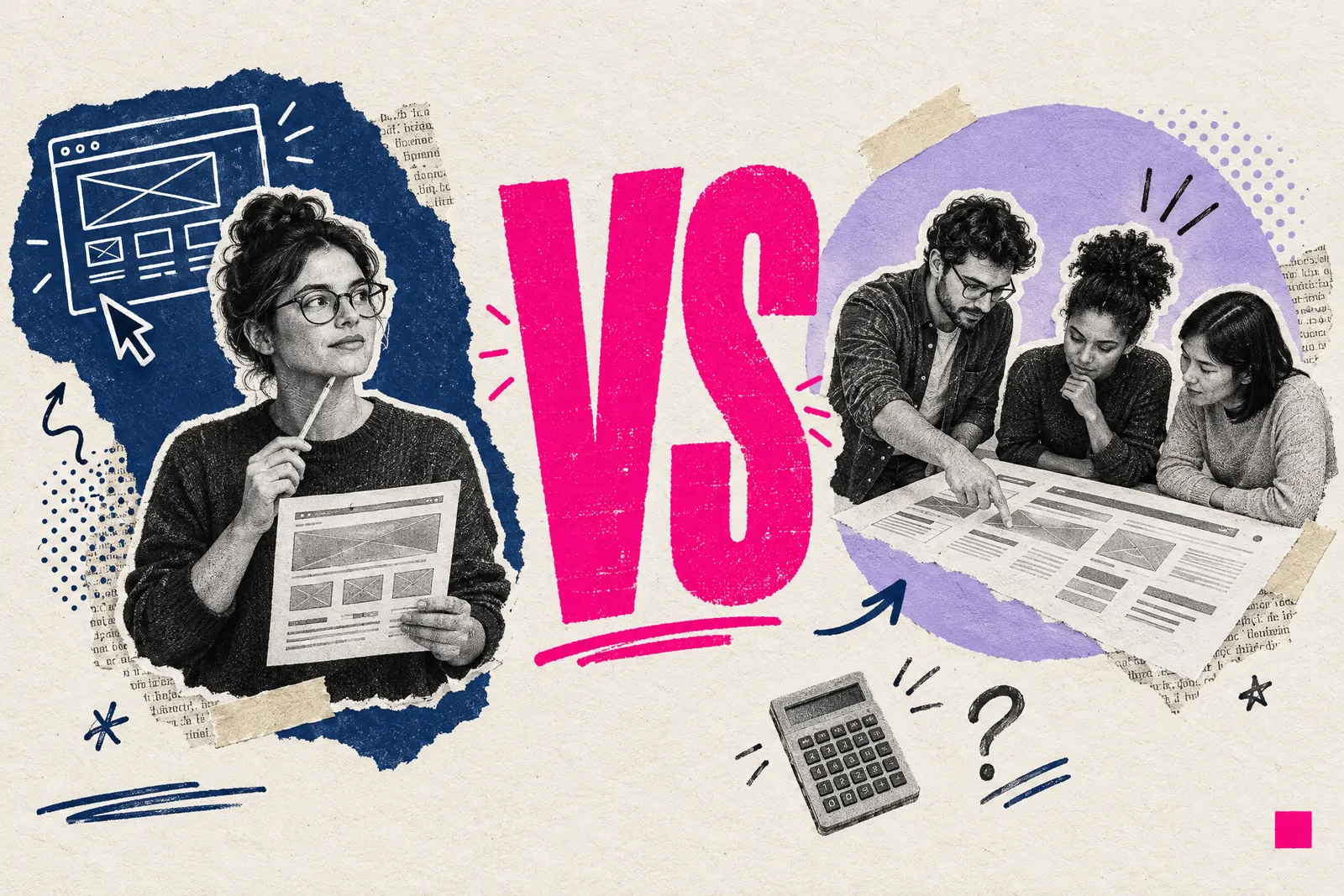
What is the difference between a website designer and a web design agency?
A website designer is usually one person. Some are designers who also build; others are developers with a good eye. They work for themselves, and you deal with them directly from the first call to launch day.
An agency is a business with a team behind the site. Even a small agency splits the work: someone leads strategy and copy, someone designs, someone builds, someone looks after search and hosting. You get a main point of contact, plus people behind them you may never speak to.
There is no shortage of freelancers. IPSE, the association for the self-employed, puts the UK freelance workforce at about 2.046 million people in its most recent count, and designers are part of that group. So availability is rarely the issue. The shape of your project is what decides it.
A useful way to frame it: a freelancer sells you their skill and their time. An agency sells you a process and an outcome, with several skills inside it. Neither is better in the abstract. What matters is which of those your project needs.
When is a freelance website designer the right choice?
A freelancer is often the best value when the job is clearly defined and mostly about design and build. Good signs you are in that position:
- You already know what you want to say. Your positioning is settled, you have the copy or can write it, and you have decent photography.
- The site is small: a handful of pages, a contact form, perhaps a booking link.
- You want one person who knows your project inside out and replies to your messages themselves.
- You are comfortable managing the rest yourself: Google Business Profile, search, analytics and someone to call when something breaks.
- Budget is tight and you would rather pay for craft than for overheads.
A strong freelancer with a portfolio in your sector can produce better design work than a mediocre agency. You also get faster decisions. Nobody is relaying feedback through an account manager, and small changes can happen the same afternoon.
The trade-off is breadth. Most freelancers are very good at one or two things. If your designer is excellent at layout but has never set up Google Search Console, or has no view on what your homepage headline should say, those gaps land on your desk. Or worse, on nobody's.
When does a web design agency make more sense?
An agency earns its fee when the website has to do more than look right. That usually means one or more of these is true:
- The site needs to bring in enquiries, so messaging, page structure, search foundations and conversion matter as much as the visuals.
- You do not have settled copy and need someone to work out what to say, and to whom.
- The site connects to other things: a CRM, booking or quoting tools, automated follow-up or a client portal.
- You want proper care after launch, covering hosting, security, backups, updates and someone accountable when things go wrong.
- The business cannot afford for the project to stall if one person falls ill, takes a full-time job or goes travelling for three months.
That last point is underestimated. Continuity is a large part of what you pay an agency for. If a solo freelancer steps away, your project or your support stops with them. A team with a documented process can carry on.
The fair criticism of agencies is cost, and some pad projects with meetings and layers of sign-off. You can also be handed to a junior once the pitch is won. Ask who will do the work day to day, and meet them before you sign.
Is there a middle option between a freelancer and an agency?
Yes, and it deserves a look. Many small studios are two to five people, often a designer and a developer who work together permanently, sometimes with a trusted copywriter on call. You get more breadth than a solo freelancer and more direct contact than a large agency.
Some freelancers also work in loose collectives, bringing in a copywriter or search specialist for each project. That can work well. Check who holds the contract, who you pay, and who is responsible if one part goes wrong. If the answer to that last question is "it depends", you are carrying the risk.
Founder-led agencies sit close to this space too: smaller teams, with the founder involved in the work as well as the pitch. Roddy Digital is one of them. The model suits businesses that want senior attention and a single accountable partner without the overheads of a large agency.
How do the costs of a freelancer and an agency compare?
Freelancers usually price by the day or by the project. IT Jobs Watch, which tracks UK contract adverts, shows a median daily rate of £330 for web designer contracts in the six months to 15 October 2026. Contract roles are only a rough guide to what a small business will pay, and rates vary a lot with experience, but it is a useful yardstick. At that rate, a small brochure site that took eight to ten days would cost roughly £2,640 to £3,300, before copy, photography or hosting.
Agencies price in a few ways: a one-off project fee, a monthly package or a longer partnership. Our own website packages run on a 12-month term from £350 a month plus VAT for up to 10 pages, with design and build, copywriting, on-page SEO foundations, GA4 and Search Console, Google Business Profile set-up, hosting, SSL, security and backups included. The full breakdown is on our website packages page.
The fairer comparison is total cost over the first year, so add up every line rather than the build price alone:
| Cost line | Freelancer (often) | Agency (often) |
|---|---|---|
| Design and build | Day rate or project fee | Project fee or monthly package |
| Copywriting | Extra, or your job | Included or quoted together |
| SEO foundations | Varies by person | Usually part of the build |
| Hosting, SSL and backups | Separate bill | Often included |
| Changes after launch | Hourly or day rate | Allowance or hourly rate |
| Cover if someone is away | Rarely | Team cover |
For local figures, see how much a website costs in Cardiff in 2026, and for what should sit inside a monthly plan, read website packages explained.
What are the risks with each, and how do you protect yourself?
Most website horror stories come from the same few gaps, whoever you hire. Close them at the start and either route is safe.
Who owns the domain?
Your domain should be registered to your business, with you as the registrant. For .uk domains you can check the record with Nominet's WHOIS lookup. If your designer registered it in their own name for convenience, ask them to transfer it now, while relations are good.
Who holds the logins?
You should have admin access to the website, the hosting, Google Analytics, Search Console and your Google Business Profile. Your supplier can have their own access alongside yours. Keep a simple list of every account and who controls it.
Who handles your customers' data?
If your website collects enquiries, someone is handling personal data on your behalf. The ICO says that when a processor handles personal data for you, there must be a written contract setting out what they can and cannot do with it. Agencies usually cover this in their terms. Many freelancers do too, but check before launch.
What happens if they stop?
Ask directly: if you stopped trading tomorrow, how would I get my site, my files and my hosting back? A good supplier, freelance or agency, will have a clear answer. Get the handover terms in writing.
What questions should you ask before hiring either?
Use the same questions for everyone on your shortlist. The answers will tell you more than the portfolio.
- Who will do the work day to day, and can I speak to them before I sign?
- Who writes the copy, and is it included in the price?
- What do you set up for search at launch: page titles, meta descriptions, schema, Search Console and Google Business Profile?
- How will we measure whether the site is working once it is live?
- Who owns the domain, the design files and the content when the project ends?
- What does support cost after launch, and how quickly do you respond?
- Can you show me a site you built that brings in enquiries, and what changed for that business?
The last question separates people who build websites from people who build websites that win work. For example, the Pest & Property Solutions site we launched in June 2026 brought in 112 enquiries in its first 36 days, with 82.7% of them coming from Google organic search. Ask every supplier for evidence of that kind, measured, from a real client.
If you want to get your thinking straight before you speak to anyone, read how to brief your web designer. A clear brief makes both freelancers and agencies quote more accurately.
Which should a Cardiff small business choose?
Cardiff has a healthy mix of freelancers, small studios and agencies, from Pontcanna and Canton to the city centre and the Bay, so you will not be short of options. Being able to meet locally is useful, especially if you want someone who knows which parts of the city and the Vale your customers search from. It matters less than skill, process and proof of results. Plenty of website projects run well on video calls; ours run on Zoom.
My rule of thumb:
- Choose a freelancer if your site is small, your message is clear, you have the copy, and you are happy managing search and support yourself or through other suppliers.
- Choose a small studio if you want a tight team and direct contact, and your needs are mainly design and build with some help on copy.
- Choose an agency if the website needs to win enquiries, connect to other systems or be looked after properly once it is live, and you want one accountable partner for all of it.
If you are in the last group, have a look at our website design service. If you are in the first, find a freelancer with work in your sector, run them through the questions above, and there is every chance you will be very happy with the result.