
You pay for every click on Google Ads, so where that click lands has a direct effect on what each enquiry costs you. Plenty of small business campaigns send ad traffic to the homepage, mainly because it is the page that already exists. Sometimes that is fine. More often it quietly wastes budget.
This guide compares the three realistic destinations (your homepage, an existing service page and a dedicated landing page), explains when each one makes sense, and sets out what a good ad landing page includes, how to track it and what it costs. If you would rather have the page designed, written and built for you, that is what our landing page design service covers.
Should Google Ads go to a landing page or your website?
For most service businesses running lead generation ads, a dedicated landing page converts more of the clicks you pay for. The searcher typed something specific, your ad promised something specific, and the page they land on should carry on that same conversation without making them hunt for it.
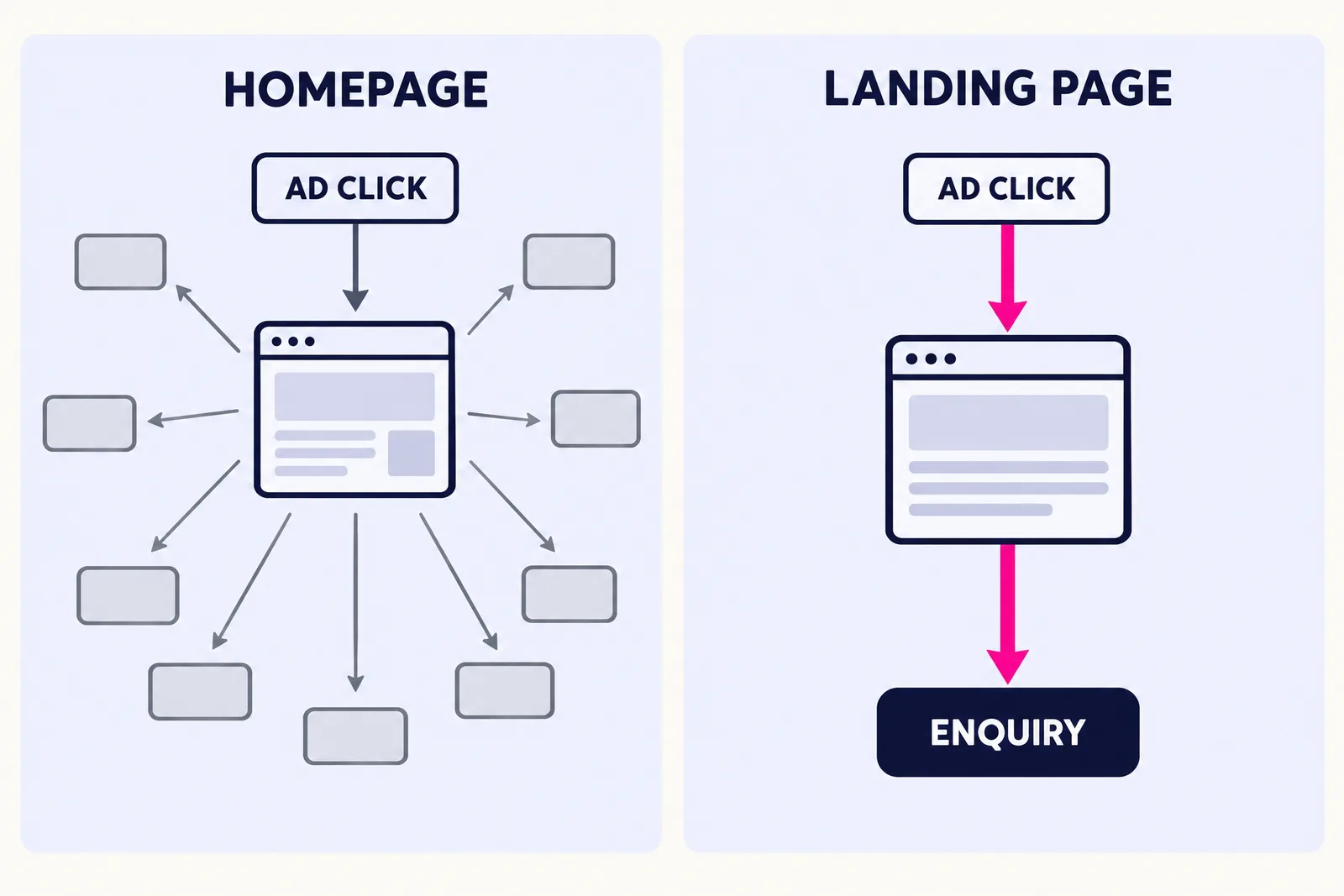
A homepage is built to serve everyone: new visitors, returning customers, job applicants and suppliers. That is its job. An ad click comes from one person with one need at one moment. Sending them to a page built for everyone asks them to do the sorting themselves, and paid visitors are rarely patient. If your site already gets visits but few enquiries, the same pattern is usually at work, which we cover in why your website isn't converting.
Your website still matters here. Many people check the main site before they enquire, and some campaigns are better pointed at an existing page. The sections below set out when each option fits.
What is the difference between a landing page and a website page?
A landing page is a single page built for one campaign, one audience and one action. A website page is part of a wider site, linked into the navigation and written to serve several kinds of visitor.
| Homepage | Service page | Dedicated landing page | |
|---|---|---|---|
| Main job | Introduce the whole business | Explain one service | Turn one type of ad click into an enquiry |
| Navigation | Full menu and many links | Full menu | Minimal or none |
| Match to the ad | Low | Medium to high | High, written for the ad group |
| Actions on the page | Many | A few | One, repeated down the page |
| Organic search value | High | High | Usually low, often kept out of organic results |
| Effort to set up | Already exists | Exists, may need edits | New page per service or campaign |
| Best for | Brand searches | Strong pages that already match the search | Service and local lead generation |
The service page is the middle option people forget. If yours already answers the search, has a clear call to action and loads quickly on a phone, it can perform close to a landing page. If it reads like a brochure, expect brochure results.
Why does a homepage usually lose ad traffic?
Because it breaks the thread between the search, the ad and the page. Someone searching for emergency boiler repair who lands on a page about your company history has to work out whether you can help, and many will press back before they do.
Google measures this thread. Landing page experience is one of the three parts of Quality Score, alongside expected click-through rate and ad relevance, and Google describes it as how relevant and useful your landing page is to people who click your ad. Google is clear that Quality Score itself is a diagnostic and not an input in the auction, but a low landing page rating is a useful warning that the page is letting down the people you paid to bring there.
The cost of that is easy to see with some simple arithmetic. LocaliQ's 2025 search advertising benchmarks, drawn mostly from US campaigns between April 2024 and March 2025, put the average conversion rate at 7.52% and the average cost per lead at $70.11 (reported by PPC Land). At that average, 100 clicks bring seven or eight enquiries. If your homepage converted at half that rate, the same spend would bring three or four, and each one would cost twice as much. Every improvement to the page lowers the cost of each enquiry without touching the bid.
Worth knowing: speed is part of the experience. Google's own help pages note that, for retail, a one-second delay on mobile can impact mobile conversions by up to 20 percent. A heavy homepage with sliders, video and pop-ups is often the slowest page on the site.
When is your existing website the right destination?
When the page already matches the search. There are four common cases, and each has one thing to watch.
- Brand searches. Someone searching for your company name wants you, so the homepage is the natural destination. Watch out for paying for clicks you would have won organically; check the search terms report regularly.
- Strong service pages. A page dedicated to one service, with a clear enquiry route near the top, can take ad traffic for that service. Watch out for menus, sidebars and blog links that pull people away before they enquire.
- Ecommerce product and category pages. For product searches and Shopping ads, the product page effectively is the landing page. Watch out for slow loading and delivery costs that only appear at checkout.
- Early testing on a small budget. If you are checking whether a search term brings any demand at all, an existing page lets you start this week. Watch out for judging the whole channel on a page that was never built for it.
One newer setting to check: Google's AI Max for Search campaigns include final URL expansion, which Google says can send traffic to the most relevant URLs on your website when it predicts better performance. If you have built a dedicated landing page, review this setting and use URL exclusions, so your paid clicks are not quietly routed to a blog post or your careers page.
What should a Google Ads landing page include?
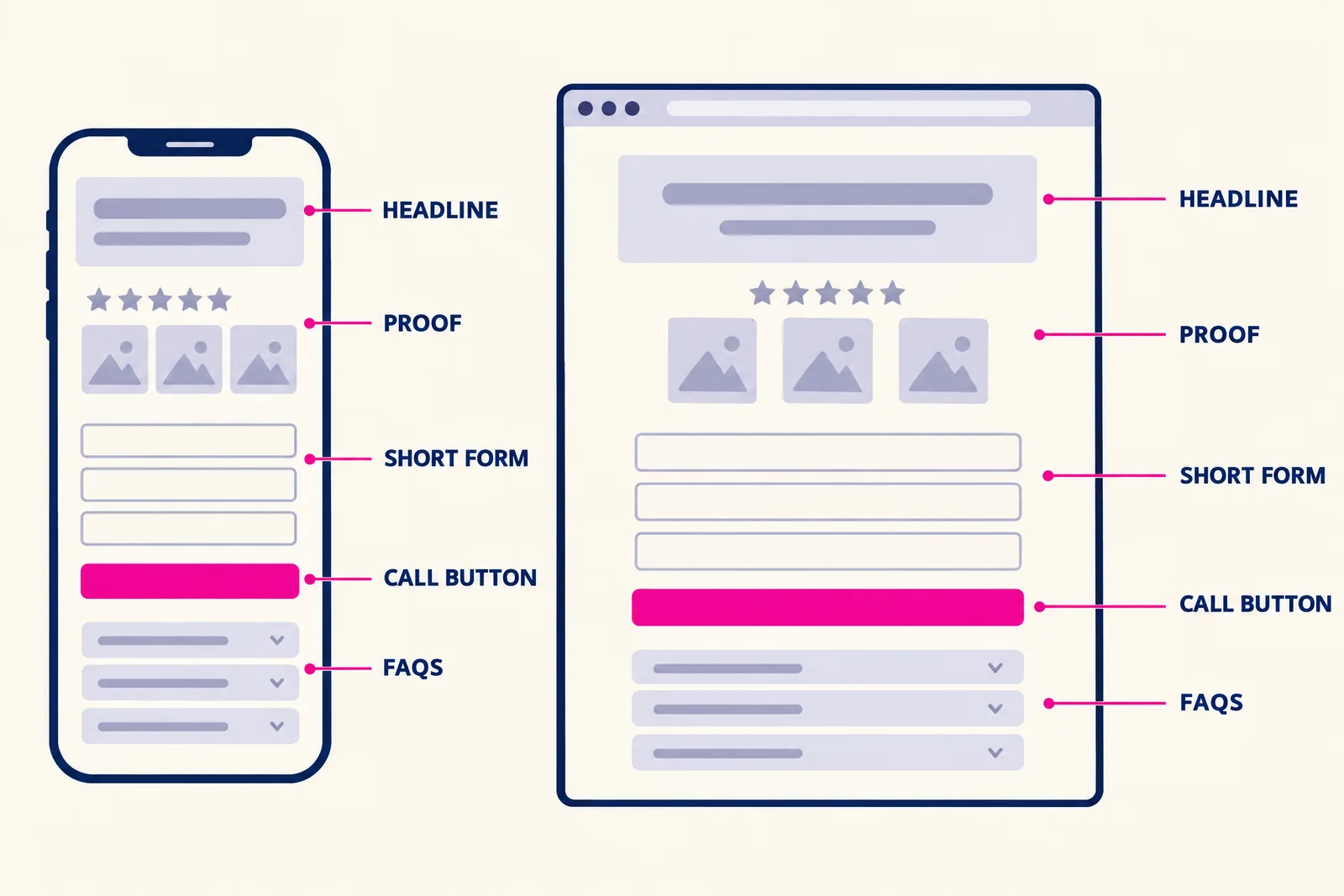
A headline that mirrors the search, one clear offer, proof, a short form or a phone number, and answers to the questions that stop people enquiring. Everything else is optional.
- A headline that repeats the search. If the ad group is about emergency electricians, the headline says emergency electrician and names the area you cover.
- One offer and one action. A free quote, a callback, a site visit or a booking. Pick one and repeat the same button further down the page.
- Proof near the top. Reviews, clients people will recognise, accreditations you actually hold and photos of real work. Keep it current.
- A short form and a tap-to-call number. Ask only for what you need to respond. On a phone, the call button often does as much work as the form.
- Answers to objections. Price guidance, how quickly you respond, the areas you cover and what happens after someone enquires. A few short FAQs handle this well.
- Speed and transparency. A page that loads quickly on mobile, shows who you are and how to reach you, and links to your privacy policy.
Keep the words plain. Unbounce's analysis of more than 41,000 landing pages found that simpler, shorter copy typically converted better: pages written at the easiest reading levels converted at 11.1%, against a median of 6.6% across all industries (Unbounce Conversion Benchmark Report). For more on turning visits into enquiries once people arrive, see our guide to converting more enquiries.
Where this goes wrong: one landing page for every campaign. If you advertise three services, you need three pages, each written for its own ad group.
How do you know if the landing page is working?
Measure the page by the enquiries it produces. Set up conversion actions for form submissions and calls, then judge each page on its cost per enquiry and on the quality of the leads it brings.
- Count every route. Record form submissions, calls from the ad itself and calls from the tap-to-call button on the page, and link Google Ads to GA4 so you can see what visitors did before they enquired.
- Check consent and tags together. If you advertise to people in the EEA, Google requires you to collect consent and pass consent signals through Consent Mode, or you lose personalised and remarketing features there (Search Engine Journal explains the detail). Wherever you advertise, test that your cookie banner and tags work together, because a broken set-up can leave real enquiries unrecorded.
- Test one thing at a time. Change the headline, the offer or the form length, never all three at once, and give each version enough clicks to judge fairly.
- Look past the form. Ask your team which enquiries became quotes and which became work. A page that brings fewer but better leads may be the better page.
The page only wins the enquiry. What happens in the next hour decides whether it turns into work, which is why landing pages and follow-up belong in the same plan. Our piece on why leads go cold covers that half of the job.
What does a landing page cost, and is it worth it?
It depends on how many pages you need and who builds them, but the page is a one-off cost and wasted ad spend repeats every month. That is why I treat the destination as the first thing to fix in a Google Ads account, ahead of bids and budgets.
There are three common ways to get one built:
- A landing page builder. A subscription tool with templates you edit yourself. Best for marketers who want to test lots of versions quickly. Watch out for another monthly subscription, pages on a separate subdomain and designs that drift away from your brand.
- A page built into your website. A new page on your existing site, usually left out of the main menu. Best for businesses that want content, tracking and hosting in one place. Watch out for site templates that force the full menu and footer onto the page.
- An agency or developer build. A page designed, written and built for the campaign. Best for businesses that want the copy, design and tracking done together. Watch out for pages handed over without conversion tracking or a plan for testing.
At Roddy Digital we quote landing pages on a fixed scope, and smaller changes to an existing page are charged at our hourly rate of £95 + VAT. If the bigger issue is the website itself, our website packages explained article shows what a full build includes, with GA4, Search Console and on-page SEO foundations set up as standard.
Where should a city-based business running local ads start?
Start with one landing page for your most profitable service in the area you most want work from, then add pages as each campaign proves itself.
Local searchers want to know quickly that you cover them. Name the town or district in the headline, show jobs or clients from the area if you have them, and make your service area plain. For example, for most companies in Cardiff and South Wales, a page for each core service that names Cardiff and the surrounding areas they genuinely serve, such as the Vale of Glamorgan, Newport or Caerphilly, will match local searches more closely than a homepage trying to speak to everyone.
Point each local ad group at its matching page, then let the cost per enquiry tell you where to build next.