

Most sales proposals lose for the same reason: they read like a brochure when the buyer wanted a decision document. The prospect already liked you on the call. What they need now is something they can read in ten minutes, forward to whoever else signs off, and say yes to without phoning you to ask what something means.
I started out in sales before I moved into marketing, and more than twenty years in, I still read every proposal as a sales document first and a design job second. This guide covers the structure that works for a service business, how to present price, the mistakes that quietly kill deals, and a one-page checklist to run before you hit send. If your proposals keep stalling because the words are not landing, our messaging and copywriting service is where we fix that.
What should a sales proposal actually do?
A sales proposal should confirm a decision the buyer has mostly made already, in writing, so that saying yes feels safe. It recaps the conversation, shows you understood the problem, sets out clear choices and asks for one next step.
By the time it goes out, most of the selling should be done. If you send a proposal to someone you have not properly spoken to, you are asking a document to do the work of a conversation, and it usually loses. The best proposals contain no surprises: the price, scope and timings have all been talked through on the call, and the document simply puts them somewhere the buyer can point to.
It also has a second reader you will probably never meet. In most businesses above a handful of people, someone else (a finance director, a business partner, a spouse who co-owns the company) will read it cold. Proposify's State of Proposals 2026 report, which looked at more than 742,000 proposals sent through its platform in 2025, found close rates rise by 20% when more than one stakeholder views a proposal. Write for the person who was not on the call.
What should go in a sales proposal?
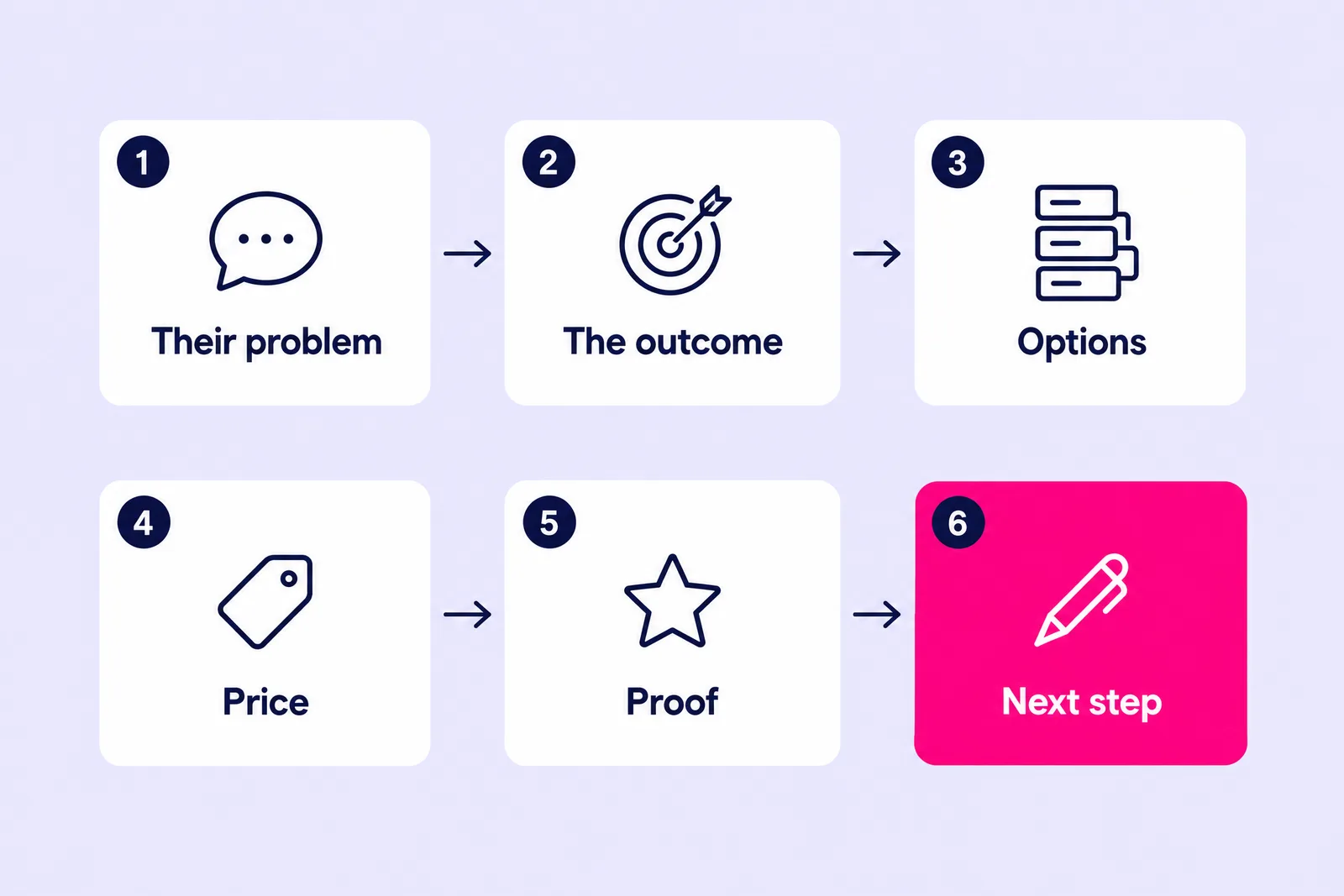
A winning service proposal has six parts, in this order: the problem in the client's words, the outcome they want, two or three options with clear scope, the price, proof that you can do it, and a single next step. Everything else is optional.
1. The problem, in their words
Open with the client's situation, written the way they described it. Go back through your call notes and use their phrases. If they said "we lose jobs because nobody rings people back", write exactly that; "lead response optimisation" means nothing to them. This is the section that tells the reader you were listening, and it is the one most proposals skip in favour of a page about the agency.
For example, a Cardiff building contractor might tell you their website looks fine but the phone has gone quiet since a competitor redesigned theirs. That sentence, nearly word for word, is your opening paragraph.
2. The outcome they want
State what will be different when the work is done, in terms the buyer cares about. More booked surveys, fewer hours spent chasing invoices, a website the sales team is happy to send people to. Keep it specific and realistic. Never promise a number you cannot control, and never borrow results from another client to imply they will get the same.
3. Options with clear scope
Give two or three ways to solve the problem, each with exactly what is included. Options change the question in the buyer's head from "should we do this?" to "which version should we do?", which is a far easier decision to make. Scope matters as much as the options themselves: list what is in, what is out, and what happens if the scope changes.
4. The price
Show the price plainly, next to each option, with VAT, payment terms and how long the price is valid. We cover the detail in the pricing section below, because this is where most proposals wobble.
5. Proof
Add one or two pieces of relevant evidence: a short case study from a similar business, a named testimonial, or a link to live work. One close match beats ten loosely related logos. If you are newer and have little proof, explain your process in plain steps instead, so the buyer can see how the work will run.
6. One next step
End with a single, specific action: sign here, reply to confirm Option B, or book a 20-minute call to go through it. Give a date. A proposal that ends with "let us know if you have any questions" hands control of the timeline to the buyer, and the buyer is busy.
How long should a sales proposal be?
A sales proposal should be as short as it can be while still answering every question the buyer will have. For most small service projects that is two to six pages, with a one-page summary at the front that could stand on its own.
Length on its own does not win. In the Proposify data, winning proposals averaged 11 pages and losing ones 13, across a wide range of industries and deal sizes. The same report found buyers spent 25.3 minutes on proposals they went on to sign against 15.8 minutes on ones they rejected. Read together, the data suggests buyers give more time to proposals that are easy to read, whatever their length.
A practical rule: if a section does not help the buyer decide, move it to an appendix or cut it. Company history, team photos and a list of every service you offer rarely help anyone choose. Worth knowing: the one-page summary is the part that gets forwarded, so write it last and make sure it covers the problem, the recommended option, the price and the next step.
How should you present the price in a proposal?
Present the price clearly, close to the options, and in a format the buyer can compare at a glance: a short table with each option, what it includes, the price and the payment terms. Hiding it at the back only makes buyers hunt for it and trust you less.
A few rules make pricing easier to accept:
- Lead with the recommended option. Put the option you would choose in their position in the middle or first, and say why in one sentence.
- Say whether it is a quote or an estimate. In UK practice a quotation is an agreed fixed price and an estimate is an approximate price that may change. Buyers notice the difference, so be explicit.
- Show VAT clearly. State whether prices include or exclude VAT. Business buyers usually expect prices plus VAT; say so plainly.
- List what is not included. A short "not included" list prevents most scope arguments before they start.
- Set an expiry date. A price valid for 30 days gives the buyer a reason to decide and protects you if costs move.
- Explain payment terms. Deposit, stages, monthly or on completion. Unclear terms are a common reason a signed-off proposal stalls in finance.
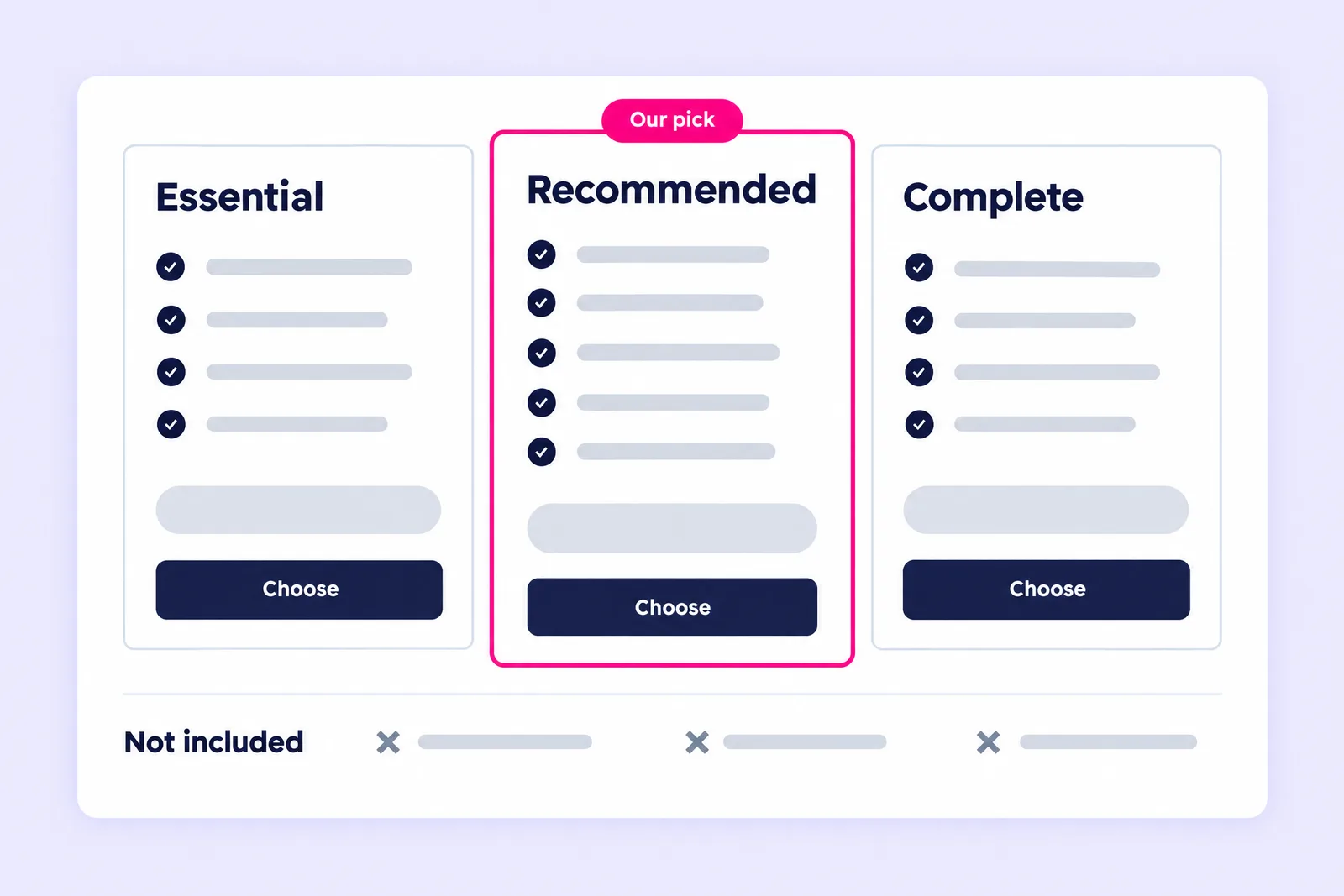
Here is the shape we use for a three-option page. The numbers are placeholders; the structure is the point.
| Option | Best for | What is included | Price and terms |
|---|---|---|---|
| Essential | Fixing the most urgent problem first | The core deliverable only, with one round of changes | Fixed price, plus VAT, 50% deposit |
| Recommended | Solving the problem properly in one go | Everything in Essential, plus the pieces that make it work day to day | Fixed price, plus VAT, staged payments |
| Complete | Businesses that want it handled and maintained | Everything in Recommended, plus ongoing support for an agreed term | Set-up fee plus monthly fee, plus VAT |
Where this goes wrong: three options that differ only in quantity (five pages, ten pages, fifteen pages) give the buyer nothing to think about except price. Make each option solve the problem to a different depth.
What are the most common sales proposal mistakes?
The most common mistakes are opening with your company instead of their problem, burying the price, offering no clear choice, and ending without a next step. Each one gives the buyer a small reason to put the decision off.
- Starting with "About us". The buyer already knows who you are; they took the call. Lead with their situation and put your credentials in the proof section.
- Copying and pasting from the last proposal. A template is good for layout and terms. The problem and outcome sections must be written fresh every time, or the buyer can tell.
- Writing in jargon. If the person who was not on the call cannot follow it, it will not get signed. Plain English wins.
- Vague scope. "Ongoing support" or "SEO optimisation" means different things to different people. Spell out what you will do, how often and what you will report.
- Too many options. Two or three is enough. Five options create a comparison job the buyer did not ask for.
- No expiry date. Without one, a proposal can sit in an inbox for months and then come back expecting last year's price.
- Sending it and waiting. Once the proposal lands, the real closing work begins.
A simple fix for the first three: keep your design and terms locked in one master template and only rewrite the copy. At Roddy Digital, every proposal comes from one locked master template, so the time goes into the parts that change the decision.
What should you do after you send a sales proposal?
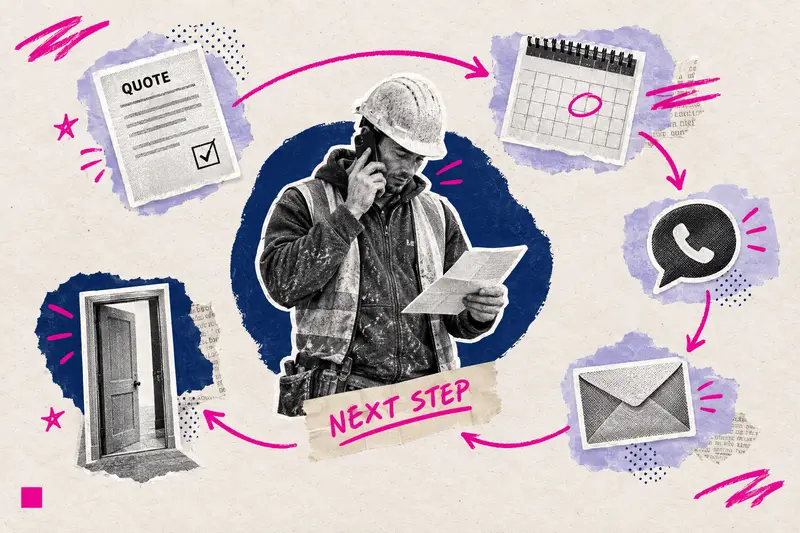
Walk the buyer through the proposal on a short call as well as emailing it, then follow up on a set schedule until you get a clear yes or no. A proposal sent without a follow-up plan is the most common place for a warm lead to go cold.
The best approach is to book the walkthrough at the end of the discovery call: "I will send it on Tuesday, can we take 20 minutes on Thursday to go through it?" That way the buyer reads it with you, asks questions in real time, and you hear objections while you can still answer them. We run these on Zoom and record them, which also gives the second decision-maker something to watch.
After that, follow up with something useful each time: an answer to a question they raised, a revised option, a relevant example. Revisions are worth making. Proposify's data found close rates rose with each revision, by 18% after one and 45% after three. That suggests buyers who ask for changes are engaged, so treat a request to adjust as a buying signal.
For the full follow-up routine, including what to say at each stage, see our guide on how to follow up on a quote without being pushy, and if deals tend to stall before the proposal stage, why leads go cold covers the system behind it.
Is there a one-page checklist for a sales proposal?
Yes. Run through this list before every proposal goes out. If you cannot tick an item, fix it first.
- The opening describes the client's problem in their own words, from your call notes.
- The outcome is specific, realistic and something the buyer cares about.
- There are two or three options, each solving the problem to a different depth.
- Every option lists what is included, and there is a short "not included" list.
- Prices sit next to the options, with VAT stated and payment terms explained.
- It says whether this is a fixed quote or an estimate, and when the price expires.
- There is at least one piece of relevant proof: a similar case study, testimonial or live example.
- A one-page summary at the front could be forwarded on its own and still make sense.
- Someone who was not on the call could read it and understand it.
- It ends with one next step and a date.
- The walkthrough call is already booked.
If the problem section is the hardest part to write, it usually means the offer itself is not sharp yet. Our guide on how to write a value proposition is a good place to tighten that before you rewrite the template, and converting more enquiries covers the steps either side of the proposal.