
Quick answer: An email follow-up sequence is a planned set of messages sent after a quote or enquiry, each one adding something new. The version that works for most service businesses is five touches on days 1, 3, 7, 14 and 30: a thank you, a useful answer, a specific next step, a plain check-in and a courteous close. Written once, it runs for every lead.
You sent the quote on Tuesday. It is now the following Thursday. You have not heard a word, and you are not sure whether chasing makes you look keen or desperate. So you leave it, and the job goes to whoever did not leave it.
That silence is where most service businesses lose money, and it has nothing to do with the quality of the work or the price. Nobody decided against you. They got busy, the email slipped down the inbox, and the next time they thought about it the moment had passed.
A follow-up sequence fixes this without turning you into a pest. This guide gives you the structure we build for clients, the thinking behind each message, and copy you can adapt this afternoon.
Why does email still work for follow-up?
Because it is the one channel the buyer already uses to make the decision. The quote arrived by email. The questions came by email. The approval, when it comes, will almost certainly be an email with "go ahead" in it. A follow-up that lands in the same thread, with the same subject line, sits exactly where the decision is being made.
Social posts are seen by whoever happens to be scrolling. A phone call interrupts. A text feels personal in a way that is not always welcome from a supplier. Email is asynchronous, searchable and expected. It is also the only one of those channels you can automate properly without it feeling automated, provided the messages are written like a person wrote them.
The reason email gets written off is that most follow-up emails are terrible. "Just checking in", "bumping this to the top of your inbox", "did you get a chance to look at my proposal". None of those give the reader a reason to reply. The fix is the content of the sequence, not the channel.
What should a follow-up sequence contain?
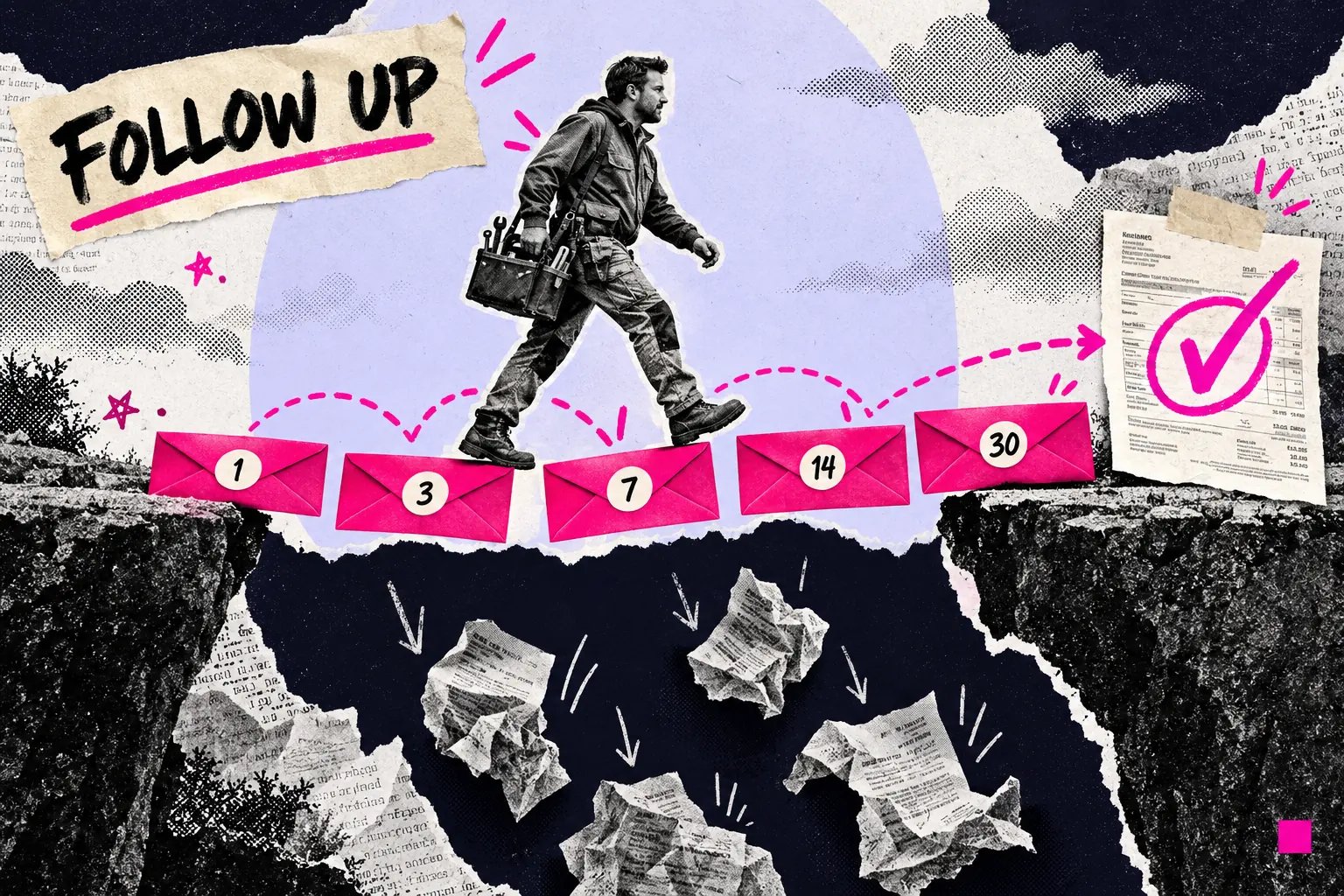
Five messages, over thirty days, each one doing a different job. This is the 1-3-7-14-30 sequence.
| Day | Touch | Job of the message | Subject line pattern |
|---|---|---|---|
| 1 | Thank you and confirm | Prove it arrived, set the next step, remove friction | Your quote for [job], and what happens next |
| 3 | Add value | Answer the question they have not asked yet | One thing people ask about [job] |
| 7 | Specific next step | Make saying yes easy with a date or an option | Two ways to take [job] forward |
| 14 | Plain check-in | Ask directly, give permission to say no | Still the right time for [job]? |
| 30 | Courteous close | Close the loop, leave the door open | Closing the file on [job] |
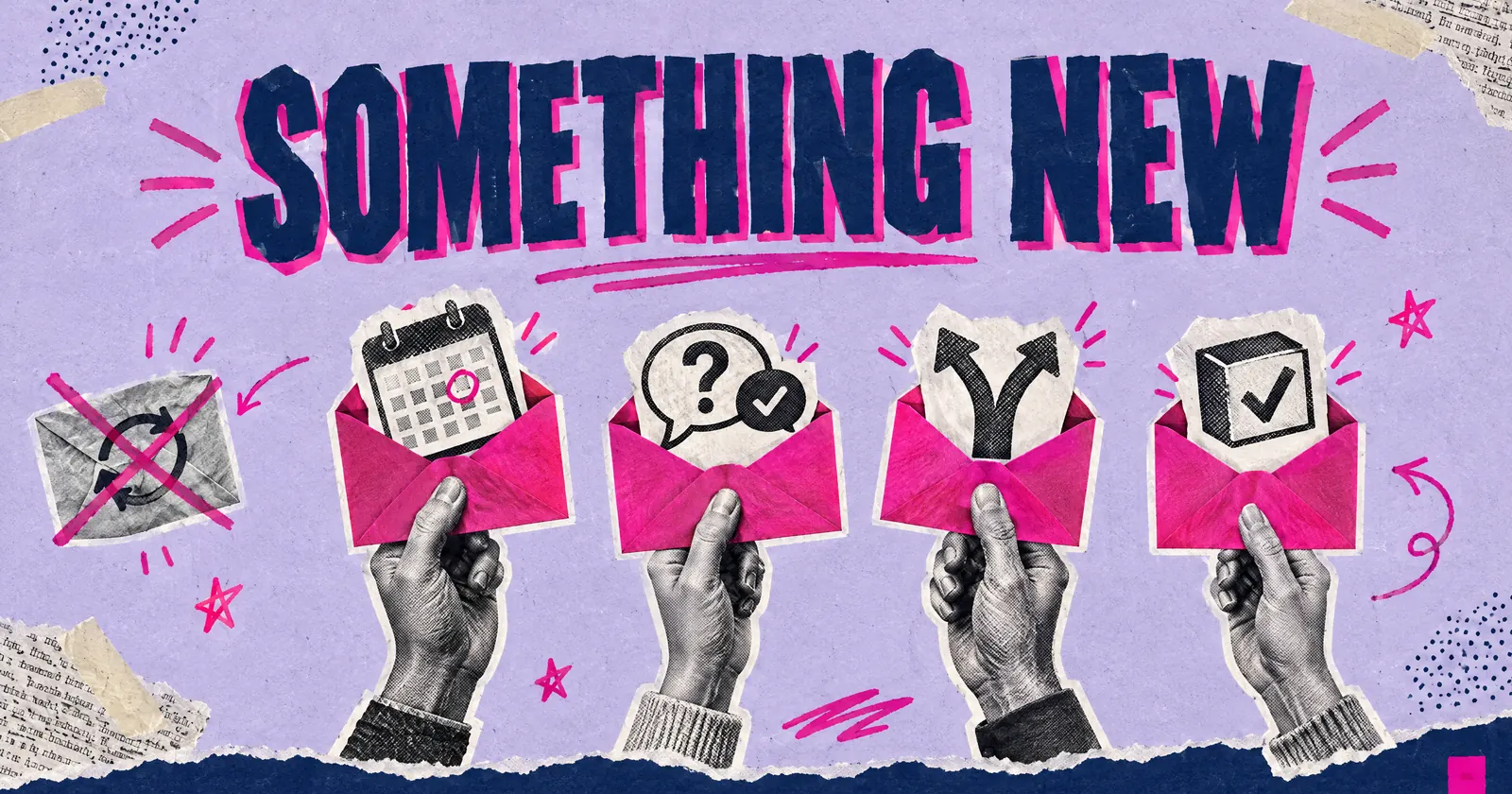
The rule that makes it work: every touch adds something the last one did not. A date, a document, an answer, an option, a decision. If a message only repeats the ask, delete it. Repetition is what makes follow-up feel like nagging; new information is what makes it feel like service.
Day 1: thank you and confirm
Send this the same day as the quote, ideally within the hour. It confirms the quote arrived, says in one line what happens next, and asks one easy question.
Thanks for talking me through the kitchen extension this morning. The quote is attached, and it covers everything we discussed including the steel and the making good.
If it works for you, the next step is a thirty-minute site visit to confirm measurements, and I can hold the week of 10 November until Friday. Would a morning or an afternoon suit better?
Notice there is a date, a hold and a choice. The reader can reply with one word.
Day 3: add value
This is the message most businesses never send, and it is the one that separates you from the other two quotes. Pick the question that comes up on every job of this type and answer it before they ask.
One thing nearly everyone asks at this stage is whether they need to move out while the work is done. For an extension like yours the answer is usually no: the kitchen stays usable until the last ten days, and we set up a temporary sink and hob in the dining room for that stretch.
Happy to walk you through the sequence if it helps the decision.
No ask beyond the offer to help. You have shown you understand their situation better than the alternative supplier, and you have done it in four lines.
Day 7: a specific next step
A week in, be direct about moving forward, and give two options rather than an open question.
Wanted to make it easy to take this forward. Two options:
- Confirm the site visit for the week of 10 November and I will send the booking straight over.
- If the timing has moved, tell me the month you have in mind and I will pencil it in now so you are not waiting on availability.
Either way, a one-line reply is all I need.
Day 14: the plain check-in
Two weeks on, ask the question honestly and give them permission to say no. People reply to this one because it costs them nothing.
Is this still the right time for the extension? If you have gone another way or paused it, that is completely fine; let me know and I will stop chasing. If it is still live, tell me what is holding it up and I will see if I can help.
The phrase "I will stop chasing" is doing a lot of work. It tells the reader you respect their inbox, and it often produces the real reason the decision has stalled, which is usually something you can solve.
Day 30: the courteous close
A month after the quote, close the loop. Treat it as a reset rather than a goodbye, so the next contact feels natural.
I am going to close the file on this one so you do not keep hearing from me. The quote stands for sixty days from the date on it, and if the project comes back to life you can reply to this thread any time and we will pick up where we left off.
Thanks again for considering us.
Closing properly is what lets you follow up again in three months without it being awkward.
How do you run the sequence without doing it by hand?
Start by hand for a fortnight. Write the five emails as templates with square brackets where the detail goes, keep them in a notes file or your email client's templates, and set a reminder for each quote. Two weeks of doing it manually teaches you which messages get replies and which need rewriting, and that is worth more than any tool.
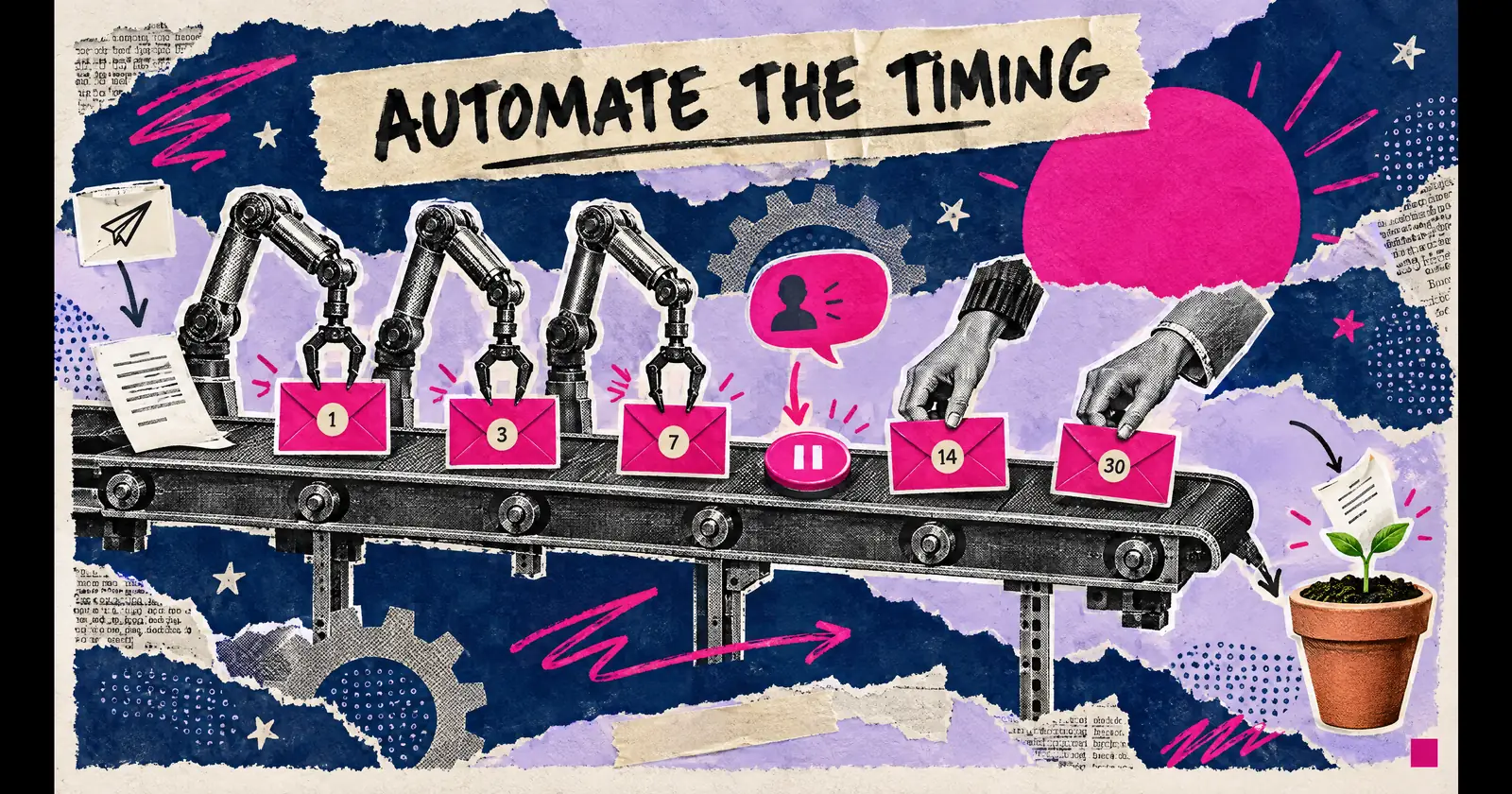
Then automate the parts that do not need you. Most CRMs, including the free tiers of the popular ones, let you enrol a contact in a sequence when a deal moves to "quote sent" and stop it automatically when they reply. Where we build these for clients, the set-up looks like this:
- A deal stage called Quote sent triggers the sequence.
- Day 1 goes out from the salesperson's own address, not a noreply.
- Any reply pauses the sequence and creates a task for a human.
- Day 14 and day 30 include a line the salesperson personalises before sending, so the sequence never fires a generic email at someone who had a specific conversation.
- A deal that reaches day 30 with no reply moves to a Nurture stage, and the quarterly check-in picks it up from there.
The automation is the easy part; the value sits in the templates and the stop rules. If you want the fuller picture of how this sits inside a sales process, our guide to converting more enquiries covers the whole journey from first contact to invoice, and AI and Automation for Small Business: Where to Actually Start explains which parts of the admin to hand to a system first.
What goes wrong with follow-up sequences?
The same five things, almost every time.
- Every message asks the same question. The sequence becomes five versions of "any news?" and the reader stops opening them. Fix: the something-new rule above.
- It starts too late. The first follow-up goes out a week after the quote, by which point another supplier has already confirmed a date. Fix: day 1 is the same day.
- It never stops. The sequence keeps firing after the customer has replied, or after they have said no. Fix: a reply pauses everything, and the day 30 close is a real close.
- It sounds like a robot. Merge fields in the wrong place, a signature block with a marketing banner, a subject line in title case with an emoji. Fix: write it the way you would write to one person, and send it from a person.
- Nobody owns it. It is in the CRM, but no one checks the tasks it creates, so the human touches at day 14 and 30 never happen. Fix: one owner, one weekly fifteen-minute review of everything at quote stage.
A note on tone
A follow-up sequence is a series of small courtesies that happen to produce revenue, and it should read nothing like a sales script. The businesses that get this right write every message as if the reader has already said yes in their head and just needs it to be easy. That is why the day 1 email holds a date, the day 3 email answers a worry, and the day 7 email offers two routes instead of one question. Each one removes a reason to delay.
From the enquiry logs we set up for clients, the pattern we see most often is simple: the quote that gets a specific, useful second email inside the first week is the one that gets answered, and the quote that gets a vague chase on day ten is the one that does not. The sequence turns that into a habit rather than a hope.
Key takeaways
- Silence loses more quotes than price does.
- The 1-3-7-14-30 sequence gives you five touches over thirty days, each with a different job.
- Every message must add something new: a date, an answer, an option or a decision.
- Run it by hand for two weeks, then automate the triggers and stop rules in your CRM.
- A reply pauses the sequence, a human handles days 14 and 30, and day 30 is a real close.
Frequently asked questions
How many follow-up emails should you send after a quote?
Five over thirty days is the structure that suits most service businesses: days 1, 3, 7, 14 and 30. Fewer than three and you give up before the buyer has had time to decide. More than five, or more often, and you start to feel like a nuisance rather than a supplier who is organised.
How soon should you follow up after sending a quote?
The same day, ideally within the hour. The first follow-up is a confirmation that the quote arrived, a line on what happens next and one easy question. It is the fastest way to move from "quote sent" to a booked next step, and it sets the tone for everything after it.
What should a follow-up email say instead of "just checking in"?
Something the reader did not have before: a date you can hold, an answer to the question everyone asks at that stage, two ways to take the job forward, or an honest question with permission to say no. If the message only repeats the ask, rewrite it until it adds something.
Can you automate quote follow-up without it feeling automated?
Yes, if the messages are written as a person and sent from a person, a reply pauses the sequence, and the later touches include a line the salesperson personalises. Most CRMs can trigger the sequence from a "quote sent" stage. Automate the timing and keep the thinking human.
What is an email follow up sequence?
A planned series of emails sent after a quote, proposal or enquiry, spaced over days or weeks, each with a defined purpose. A good sequence confirms, adds value, offers a next step, checks in plainly and closes courteously, and it stops the moment the recipient replies or says no.
If your quotes are going quiet and you would rather have a system than a hope, we build the follow-up sequence, the CRM stages and the automation around it as part of our growth and automation work. Talk to Roddy Digital about where your enquiries are leaking.